Credit: Carnegie Mellon University
To build on a groundbreaking study that used brain imaging to identify individuals with suicidal thoughts, Carnegie Mellon University's Marcel Just and the University of Pittsburgh's David A. Brent have received a five-year, $3.8 million grant from the National Institute for Mental Health (NIMH).
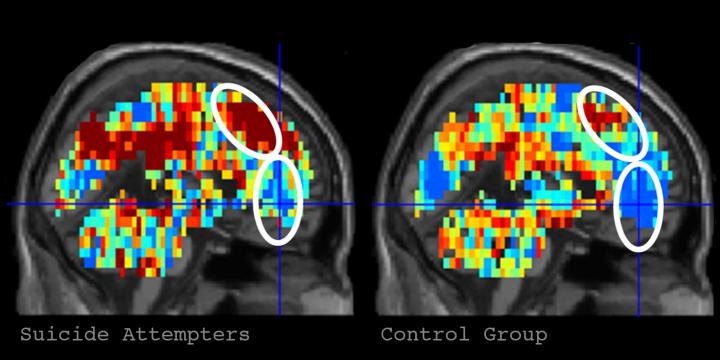
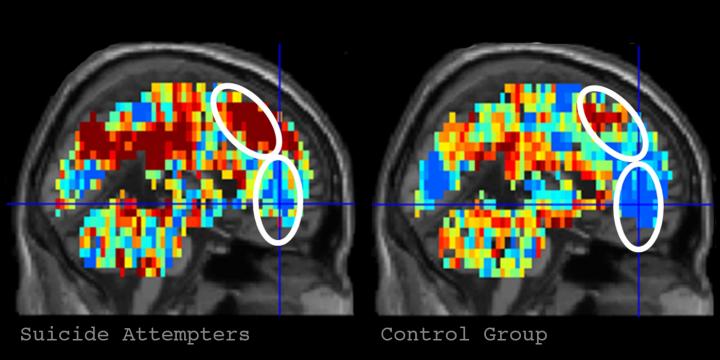
The grant will be used to advance Just and Brent's previous research and establish reliable neurocognitive markers of suicidal ideation and attempt. They will examine the differences in brain activation patterns between suicidal and non-suicidal young adults as they think about words related to suicide — such as positive and negative concepts — and use machine learning techniques to identify neural signatures of suicidal ideation and behavior.
"The cornerstone of this project is our recent ability to identify what concept a person is thinking about based on its accompanying brain activation pattern or neural signature," said Just, the D.O. Hebb University Professor of Psychology in CMU's Dietrich College of Humanities and Social Sciences. "We were previously able to obtain consistent neural signatures to determine whether someone was thinking about objects like a banana or a hammer by examining their fMRI brain activation patterns. But now we are able to tell whether someone is thinking about 'trouble' or 'death' in an unusual way. The alterations in the signatures of these concepts are the 'neurocognitive thought markers' that our machine learning program looks for."
The new funding will support the Predicting Risk Imaging Suicidal Minds (PRISM) project. It will enable Just and Brent to test the technology in a much larger sample of patients than in the 2017 study, and to include a variety of comparison patients with other psychiatric illnesses.
If the project is as successful as their preliminary work, it will advance clinical practice by improving physicians' ability to:
- Detect and monitor suicidal risk;
- Understand alterations in thinking and feelings related to suicide in their patients; and
- Develop personalized treatment strategies for their suicidal patients based on their altered patterns of thinking and feeling that can more precisely and effectively reduce suicide risk.
"Suicide is the second leading cause of death among young adults in the U.S., and current assessment methods rely entirely on patients self reporting and doctors' observations," said Brent, who holds an endowed chair at the University of Pittsburgh School of Medicine. "Any new inroads to better diagnosis and treatment have the potential to save lives."
Learn more about how Just and Brent used brain imaging to identify individuals with suicidal thoughts.
###
Related Links
CMU, Pitt Brain Imaging Science Identifies Individuals With Suicidal Thoughts https://www.cmu.edu/dietrich/news/news-stories/2017/october/brain-imaging-science-identifies-suicidal-thoughts.html
Video: Brain Imaging Science Identifies Individuals With Suicidal Thoughts https://youtu.be/MhrkHsUsXmc
CMU Psychology https://www.cmu.edu/dietrich/psychology/
UPMC http://www.upmc.edu
Media Contact
Shilo Rea
[email protected]
412-268-6094
@CMUScience
http://www.cmu.edu