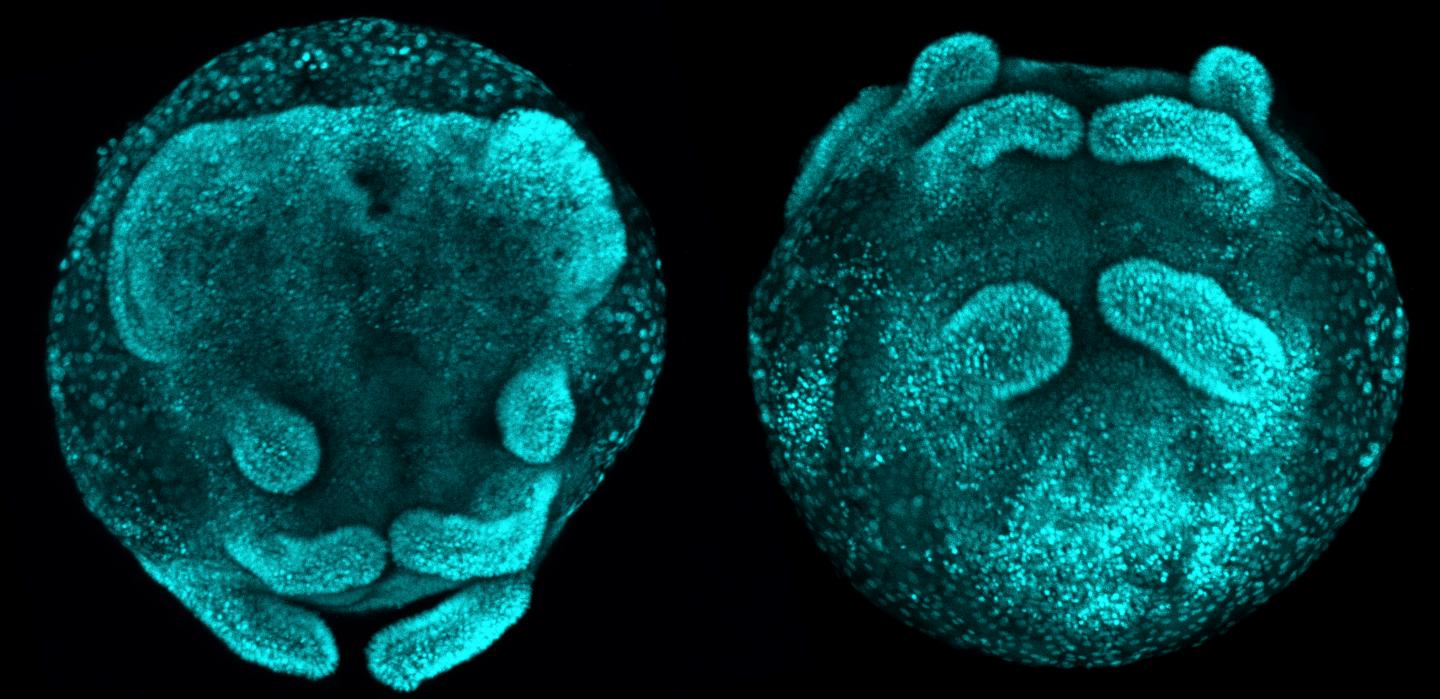
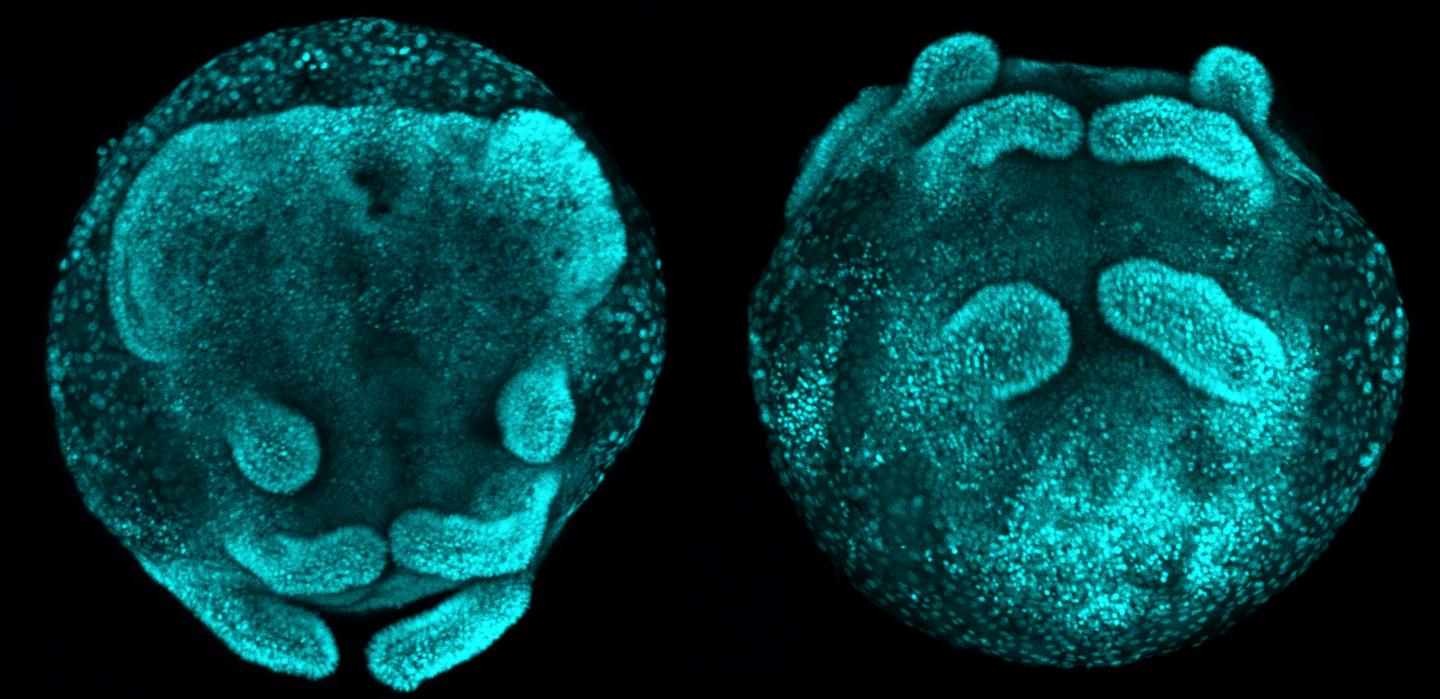
Credit: Paese et al., 2018
Scientists have pinpointed a key gene that controls segmentation during spider development, which reveals a further similarity to the control of segmentation in insects, a study in eLife reports.
The research suggests the Sox gene was duplicated in the spider and then may have replaced the function of another related Sox gene that is still used in segmentation in insects, shedding new light on the evolutionary secrets that allow such a diverse range of animals to build their bodies.
Segmentation is an essential developmental process in arthropods that involves the formation of body segments with different functions. In insects, this happens in two ways – either all segments are made almost simultaneously, or a few segments at the front of the body are specified, such as the head, and then posterior segments are added afterwards, which is similar to what happens in most other arthropods such as spiders.
"We have a detailed and growing understanding of the regulation of segmentation in various insects, but previous studies have shown that some different genetic mechanisms are used to generate segments in spider embryos," says lead author Christian Paese, PhD Student in the Evolution of Animal Development and Morphology Group at Oxford Brookes University, UK. "In insects, the SoxB gene, Dichaete, is involved in segmentation. Having identified a family of Sox genes in the spider Parasteatoda tepidariorum, we wanted to see whether they also play a role during segmentation in these animals too."
The team first studied where the different Sox genes are used in spider embryos. They established that Sox21b-1 was supplied by the mother spider, and that its patterns of activity suggested it was involved in segmentation.
To study this further, they used RNA interference to silence the Sox21b-1 gene in the spider and observed the effects on development. This revealed that the gene is needed for segmentation of both the anterior and posterior segments in spiders. In the anterior, Sox21b-1 plays the role of a 'gap gene', meaning it is one of the first genes to be switched on in development and specifies the simultaneous formation of some of the leg-bearing segments of the body. In the posterior, Sox21b-1 regulates the 'segment addition zone', which allows additional segments to be sequentially added by switching on an important set of developmental genes in the Wnt and Delta-Notch pathways (cell-signalling systems that regulate development in multicellular organisms).
The team also showed that, as well as being involved in segmentation, Sox21b-1 regulates cell division in the early embryo. Although Sox21b-1 silencing had the most pronounced effects on the trunk of the developing spider, causing shortened embryos with missing leg segments, it also influenced the fate of cells in the head region too, which requires further investigation.
"Our work on Sox21b-1 provides important new insights into the evolution and regulation of segmentation in arthropods," concludes senior author Alistair McGregor, Professor of Evolutionary Developmental Biology at Oxford Brookes University. "It is highly significant that two very closely related SoxB genes are involved in segmentation in both Parasteatoda tepidariorum spiders and in insects, pointing to an ancient role for this subfamily of Sox genes in invertebrates. It will be interesting to examine any segmentation roles of Sox genes in other spiders and arachnids, including those that did not undergo a genome duplication."
###
Reference
The paper 'A SoxB gene acts as an anterior gap gene and regulates posterior segment addition in a spider' can be freely accessed online at https://doi.org/10.7554/eLife.37567. Contents, including text, figures and data, are free to reuse under a CC BY 4.0 license.
This work was originally published as a preprint on bioRxiv, at https://doi.org/10.1101/298448.
Media contacts
Emily Packer, Senior Press Officer
eLife
[email protected]
01223 855373
Natalie Gidley, Communications Officer (Media Relations)
Oxford Brookes University
[email protected]
01865 484452
About eLife
eLife aims to help scientists accelerate discovery by operating a platform for research communication that encourages and recognises the most responsible behaviours in science. We publish important research in all areas of the life and biomedical sciences, including Evolutionary Biology, which is selected and evaluated by working scientists and made freely available online without delay. eLife also invests in innovation through open source tool development to accelerate research communication and discovery. Our work is guided by the communities we serve. eLife is supported by the Howard Hughes Medical Institute, the Max Planck Society, the Wellcome Trust and the Knut and Alice Wallenberg Foundation. Learn more at https://elifesciences.org.
To read the latest Evolutionary Biology research published in eLife, please visit https://elifesciences.org/subjects/evolutionary-biology.
About Oxford Brookes University
Set in a historic student city, Oxford Brookes is one of the UK's leading universities and enjoys an international reputation for teaching excellence and innovation as well as strong links with business and industry. More information is available on the Oxford Brookes website at http://www.brookes.ac.uk.
Media Contact
Emily Packer
[email protected]
@elife
http://www.elifesciences.org
Original Source
http://elifesciences.org/for-the-press/6a98b75d/a-common-ancestral-gene-causes-body-segmentation-in-spiders-and-insects http://dx.doi.org/10.7554/eLife.37567