Credit: Vranish et. al.
A sedentary lifestyle can cause an impairment of the transport of blood around the body, which increases the risk of disease in the heart and blood vessels. New research published in Experimental Physiology suggests that performing simple leg exercises whilst lying down might help to prevent these problems.
Previous work has demonstrated that prolonged sitting for up to 6 hours results in a decline in both blood flow to the limbs and in our larger arteries' ability to widen to accommodate increased blood flow. This is the first study to demonstrate that sitting for just 10 minutes is sufficient to reduce blood flow to the legs and impairs the function of small blood vessels supplying muscles in the leg.
This paper also demonstrates a reduction in the function of small blood vessels when lying down. However, this study suggests we might be able to somewhat reverse this impairment in function by performing simple leg exercises when lying down in bed or on the sofa. These findings are important in increasing our understanding of the negative impact of sitting and physical inactivity on blood vessel function and the supply of blood to the legs.
The effects of sitting on blood circulation have been attributed to blood passing more sluggishly through arteries whilst sitting. The researchers who performed this study aimed to find out whether these reductions were caused by sustained sitting, or whether 10 minutes would be sufficient to have a negative effect.
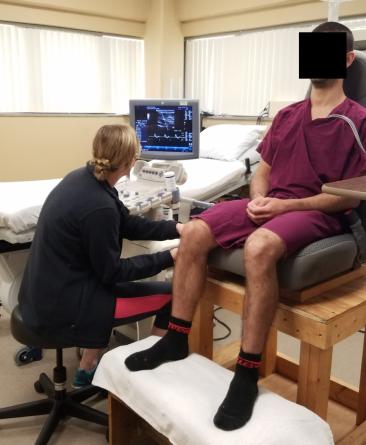
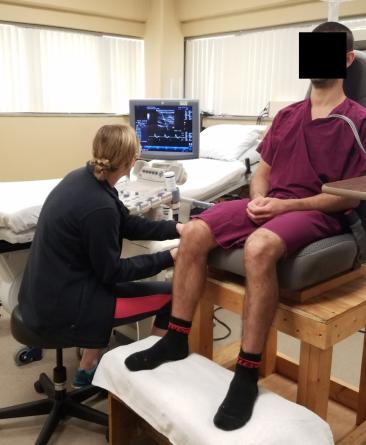
The research group used a Doppler ultrasound technique alongside the knee to measure blood flow and examined the extent to which blood vessels widened in 18 healthy, young males. These measurements were made prior to and following a 10-minute period of sitting or during a period of rest whilst lying down, with or without leg exercises, which were performed by extending the foot back and forth every two seconds for a third of the time spent lying down. Results showed that a 10 minute period of sitting reduced participants' ability to rapidly increase blood flow to the lower legs via small blood vessels, but did not affect the widening of larger arteries in response to increased blood flow. These findings suggest that a brief period of inactivity affects an individual's ability to rapidly push blood to the lower limbs as efficiently as normal, but doesn't affect the ability of large blood vessels to widen. The results also suggest leg exercises can help maintain rapid increases in the blood supply to the limbs.
The current study demonstrates changes in blood vessel function measured at the level of the knee. However, the researchers only tested healthy young males, and as such, their findings cannot be extended to females. It remains unknown as to how these responses may vary with age, or with people who have heart problems. Further research may investigate the impact of sitting and inactivity on blood vessels in other places in the body. For example, would sitting impact the function of blood vessels supplying the brain? Finally, studies designed to investigate the impact of repeated bouts of short-term sitting on blood vessel function are needed.
Co-author Dr. Paul Fadel sheds light on his team's results: "These findings further our understanding of the negative impact of inactivity on blood vessel function and demonstrate the positive effects of simple leg exercises whilst lying down providing further insight into how inactivity affects vascular health of the lower legs".
###
Media Contact
Andrew Mackenzie
[email protected]
020-726-95728
@ThePhySoc
Related Journal Article
http://dx.doi.org/10.1113/EP086918