

• HOME
  • NEWS
  • EXPLORE
    • CAREER
      • Companies
      • Jobs
    • EVENTS
    • iGEM
      • News
      • Team
    • PHOTOS
    • VIDEO
    • WIKI
  • BLOG
  • COMMUNITY
    • FACEBOOK
    • INSTAGRAM
    • TWITTER
Saturday, February 7, 2026
BIOENGINEER.ORG
No Result
View All Result
  • Login
  • HOME
  • NEWS
  • EXPLORE
    • CAREER
      • Companies
      • Jobs
        • Lecturer
        • PhD Studentship
        • Postdoc
        • Research Assistant
    • EVENTS
    • iGEM
      • News
      • Team
    • PHOTOS
    • VIDEO
    • WIKI
  • BLOG
  • COMMUNITY
    • FACEBOOK
    • INSTAGRAM
    • TWITTER
  • HOME
  • NEWS
  • EXPLORE
    • CAREER
      • Companies
      • Jobs
        • Lecturer
        • PhD Studentship
        • Postdoc
        • Research Assistant
    • EVENTS
    • iGEM
      • News
      • Team
    • PHOTOS
    • VIDEO
    • WIKI
  • BLOG
  • COMMUNITY
    • FACEBOOK
    • INSTAGRAM
    • TWITTER
No Result
View All Result
Bioengineer.org
No Result
View All Result
Home NEWS Science News Biology

Mechanism behind orchid beauty revealed

Bioengineer by Bioengineer
August 20, 2018
in Biology
Reading Time: 2 mins read
0
Share on FacebookShare on TwitterShare on LinkedinShare on RedditShare on Telegram
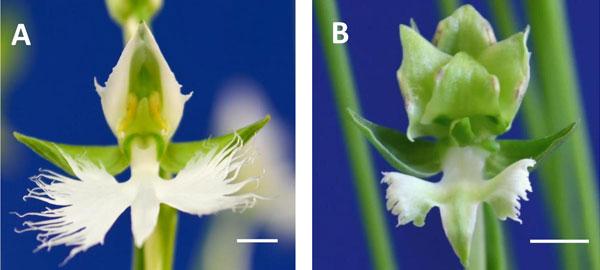
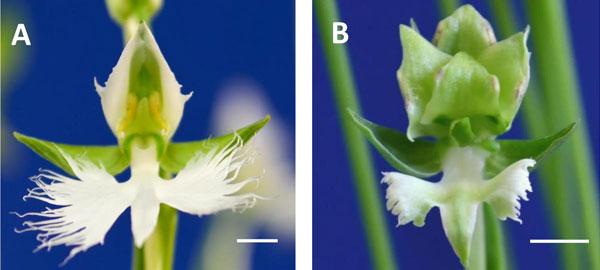
IMAGE

Credit: Mai Mitoma

Researchers at Tohoku University in Japan have identified the gene related to the greenish flower mutation in the Habenaria orchid.

Associate Professor Akira Kanno and PhD candidate Mai Mitoma have discovered that the greenish flower mutation is caused by a retrotransposon insertion in one of the floral homeotic genes in the Habenaria orchid. The modification of this gene by a genetic transformation system enables the development of greenish flowers in orchids and other plant species.

Orchids are important ornamental plants with high commercial value. The orchid lip, which acts as a landing platform for pollinators (insects) can vary in shape, form and color. At the center of the flower, an orchid has a unique reproductive organ called a column. Botanists have been interested in the shape of the orchid flower for a long time, however, until now the molecular mechanism of the orchid flower development has been largely unclear. Being able to modify orchid floral structures through genetic engineering would be very valuable for orchid breeders allowing for an increase in orchid production.

Kanno explained the process, which was undertaken to reveal the mechanism: "first, we used a mutant orchid cultivar with greenish flowers to analyze the important genes related to flower development in orchids. Then we found the retrotransposon insertion in one of the floral homeotic genes called the SEPALLATA-like gene in the mutant orchid cultivar."

This mutant cultivar has greenish flowers. The loss-of-function of the SEPALLATA-like gene transformed the white petals to greenish organs and the column was converted into greenish leaf-like organs; revealing that the SEPALLATA-like gene is essential for petal, lip and column development in orchids.

In the future, the team aims to modify the SEPALLATA-like gene in other orchid species. It is thought that the reduced expression of the SEPALLATA-like gene may produce greenish flowers. These transgenic plants may help us to better understand the molecular mechanism of floral development in orchids.

###

Media Contact

Akira Kanno
[email protected]
@TohokuUniPR

http://www.tohoku.ac.jp/en/

Original Source

https://www.tohoku.ac.jp/en/press/mechanism_behind_orchid_beauty_revealed.html http://dx.doi.org/10.3389/fpls.2018.00831


Share14Tweet8Share2ShareShareShare2

Related Posts

Florida Cane Toad: Complex Spread and Selective Evolution

Florida Cane Toad: Complex Spread and Selective Evolution

February 7, 2026
New Study Uncovers Mechanism Behind Burn Pit Particulate Matter–Induced Lung Inflammation

New Study Uncovers Mechanism Behind Burn Pit Particulate Matter–Induced Lung Inflammation

February 6, 2026

DeepBlastoid: Advancing Automated and Efficient Evaluation of Human Blastoids with Deep Learning

February 6, 2026

Navigating the Gut: The Role of Formic Acid in the Microbiome

February 6, 2026
Please login to join discussion

POPULAR NEWS

  • Robotic Ureteral Reconstruction: A Novel Approach

    Robotic Ureteral Reconstruction: A Novel Approach

    82 shares
    Share 33 Tweet 21
  • Digital Privacy: Health Data Control in Incarceration

    63 shares
    Share 25 Tweet 16
  • Study Reveals Lipid Accumulation in ME/CFS Cells

    57 shares
    Share 23 Tweet 14
  • Breakthrough in RNA Research Accelerates Medical Innovations Timeline

    53 shares
    Share 21 Tweet 13

About

We bring you the latest biotechnology news from best research centers and universities around the world. Check our website.

Follow us

Recent News

Barriers and Boosters of Seniors’ Physical Activity in Karachi

Evaluating Pediatric Emergency Care Quality in Ethiopia

TPMT Expression Predictions Linked to Azathioprine Side Effects

Subscribe to Blog via Email

Enter your email address to subscribe to this blog and receive notifications of new posts by email.

Join 73 other subscribers
  • Contact Us

Bioengineer.org © Copyright 2023 All Rights Reserved.

Welcome Back!

Login to your account below

Forgotten Password?

Retrieve your password

Please enter your username or email address to reset your password.

Log In
No Result
View All Result
  • Homepages
    • Home Page 1
    • Home Page 2
  • News
  • National
  • Business
  • Health
  • Lifestyle
  • Science

Bioengineer.org © Copyright 2023 All Rights Reserved.