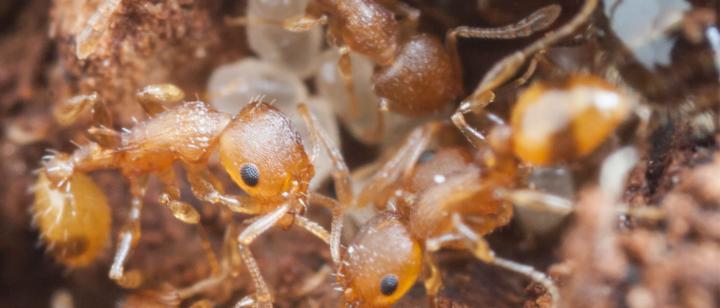
Credit: Lauren Nichols, Case Western Reserve University
CLEVELAND–The relatively swift adaptability of tiny, acorn-dwelling ants to warmer environments could help scientists predict how other species might evolve in the crucible of global climate change.
That's a big-picture conclusion from research into the some of the world's smallest creatures, according to evolutionary biologists at Case Western Reserve University.
More specifically, the scientists are comparing the adaptability of a certain species of ant raised in the "heat-island" microclimate of three U.S. cities to those in nearby cooler rural areas.
"What we're finding is the potential for ants–and other animals, perhaps–to evolve in response to anthropogenic (human-caused) climate change," said lead researcher Sarah Diamond, who first began peering into acorns to study the ants in 2015. The research so far has shown that the ants adapt to a hotter world in only about 20 generations, or about 100 years.
This comparatively lightning-fast evolutionary response is adding to scientists' understanding of evolutionary processes, in general, but also in understanding the effects of urbanization, said Diamond, the George B. Mayer Assistant Professor of Urban and Environmental Studies at the university.
"While we usually think of evolution as happening over thousands of years or more, we're finding that it is happening more rapidly in these cases," she said, "and that presents a unique opportunity to test the predictability and parallelism of evolutionary change."
The most recent study by Diamond and Ryan Martin, an assistant professor of biology at Case Western Reserve, was published in July in the Proceedings of the Royal Society B, a broad-scope biology journal.
Earlier research by the Case Western Reserve researchers was featured in a New York Times report and elsewhere and focused primarily on how "city ants and country ants" adapted in Cleveland and a nearby rural area.
The outcome of that earlier study was that ants from the city were more tolerant of heat than rural ants living in colonies about five degrees Fahrenheit cooler–an adaptation that would have arisen only over the last century as the city became urbanized and warmer due to the heat island effect.
Different cities, mixed results
The new paper describes how the research was extended to two more cities, Cincinnati, Ohio and Knoxville, Tennessee, to test whether the ants would respond in "parallel" to urban heat islands.
The scientists added the two new sites to test whether the outcomes would be consistent, or whether each area is distinctive, and because "cities function as easily replicated warming experiments across the globe" due to the urban heat island effect, Diamond said.
The measurements: Urban ants were again more tolerant to heat but lost some of their tolerance to cold compared to their rural neighbors. The researchers also found that urban ant populations produced more "sexual reproductives"–offspring who could, in turn, reproduce–under warmer laboratory rearing temperatures that mimicked their city habitats; rural populations produced fewer.
This new result suggests that the urban ants are indeed adapting to city life: "Their increased tolerance for warm temperatures is helping them live in cities," Martin said.
In Cleveland and Knoxville, they did, but "Cincinnati is misbehaving," Diamond said with a laugh, noting that the city ants there did not show the same degree of adaptability.
"Something is going on with that city and we need to figure out what that is," she said. "But that's not a bad thing. It's actually super useful to know just how contingent or deterministic evolution is. We'll keep looking and try to understand what's going on."
###
Media Contact
Michael Scott
[email protected]
216-368-1004
@cwru
http://www.case.edu
Original Source
http://thedaily.case.edu/ants-acorns-climate-change/ http://dx.doi.org/10.1098/rspb.2018.0036