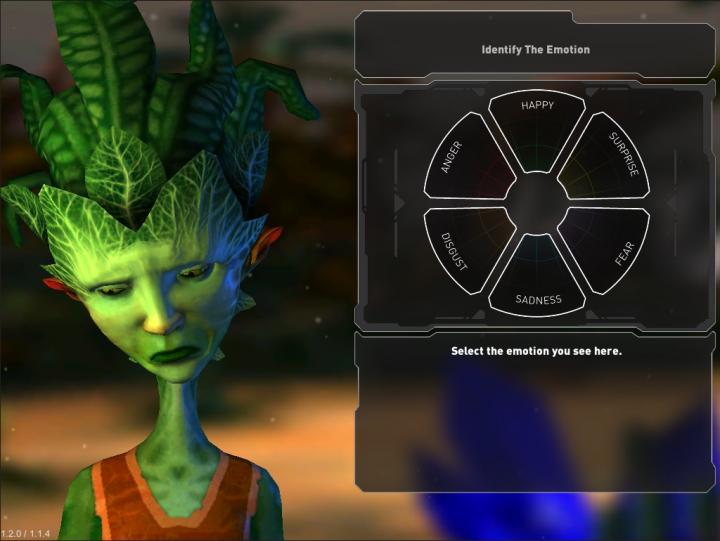
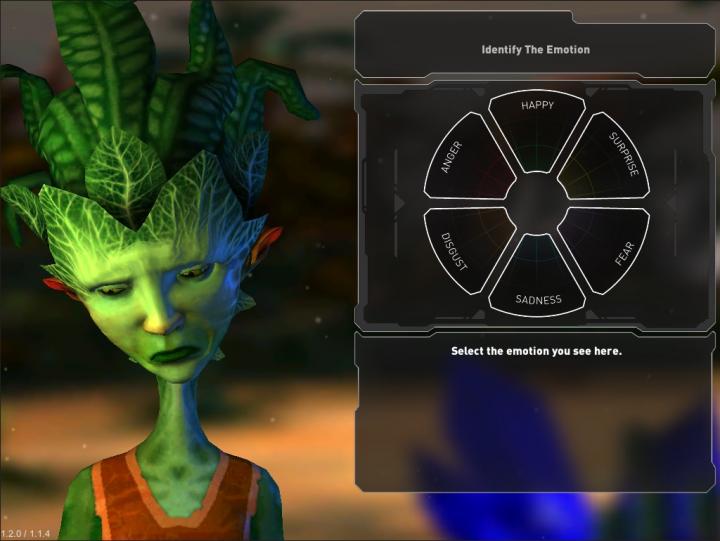
Credit: Center for Healthy Minds/University of Wisconsin-Madison
MADISON, Wis. — A space-exploring robot crashes on a distant planet. In order to gather the pieces of its damaged spaceship, it needs to build emotional rapport with the local alien inhabitants. The aliens speak a different language but their facial expressions are remarkably humanlike.
This fantastical scenario is the premise of a video game developed for middle schoolers by University of Wisconsin-Madison researchers to study whether video games can boost kids' empathy, and to understand how learning such skills can change neural connections in the brain.
Results published this week in npj Science of Learning (a Nature journal) reveal for the first time that, in as few as two weeks, kids who played a video game designed to train empathy showed greater connectivity in brain networks related to empathy and perspective taking. Some also showed altered neural networks commonly linked to emotion regulation, a crucial skill that this age group is beginning to develop, the study authors say.
"The realization that these skills are actually trainable with video games is important because they are predictors of emotional well-being and health throughout life, and can be practiced anytime — with or without video games," says Tammi Kral, a UW-Madison graduate student in psychology who led the research at the Center for Healthy Minds.
Richard Davidson, director of the center and a professor of psychology and psychiatry at UW-Madison, explains that empathy is the first step in a sequence that can lead to prosocial behavior, such as helping others in need.
"If we can't empathize with another's difficulty or problem, the motivation for helping will not arise," says Davidson, who headed the research team. "Our long-term aspiration for this work is that video games may be harnessed for good and if the gaming industry and consumers took this message to heart, they could potentially create video games that change the brain in ways that support virtuous qualities rather than destructive qualities."
On average, youth between the ages of 8 and 18 rack up more than 70 minutes of video gameplay daily, according to data from the Kaiser Family Foundation. This spike in gameplay during adolescence coincides with an explosion in brain growth as well as a time when kids are susceptible to first encounters with depression, anxiety and bullying. The team wanted to learn whether there were ways to use video games as a vehicle for positive emotional development during this critical period.
Researchers randomly assigned 150 middle schoolers to two groups. One played the experimental game, called "Crystals of Kaydor," which was created for research purposes and intended to teach empathy. The second group played a commercially available and entertaining control game called "Bastion" that does not target empathy.
In Crystals of Kaydor, kids interacted with the aliens on the distant planet and learned to identify the intensity of emotions they witnessed on their humanlike faces, such as anger, fear, happiness, surprise, disgust and sadness. The researchers measured how accurate the players were in identifying the emotions of the characters in the game. The activity was also intended to help the kids practice and learn empathy.
Those who played Bastion partook in a storyline where they collected materials needed to build a machine to save their village, but tasks were not designed to teach or measure empathy. Researchers used the game because of its immersive graphics and third-person perspective.
The team obtained functional magnetic resonance imaging scans in the laboratory from both groups before and after two weeks of gameplay, looking at connections among areas of the brain, including those associated with empathy and emotion regulation. Participants in the study also completed tests during the brain scans that measured how accurately they empathized with others.
The researchers found stronger connectivity in empathy-related brain networks after the middle schoolers played Crystals of Kaydor compared to Bastion. Moreover, Crystals players who showed strengthened neural connectivity in key brain networks for emotion regulation also improved their score on the empathy test. Kids who did not show increased neural connectivity in the brain did not improve on the test of empathic accuracy.
"The fact that not all children showed changes in the brain and corresponding improvements in empathic accuracy underscores the well-known adage that one size does not fit all," says Davidson. "One of the key challenges for future research is to determine which children benefit most from this type of training and why."
Teaching empathy skills in such an accessible way may benefit populations who find these skills challenging, including individuals on the autism spectrum, Davidson adds.
###
The game — developed in partnership with Gear Learning at UW-Madison and researchers Constance Steinkuehler and Kurt Squire, who are now professors of informatics at the University of California, Irvine — is only being used for research purposes and is not available to the public but has helped inform other games being submitted to the FDA for clinical applications.
The research was funded by a grant from the Bill & Melinda Gates Foundation.
Learn more from the Center for Healthy Minds about simple and tech-free ways to teach empathy in youth at https://centerhealthyminds.org/join-the-movement/5-tips-for-empathy-building-in-teens
–Marianne Spoon, [email protected], 608-890-3074
IMAGES AND VIDEO: https://uwmadison.box.com/v/video-game-empathy
Media Contact
Marianne Spoon
[email protected]
@UWMadScience
http://www.wisc.edu
Original Source
https://news.wisc.edu/a-video-game-can-change-the-brain-may-improve-empathy-in-middle-schoolers/ http://dx.doi.org/10.1038/s41539-018-0029-6