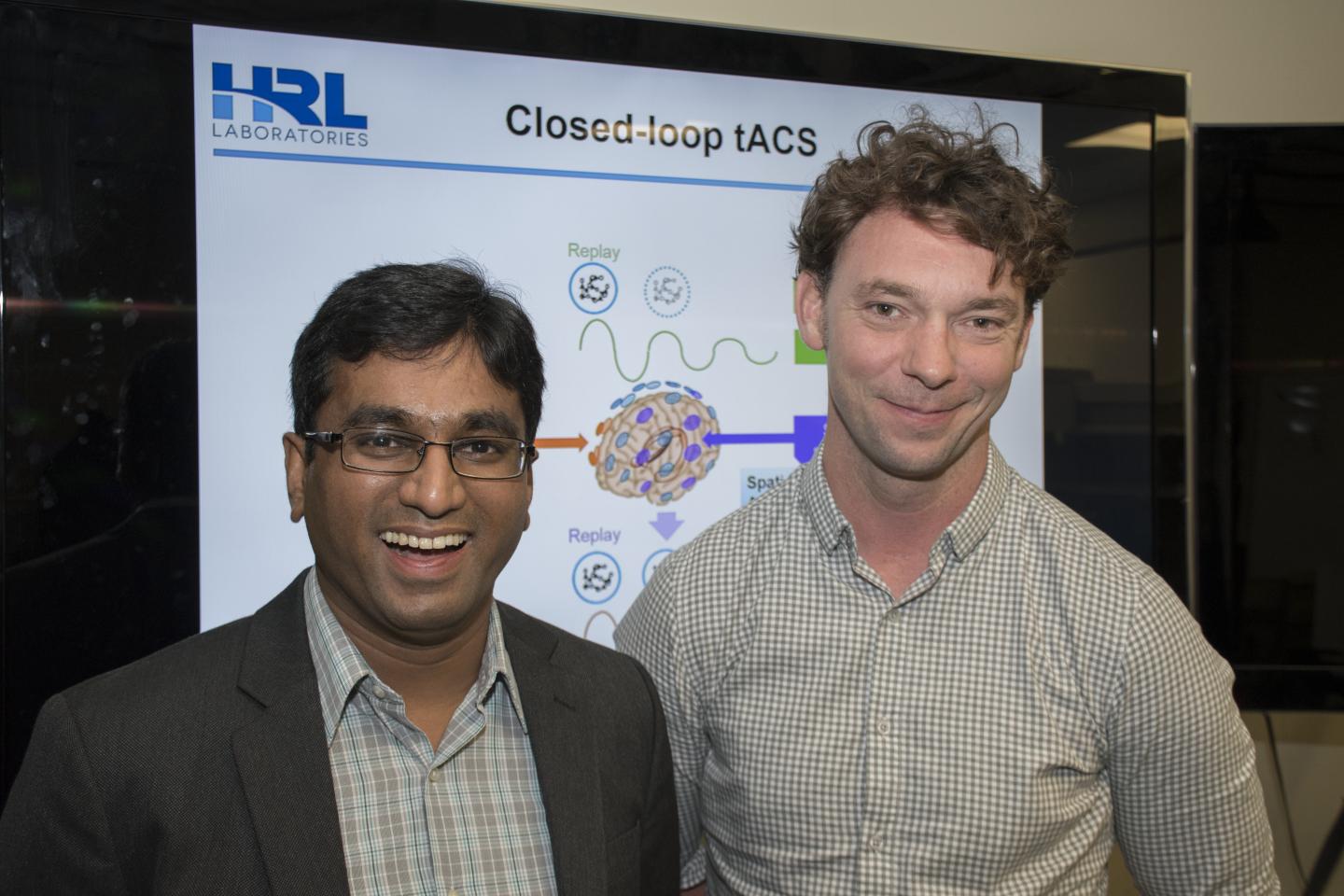
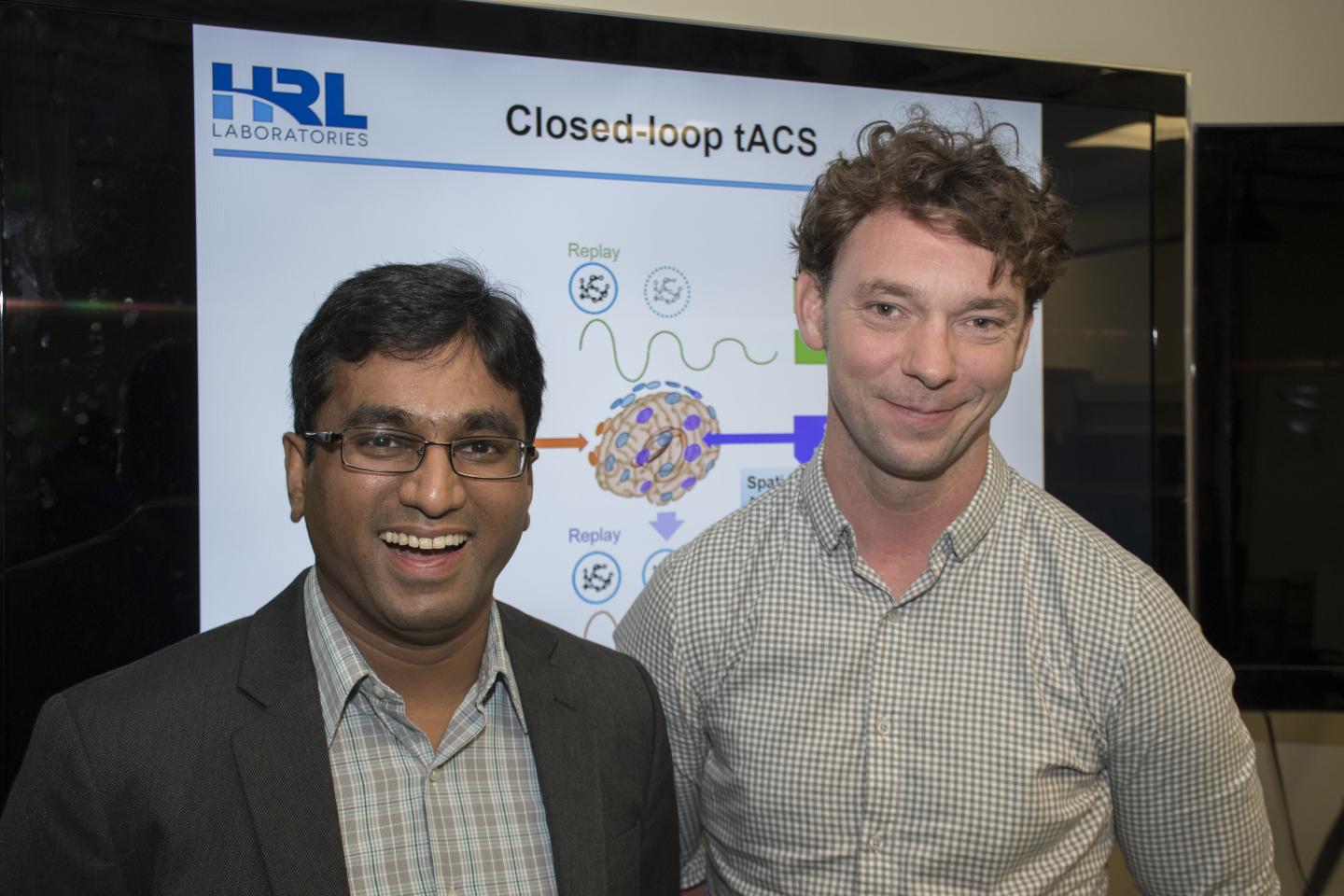
Credit: HRL Laboratories
HRL Laboratories, LLC, in collaboration with University of New Mexico (UNM), have published the first study showing that transcranial alternating current stimulation (tACS) of the brain during sleep increases human subjects' ability to accurately assess hidden targets in novel visual scenes. The new "closed-loop" method effectively reduces the typical overnight drop in performance for novel scenes by about 48%.
"This technique is for accelerating learning, memory, and skill acquisition," said Dr. Praveen Pilly, HRL's principal investigator and last author on the study. "The processes we affected with noninvasive electrical stimulation are slow-wave oscillations of the brain's electrical field that occur during non-REM sleep stages 2 and 3. We tracked ongoing oscillations and applied tACS that matched their frequency and phase in the slow-wave oscillation band. This matching is what we mean by a closed-loop system. The technique is unique to HRL, and although others have speculated on the concept, we are the first to publish results on a closed-loop slow-wave tACS system."
The theory on slow-wave oscillations relating to memory retention is that new sensory information is initially encoded in the hippocampus of the brain for short-term storage. Then, because they can be quickly forgotten, the memories are transferred during sleep from the hippocampus to the cerebral cortex where they are integrated and consolidated with previous knowledge. This enables the new knowledge to be remembered and generalized better, increasing retention of new skills for longer periods. As the first study in which closed-loop electrical stimulation was used for hippocampus-dependent memories, the HRL research takes tACS to the next level.
"The main task that we used for testing is generally referred to as a target detection task," said Dr. Nicholas Ketz, lead author on the study. "We used a set of images with very subtle cues that determined if they were part of threatening situations–close up or distant targets that are perceived as dangers–or non-threatening situations, which look almost exactly the same, but with the visual cues missing. This is how people can be trained to look for subtle cues of possible dangers."
In the experiment, subjects had tACS applied or not applied (sham group) during sleep overnight. Their performance on the task was then measured over time to detect persistence of enhanced learning.
"A critical aspect of the test was that some images were exact replications of the training images and some were from a new viewpoint," Ketz said. "For example, in a scene in which the subject had to look under a rock to find a target, that image was repeated initially, then for the more generalized image the same rock and target appeared, but from a different angle or vantage point. This tested whether subjects' memories for that scene were comprehensive or specific. The theory of memory consolidation, which we were augmenting with tACS, suggests that consolidation enables memory for the more generalized image type. This means that experiences are incorporated in a more robust representation that enables adaptation rather than just recognizing the exact incident. Another key contribution from our work is the extraction of stimulation-induced biomarkers in sleep EEG across the scalp in the slow-wave oscillation band that correlate with overnight performance changes for novel scenes."
The study had a within-subjects counterbalanced design in which subjects came in a few days after their initial stimulation and testing, and changed between active and sham conditions. The design greatly reduced noise in performance estimates, but it is relatively rare to have a study with one adaptation night and two experimental nights of sleep because of the amount of time subjects must volunteer. Aaron Jones, Dr. Natalie Bryant, and Dr. Vincent Clark of UNM were the other authors on the paper. They helped design the behavioral paradigm, analyze the behavioral data, and also collected all the data.
Entitled Closed-loop slow-wave tACS improves sleep dependent long-term memory generalization by modulating endogenous oscillations, the paper was published in the July issue of Journal of Neuroscience. This research was supported by the Biological Technologies Office (BTO) of the Defense Advanced Research Project Agency (DARPA) under the RAM Replay program. Dr. Justin Sanchez, current BTO Director, was the program manager.
###
Media Contact
Michele Durant
[email protected]
310-317-5321
@HRLLaboratories
Original Source
http://www.hrl.com/news/2018/08/01/skills-and-learning-improved-by-closed-loop-electrical-brain-stimulation-during-sleep