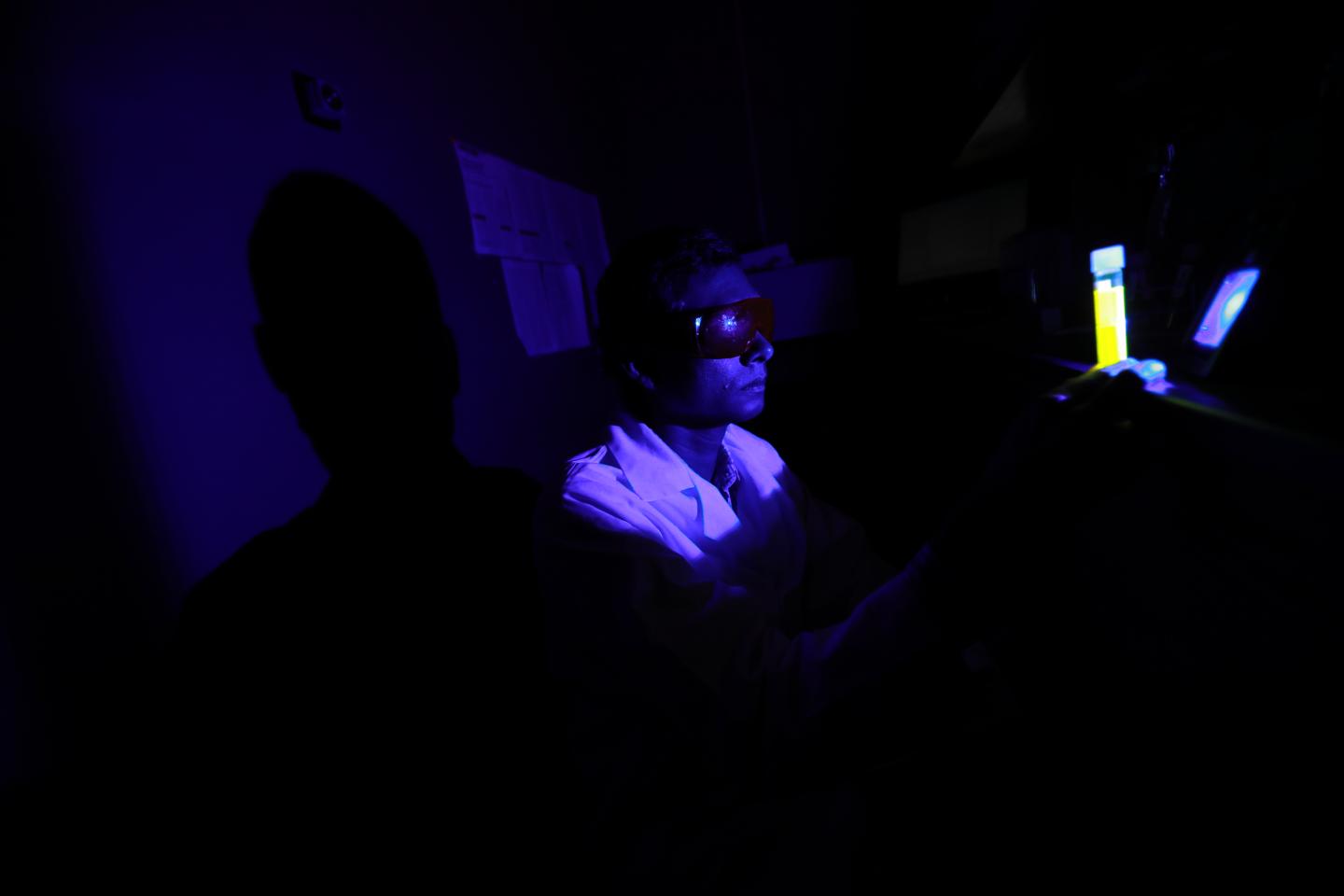
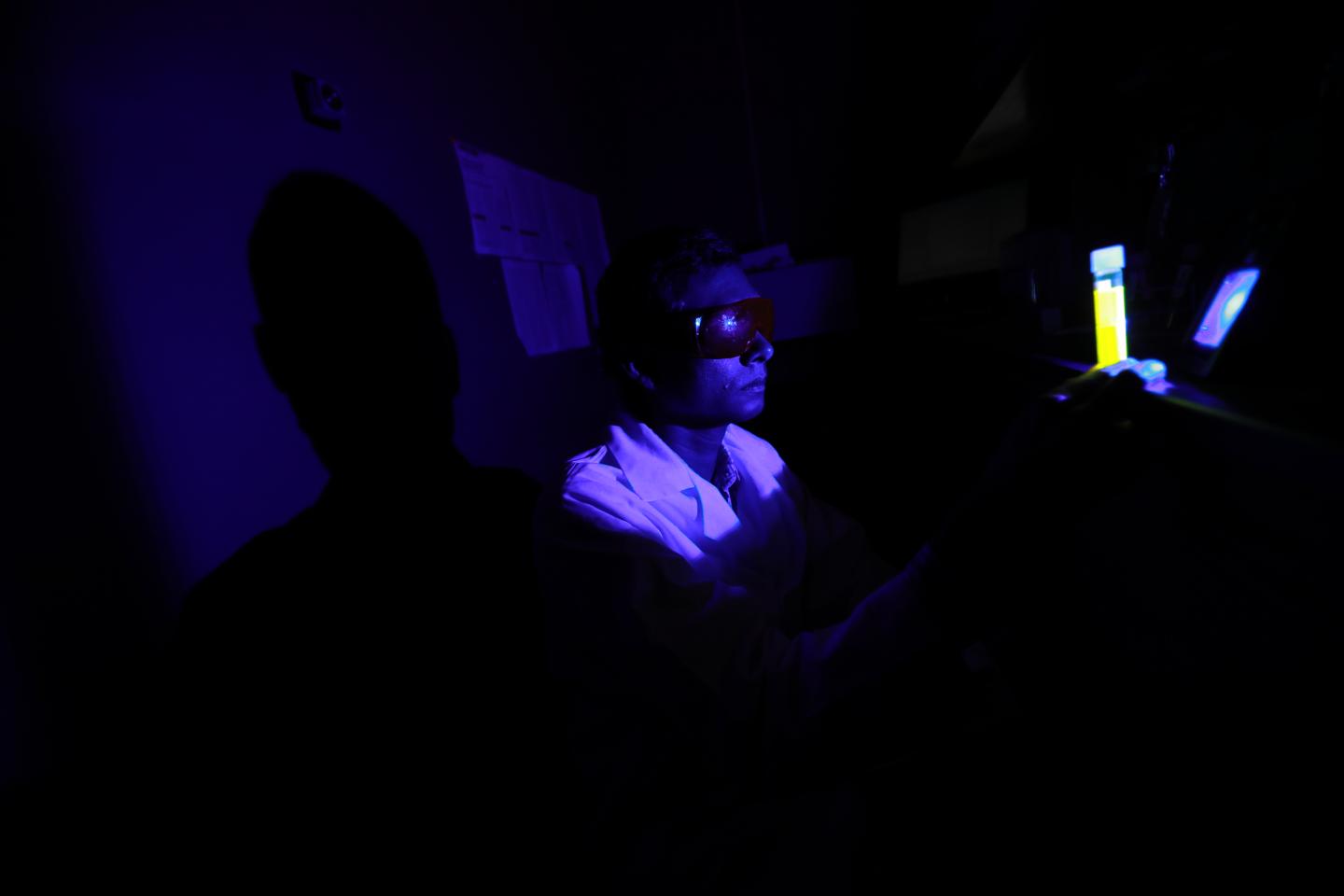
Credit: Dan Miller, The University of Toledo
Blue light from digital devices and the sun transforms vital molecules in the eye's retina into cell killers, according to optical chemistry research at The University of Toledo.
The process outlined in the study, which was recently published in the journal Scientific Reports, leads to age-related macular degeneration, a leading cause of blindness in the United States.
"We are being exposed to blue light continuously, and the eye's cornea and lens cannot block or reflect it," Dr. Ajith Karunarathne, assistant professor in the UT Department of Chemistry and Biochemistry, said. "It's no secret that blue light harms our vision by damaging the eye's retina. Our experiments explain how this happens, and we hope this leads to therapies that slow macular degeneration, such as a new kind of eye drop."
Macular degeneration, an incurable eye disease that results in significant vision loss starting on average in a person's 50s or 60s, is the death of photoreceptor cells in the retina. Those cells need molecules called retinal to sense light and trigger a cascade of signaling to the brain.
"You need a continuous supply of retinal molecules if you want to see," Karunarathne said. "Photoreceptors are useless without retinal, which is produced in the eye."
Karunarathne's lab found that blue light exposure causes retinal to trigger reactions that generate poisonous chemical molecules in photoreceptor cells.
"It's toxic. If you shine blue light on retinal, the retinal kills photoreceptor cells as the signaling molecule on the membrane dissolves," Kasun Ratnayake, a PhD student researcher working in Karunarathne's cellular photo chemistry group, said. "Photoreceptor cells do not regenerate in the eye. When they're dead, they're dead for good."
Karunarathne introduced retinal molecules to other cell types in the body, such as cancer cells, heart cells and neurons. When exposed to blue light, these cell types died as a result of the combination with retinal. Blue light alone or retinal without blue light had no effect on cells.
"No activity is sparked with green, yellow or red light," Karunarathne said. "The retinal-generated toxicity by blue light is universal. It can kill any cell type."
The researcher found that a molecule called alpha tocoferol, a Vitamin E derivative and a natural antioxidant in the eye and body, stops the cells from dying. However, as a person ages or the immune system is suppressed, people lose the ability to fight against the attack by retinal and blue light.
"That is when the real damage occurs," Karunarathne said. The lab currently is measuring light coming from television, cell phone and tablet screens to get a better understanding of how the cells in the eyes respond to everyday blue light exposure.
"If you look at the amount of light coming out of your cell phone, it's not great but it seems tolerable," Dr. John Payton, visiting assistant professor in the UT Department of Chemistry and Biochemistry, said. "Some cell phone companies are adding blue-light filters to the screens, and I think that is a good idea."
To protect your eyes from blue light, Karunarathne advises to wear sunglasses that can filter both UV and blue light outside and avoid looking at your cell phones or tablets in the dark.
"Every year more than two million new cases of age-related macular degeneration are reported in the United States," Karunarathne said. "By learning more about the mechanisms of blindness in search of a method to intercept toxic reactions caused by the combination of retinal and blue light, we hope to find a way to protect the vision of children growing up in a high-tech world."
###
Media Contact
Christine Billau
[email protected]
419-530-2077
http://www.utoledo.edu
Related Journal Article
http://dx.doi.org/10.1038/s41598-018-28254-8