Credit: American Journal of Pathology
Philadelphia, August 7, 2018 – A new study in the American Journal of Pathology reports for the first time that injection of neuropeptide vasoactive intestinal peptide (VIP) directly into the eye of mice enhanced corneal graft survival. VIP produced other benefits, including acceleration of endothelial wound closure, protection of corneal endothelial cells (CEnCs), and improved corneal graft clarity. If proven successful in clinical studies, this novel approach may help alleviate visual loss in many patients with corneal disease.
"The successful outcome of corneal transplantation mainly relies on the density and function of CEnCs, which keep the graft transparent. To improve the outcomes of corneal transplantation, various strategies have been employed to prevent immune-mediated graft rejection or enhance survival and function of CEnCs. However, an effective method has remained elusive so far," explained Ahmad Kheirkhah, MD, currently at University of Texas San Antonio, who completed the research when he was at the Massachusetts Eye and Ear, Department of Ophthalmology, Harvard Medical School, Boston, MA, USA.
In this study, researchers evaluated the effect of VIP on corneal tissue in cell culture and living animals who received corneal transplants. VIP, a 28 amino acid neuropeptide, is recognized as an immunoregulatory and protective factor in various organ systems. VIP is found in the aqueous humor of the eye and may be secreted by CEnCs. Although it is known that VIP can help preserve the integrity of CEnCs and may be used by eye banks to improve the survival of donor corneas, until now it has been unclear whether administration of VIP in vivo after corneal transplantation could improve graft survival.
The researchers observed numerous ways in which VIP may exert beneficial effects. In cell cultures of human corneal endothelial cells, VIP accelerated wound healing compared to controls. When corneal endothelial cells were exposed to the substances known to induce apoptosis (cell death), such as interferon-γ or tumor necrosis factor-α, VIP showed a dose-dependent protective effect.
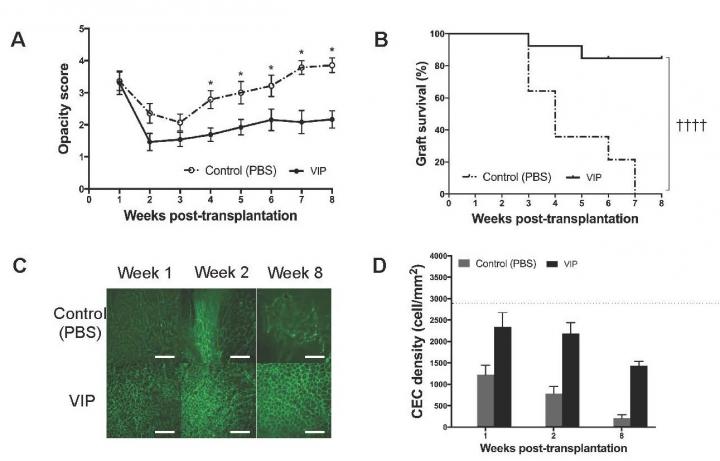
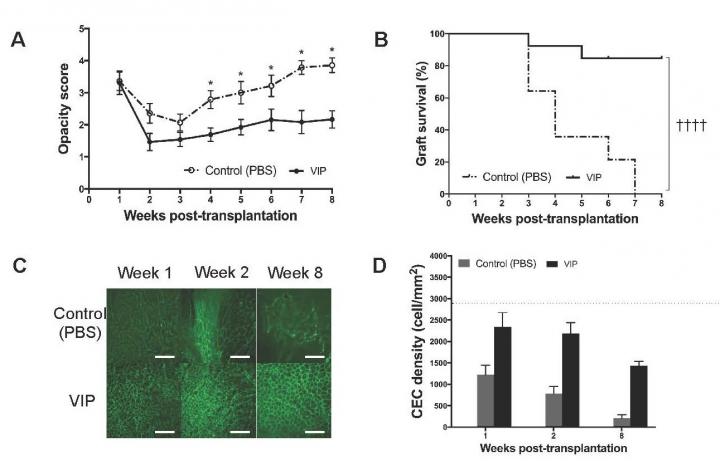
In live mice who underwent corneal transplantation, grafts were more transparent in VIP-treated mice compared to controls four to eight weeks after transplantation. Eight weeks after transplantation, 85 percent of VIP-treated grafts survived compared to 0 percent of control grafts, and corneal endothelial cell density was higher in VIP-treated corneas compared to controls.
"Millions of patients around the world are blind due to corneal opacity, and they are in dire need of corneal transplantation. Unfortunately, there is a significant shortage of donor corneas across the world. On the other hand, many donated corneas cannot be used for transplantation due to inadequate endothelial cells. Moreover, corneal transplants can deteriorate over time due to continuous loss of CEnCs," noted Reza Dana, MD, MPH, MSc, Professor of Ophthalmology at the Massachusetts Eye and Ear, Department of Ophthalmology, Harvard Medical School, Boston, MA, USA. "If confirmed in further clinical studies, we believe that the use of VIP will increase the number of donated corneas suitable for transplantation and improve the outcomes of corneal transplantation."
Corneal transplantation is the most common form of tissue transplantation in medicine today. These procedures are performed to correct the visual loss that occurs when the cornea, the transparent structure forming the front of the eye, becomes opaque (cloudy). Corneal opacity can result from many eye diseases.
###
Media Contact
Eileen Leahy
[email protected]
732-238-3628
@elseviernews
http://www.elsevier.com
Related Journal Article
http://dx.doi.org/10.1016/j.ajpath.2018.05.010