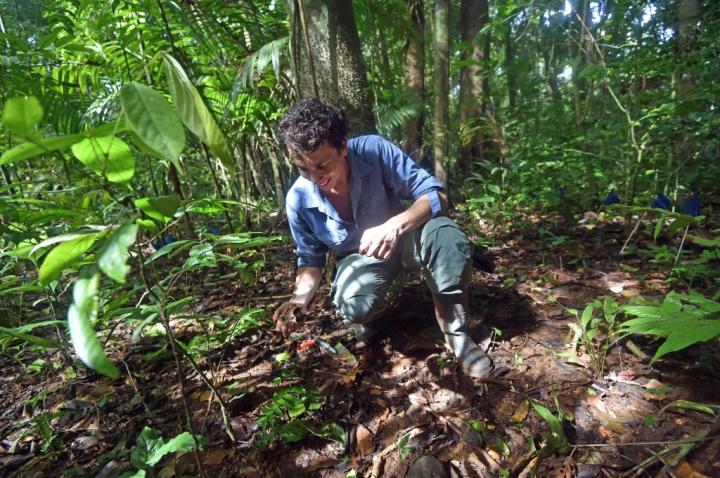
Credit: Rodrigo Aragua/AFP
The oldest living seeds found on Earth germinated after resting more than 30,000 years in Arctic soils. But in the humid tropics, seeds do not last. "A long-lived seed in the tropics is probably only a few decades old. This may not seem like much time, but it is critical to reestablish trees after deforestation and ensure species' survival," said Camilo Zalamea, post-doctoral fellow and lead author of a new paper in Ecology from the Smithsonian Tropical Research Institute (STRI) in Panama.
Seeds of tropical pioneers, trees that reestablish a forest after logging, flood, drought or fire, need strategies to overcome the two challenges every seed faces: 1) stay alive until the right conditions to grow into a plant occur, and 2) avoid being eaten by predators and decayed by soil microbes.
Although birds, bats or the wind can spread seeds from nearby forests, many of the seedlings that start a new forest emerge from seeds long buried in the soil–that is, from the soil seed bank. "For the first time, we're making the connection between seed dormancy–the characteristics that make it possible for a seed to wait until environmental conditions are suitable for growth, and seed defenses–the characteristics the seed uses to avoid being eaten or decayed," said Jim Dalling, STRI research associate and professor at the University of Illinois, Urbana-Champaign.
"Overall, pioneer tree species have three strategies to survive in the seed bank. Species that adopt one of these strategies share characteristics, or "seed-defense syndromes," Dalling said.
"For example, some seeds may protect themselves physically by producing a very hard outer coat making it difficult for animals or microorganisms to reach the living tissues inside," said Zalamea. "Other seeds survive because they produce chemical compounds to deter predators and pathogens. And some seeds are short-lived, investing little in physical or chemical defenses, but may be protected by special microbes they select from soil."
Defending seeds is expensive, requiring an investment of resources from the mother tree. For 16 of the most common pioneer tree species in Panama, the research team evaluated the seeds' physical defenses, asking: How hard is it to break the seed, how thick is the seed coat, how permeable is the seed coat and how heavy is the seed? They also evaluated the seeds' chemical defenses, by looking at the presence and abundance of protective chemicals and testing the toxicity of seed extracts.
"We found that how much a seed invests in defending itself is directly related to the time it lasts in the soil," said Betsy Arnold, STRI research associate and professor at the University of Arizona. For example, seeds that are capable of persisting for long periods in the soil rely more on chemical defenses, whereas species with shorter persistence rely more on physical defenses. So this work helps resolve just how seeds can remain alive in the soil seed bank for months to years in tropical forests."
Understanding how seeds evade or repel pests and diseases has broad application beyond tropical forests. Diseases of major seed crops–rice, wheat and maize–cost global agriculture billions of dollars a year in lost yield, and represent a significant threat to global food security. Nonetheless, remarkably little is known about how plants defend their seeds against enemies, or how seed defenses align with other properties of seeds.
"In our study, we found that tropical pioneer seeds defend themselves using three different dormancy-defense syndromes; we hope that this information can be used to develop more effective practices for crop production and weed management, restoring natural vegetation, and to generate a better understanding of natural plant community dynamics," said Adam Davis, a scientist at the U.S. Department of Agriculture.
###
This research was funded by grants from the U.S. National Science Foundation (NSF DEB-1120205, DEB-1119758) and Simons Foundation.
The Smithsonian Tropical Research Institute, headquartered in Panama City, Panama, is a unit of the Smithsonian Institution. The Institute furthers the understanding of tropical biodiversity and its importance to human welfare, trains students to conduct research in the tropics and promotes conservation by increasing public awareness of the beauty and importance of tropical ecosystems. Website. Promo video.
Ref: Zalamea, P-C, Dalling, J.W., Sarmiento, C. et al. 2018. Dormancy-defense syndromes and trade-offs between physical and chemical defenses in seeds of pioneer species. Ecology. doi: 10.1002/ecy.2419
Media Contact
Beth King
[email protected]
202-633-4700 x28216
@stri_panama
http://www.stri.org
Related Journal Article
http://dx.doi.org/10.1002/ecy.2419