• HOME
  • NEWS
  • EXPLORE
    • CAREER
      • Companies
      • Jobs
    • EVENTS
    • iGEM
      • News
      • Team
    • PHOTOS
    • VIDEO
    • WIKI
  • BLOG
  • COMMUNITY
    • FACEBOOK
    • INSTAGRAM
    • TWITTER
Tuesday, December 16, 2025
BIOENGINEER.ORG
No Result
View All Result
  • Login
  • HOME
  • NEWS
  • EXPLORE
    • CAREER
      • Companies
      • Jobs
        • Lecturer
        • PhD Studentship
        • Postdoc
        • Research Assistant
    • EVENTS
    • iGEM
      • News
      • Team
    • PHOTOS
    • VIDEO
    • WIKI
  • BLOG
  • COMMUNITY
    • FACEBOOK
    • INSTAGRAM
    • TWITTER
  • HOME
  • NEWS
  • EXPLORE
    • CAREER
      • Companies
      • Jobs
        • Lecturer
        • PhD Studentship
        • Postdoc
        • Research Assistant
    • EVENTS
    • iGEM
      • News
      • Team
    • PHOTOS
    • VIDEO
    • WIKI
  • BLOG
  • COMMUNITY
    • FACEBOOK
    • INSTAGRAM
    • TWITTER
No Result
View All Result
Bioengineer.org
No Result
View All Result
Home NEWS Science News

Bacteria Communicate to Help Each Other Resist Antibiotics

Bioengineer by Bioengineer
September 18, 2013
in Science News
Reading Time: 2 mins read
0
Share on FacebookShare on TwitterShare on LinkedinShare on RedditShare on Telegram

New research from Western University unravels a novel means of communication that allows bacteria such as Burkholderia cenocepacia (B. cenocepacia) to resist antibiotic treatment. B. cenocepacia is an environmental bacterium that causes devastating infections in patients with cystic fibrosis (CF) or with compromised immune systems.

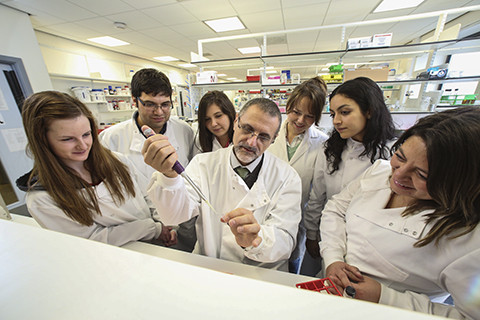
Dr. Miguel Valvano and first author Omar El-Halfawy, PhD candidate, show that the more antibiotic resistant cells within a bacterial population produce and share small molecules with less resistant cells, making them more resistant to antibiotic killing. These small molecules, which are derived from modified amino acids (the building blocks used to make proteins), protect not only the more sensitive cells of B. cenocepacia but also other bacteria including a highly prevalent CF pathogen, Pseudomonas aeruginosa, and E. coli. The research is published in PLOS ONE.

“These findings reveal a new mechanism of antimicrobial resistance based on chemical communication among bacterial cells by small molecules that protect against the effect of antibiotics,” says Dr. Valvano, adjunct professor in the Department of Microbiology and Immunology at Western’s Schulich School of Medicine & Dentistry, currently a Professor and Chair at Queen’s University Belfast. “This paves the way to design novel drugs to block the effects of these chemicals, thus effectively reducing the burden of antimicrobial resistance.”

“These small molecules can be utilized and produced by almost all bacteria with limited exceptions, so we can regard these small molecules as a universal language that can be understood by most bacteria,” says El-Halfawy, who called the findings exciting. “The other way that Burkholderia communicates its high level of resistance is by releasing small proteins to mop up, and bind to lethal antibiotics, thus reducing their effectiveness.” The next step is to find ways to inhibit this phenomenon.

The research, conducted at Western, was funded by a grant from Cystic Fibrosis Canada and also through a Marie Curie Career Integration grant.

Story Source:

The above story is reprinted from materials provided by University of Western Ontario.

Share12Tweet8Share2ShareShareShare2

Related Posts

TyG-ABSI: A New Obesity Marker for Carotid Plaque

December 16, 2025
blank

Unlocking Fagopyrum: DNA Barcoding and Nutritional Insights

December 16, 2025

New Insights into Micro- and Nanoplastics Neurotoxicity

December 16, 2025

S-Methylcysteine Shields Rats from Toxoplasma Reproductive Harm

December 16, 2025
Please login to join discussion

POPULAR NEWS

  • Scientists Uncover Chameleon’s Telephone-Cord-Like Optic Nerves, A Feature Missed by Aristotle and Newton

    Scientists Uncover Chameleon’s Telephone-Cord-Like Optic Nerves, A Feature Missed by Aristotle and Newton

    122 shares
    Share 49 Tweet 31
  • Nurses’ Views on Online Learning: Effects on Performance

    70 shares
    Share 28 Tweet 18
  • NSF funds machine-learning research at UNO and UNL to study energy requirements of walking in older adults

    70 shares
    Share 28 Tweet 18
  • MoCK2 Kinase Shapes Mitochondrial Dynamics in Rice Fungal Pathogen

    72 shares
    Share 29 Tweet 18

About

BIOENGINEER.ORG

We bring you the latest biotechnology news from best research centers and universities around the world. Check our website.

Follow us

Recent News

TyG-ABSI: A New Obesity Marker for Carotid Plaque

Unlocking Fagopyrum: DNA Barcoding and Nutritional Insights

New Insights into Micro- and Nanoplastics Neurotoxicity

Subscribe to Blog via Email

Enter your email address to subscribe to this blog and receive notifications of new posts by email.

Join 70 other subscribers
  • Contact Us

Bioengineer.org © Copyright 2023 All Rights Reserved.

Welcome Back!

Login to your account below

Forgotten Password?

Retrieve your password

Please enter your username or email address to reset your password.

Log In
No Result
View All Result
  • Homepages
    • Home Page 1
    • Home Page 2
  • News
  • National
  • Business
  • Health
  • Lifestyle
  • Science

Bioengineer.org © Copyright 2023 All Rights Reserved.