Credit: Photo by Rachel Moran
CHAMPAIGN, Ill. — Scientists once thought that female mate choice alone accounted for the eye-catching color patterns seen in some male fish. But for orangethroat darters, male-to-male competition is the real force behind the flash, a new study finds.
The research, reported in the journal Proceedings of the Royal Society B, suggests that separate populations of orangethroat darters are evolving differing color patterns as a result of the males' ability to distinguish their own from other species.
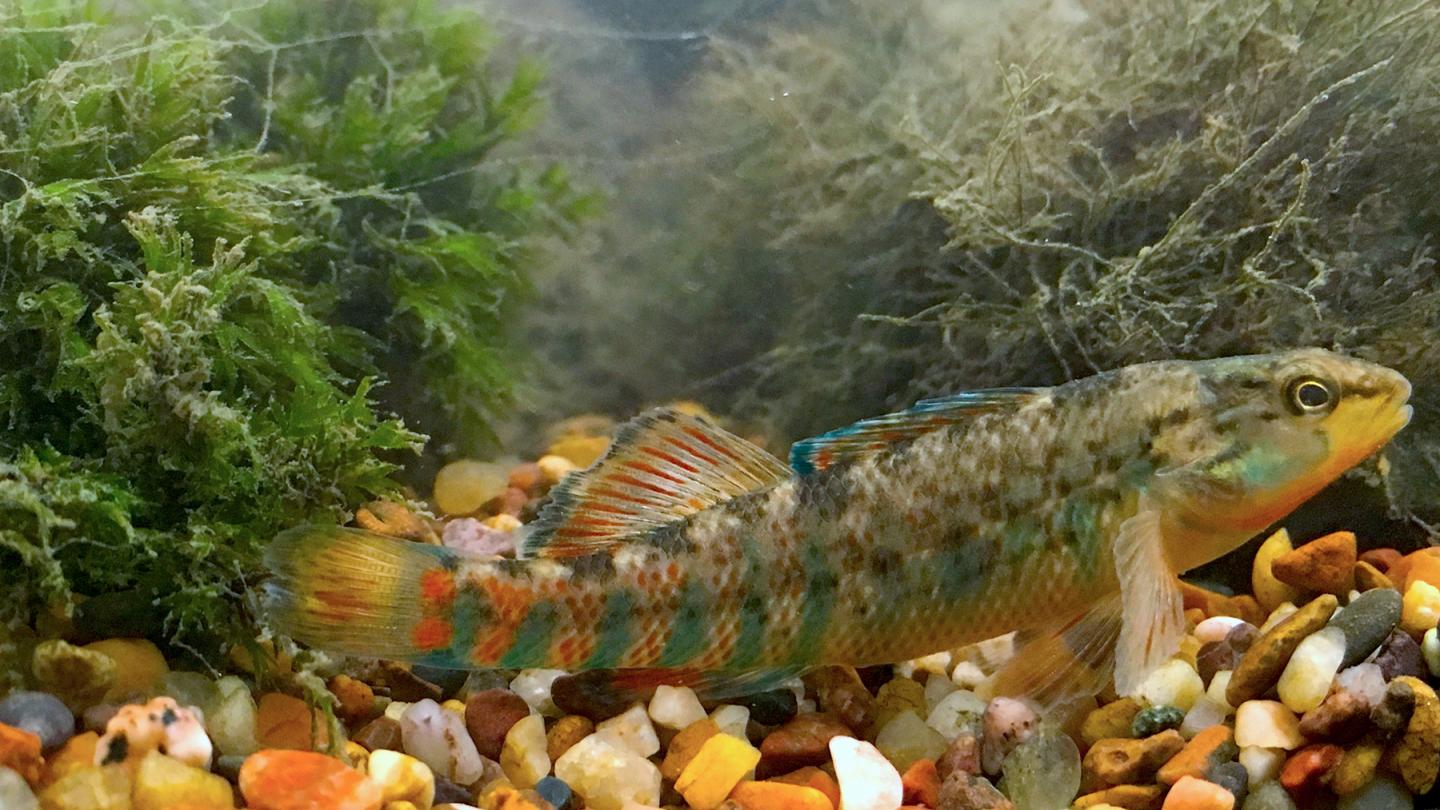
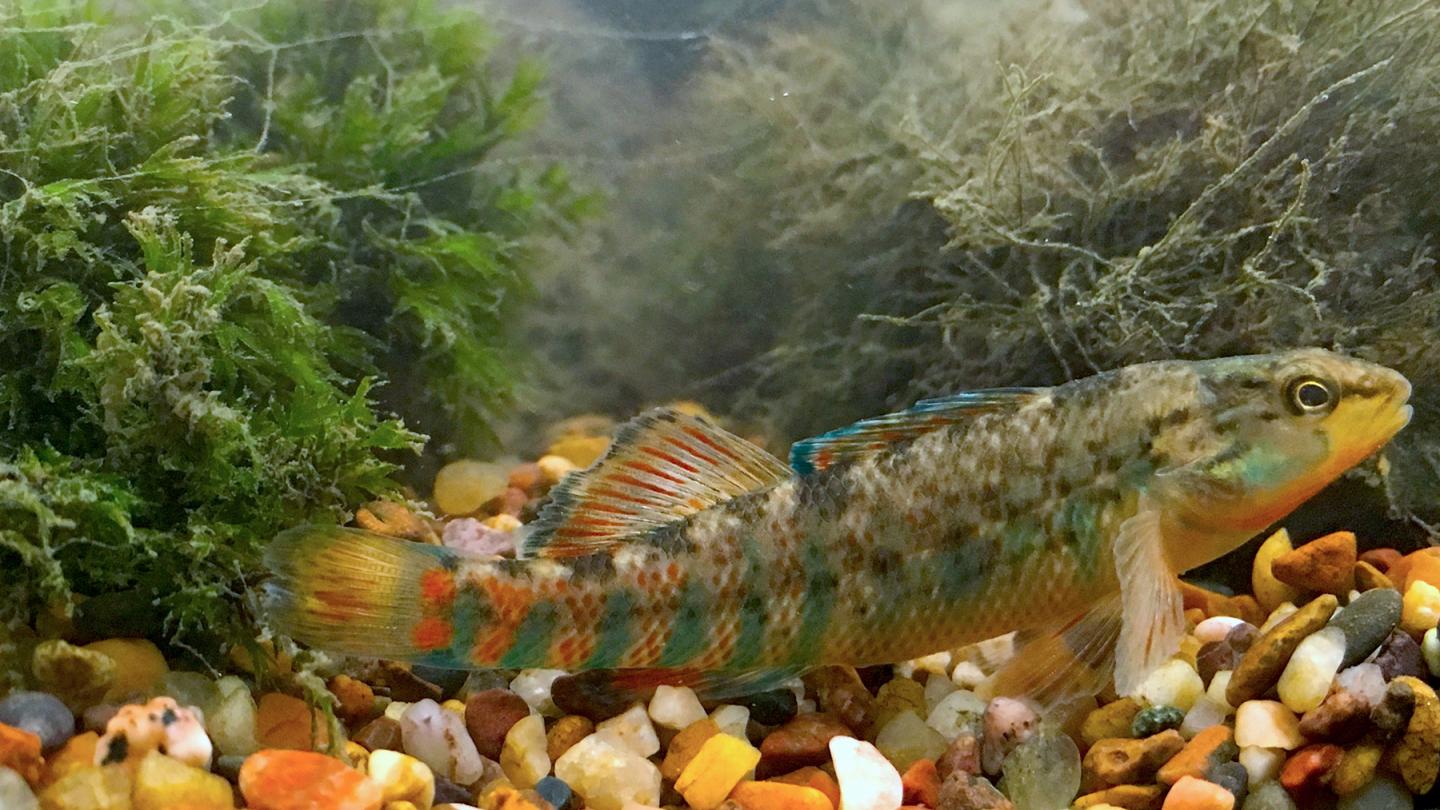
Darters are small, perch-like fish living in freshwater rivers and creeks in North America, said University of Illinois graduate student Rachel Moran, who led the research with animal biology professor Becky Fuller. The males are showy, with orange and blue-green stripes and patches, but the females are brown and tan.
"The females don't choose their mates," Moran said. When fertile, they simply burrow into the gravel and wait for a mate to arrive. "Males of the same species will come up and try to mate with a female and fight off other males," she said.
Because this aggression is costly and dangerous, the males do best if they compete only with males of their own kind, Fuller said.
"To be successful, they need to distinguish between their own and other darter species," she said.
Only orangethroats that coexist with rainbow darters have developed this ability, recent studies have found. Once they learn to avoid rainbow darters – a more distantly related species of fish – orangethroat males won't mate or fight with even closely related orangethroat species.
In the new study, Moran raised a generation of orangethroat offspring in the lab. She obtained the parents of these lab-raised fish from different populations in the wild. The experiment revealed that the distinctive male color patterns seen in separate populations of orangethroat darters persisted from generation to generation.
"This shows that this is something that is genetically based and that those differences are not due just to the environment," she said.
She also compared color patterns in populations of orangethroat darters that do and do not share habitat with rainbow darters. Orangethroat populations that never encounter rainbow darters in the wild look very similar to one another, even when they live out their lives in complete isolation from each other, she noticed.
Separate populations of orangethroat darters whose territories overlap with rainbow darters look very different from one another, however. When individuals from these different populations are brought together in the lab, they ignore and avoid one another. They will neither mate with the females or fight with the other orangethroat darter males.
Moran said there is a possible explanation for why the two species have learned to avoid one another: Hybrid offspring have low survival.
"Natural selection has favored fish that are able to distinguish between their own and the other species," she said.
"As scientists, we often assume that female mate choice is the reason for sexual dimorphism in animal species, where females are very dull and males are flashy," Moran said. "But here, we're showing that male competition also plays an important role. We now know that male competition alone can drive divergence in this really flashy signal between species and also within species."
###
The National Science Foundation and the U.S. Department of Agriculture supported this research.
Editor's notes:
To reach Rachel Moran, email [email protected].
To reach Becky Fuller, email [email protected].
The paper "Agonistic character displacement of genetically based male color patterns across darters" is available online and from the U. of I. News Bureau.
DOI: 10.1098/rspb.2018.1248
Media Contact
Diana Yates
[email protected]
217-333-5802
@NewsAtIllinois
http://www.illinois.edu
Original Source
https://news.illinois.edu/view/6367/677824 http://dx.doi.org/10.1098/rspb.2018.1248