
Credit: Brian Tran
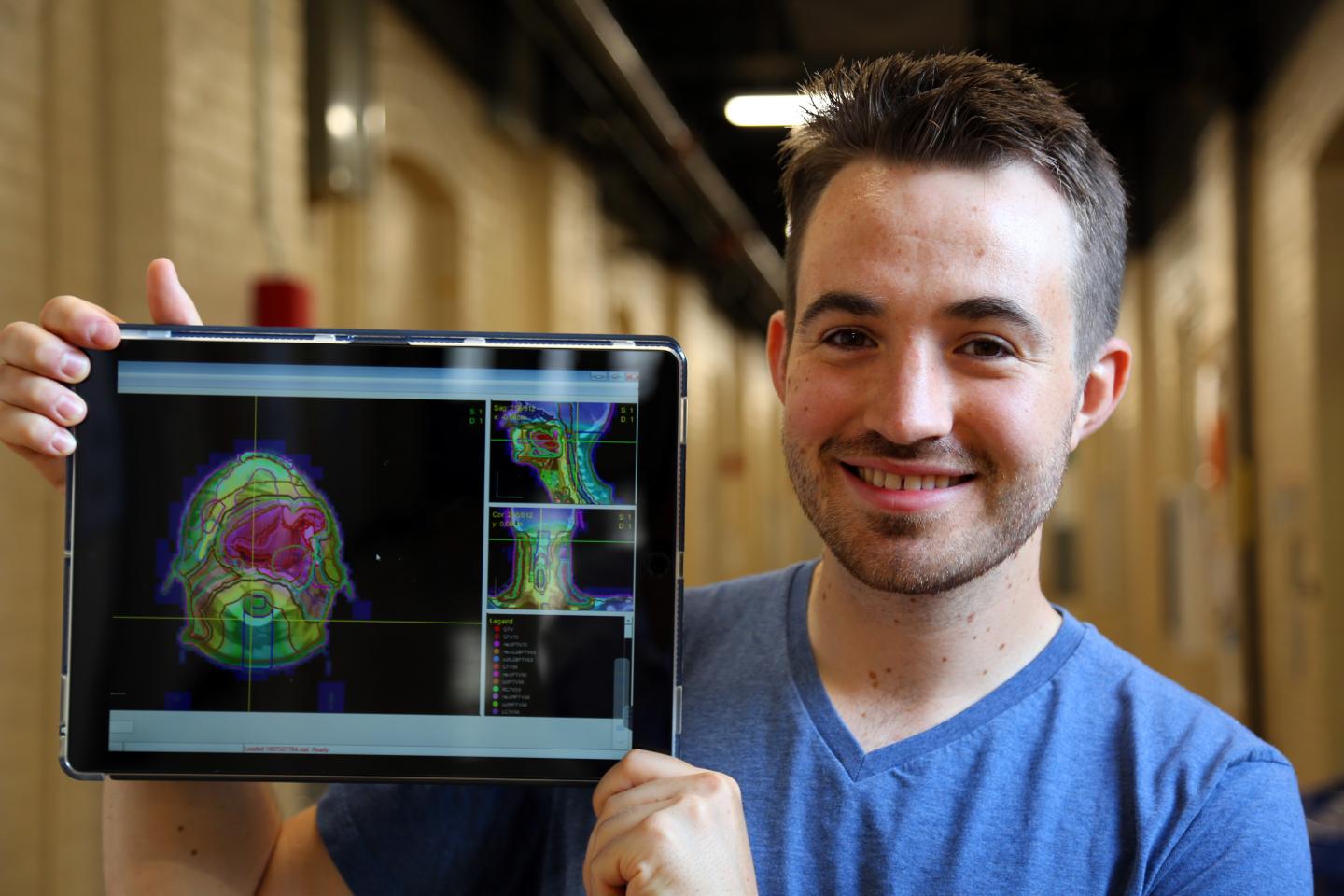
Beating cancer is a race against time. Developing radiation therapy plans — individualized maps that help doctors determine where to blast tumours — can take days. Now, engineering researcher Aaron Babier has developed automation software that aims to cut the time down to mere hours.
He and his team at the University of Toronto's Department of Mechanical & Industrial Engineering, including Justin Boutilier, supervisor Professor Timothy Chan and Professor Andrea McNiven of U of T's Faculty of Medicine, are looking at radiation therapy design as an intricate — but solvable — optimization problem.
Their software uses artificial intelligence (AI) to mine historical radiation therapy data. This information is then applied to an optimization engine to develop treatment plans. The researchers applied this software tool in their study of 217 patients with throat cancer, who also received treatments developed using conventional methods.
The therapies generated by Babier's AI achieved comparable results to patients' conventionally planned treatments. — and it did so within 20 minutes. The researchers recently published their findings in Medical Physics.
"There have been other AI optimization engines that have been developed. The idea behind ours is that it more closely mimics the current clinical best practice," says Babier.
If AI can relieve clinicians of the optimization challenge of developing treatments, more resources are available to improve patient care and outcomes in other ways. Health-care professionals can divert their energy to increasing patient comfort and easing distress.
"Right now treatment planners have this big time sink. If we can intelligently burn this time sink, they'll be able to focus on other aspects of treatment. The idea of having automation and streamlining jobs will help make health-care costs more efficient. I think it'll really help to ensure high-quality care," says Babier.
Babier and his team believe that with further development and validation, health-care professionals can someday use the tool in the clinic. They maintain, however, that while the AI may give treatment planners a brilliant head start in helping patients, it doesn't make the trained human mind obsolete. Once the software has created a treatment plan, it would still be reviewed and further customized by a radiation physicist, which could take up to a few hours.
"It is very much like automating the design process of a custom-made suit," explains Chan. "The tailor must first construct the suit based on the customer's measurements, then alter the suit here and there to achieve the best fit. Our tool goes through a similar process to construct the most effective radiation plan for each patient."
Trained doctors, and often specialists, are still necessary to fine-tune treatments at a more granular level and to perform quality checks. These roles still lie firmly outside the domain of machines.
For Babier, his research on cancer treatment isn't just an optimization challenge.
"When I was 12 years old, my stepmom passed away from a brain tumour," Babier shares.
"I think it's something that's always been at the back of my head. I know what I want to do, and that's to improve cancer treatment. I have a family connection to it. It adds a human element to the research," says Babier.
###
Media Contact
Marit Mitchell
[email protected]
416-978-4498
@uoftengineering
http://www.engineering.utoronto.ca/home.htm
Original Source
http://news.engineering.utoronto.ca/ai-tool-automates-radiation-therapy-planning/ http://dx.doi.org/10.1002/mp.12930