• HOME
  • NEWS
  • EXPLORE
    • CAREER
      • Companies
      • Jobs
    • EVENTS
    • iGEM
      • News
      • Team
    • PHOTOS
    • VIDEO
    • WIKI
  • BLOG
  • COMMUNITY
    • FACEBOOK
    • INSTAGRAM
    • TWITTER
Saturday, February 7, 2026
BIOENGINEER.ORG
No Result
View All Result
  • Login
  • HOME
  • NEWS
  • EXPLORE
    • CAREER
      • Companies
      • Jobs
        • Lecturer
        • PhD Studentship
        • Postdoc
        • Research Assistant
    • EVENTS
    • iGEM
      • News
      • Team
    • PHOTOS
    • VIDEO
    • WIKI
  • BLOG
  • COMMUNITY
    • FACEBOOK
    • INSTAGRAM
    • TWITTER
  • HOME
  • NEWS
  • EXPLORE
    • CAREER
      • Companies
      • Jobs
        • Lecturer
        • PhD Studentship
        • Postdoc
        • Research Assistant
    • EVENTS
    • iGEM
      • News
      • Team
    • PHOTOS
    • VIDEO
    • WIKI
  • BLOG
  • COMMUNITY
    • FACEBOOK
    • INSTAGRAM
    • TWITTER
No Result
View All Result
Bioengineer.org
No Result
View All Result
Home NEWS Science News Health

High-precision on-site analysis of precious metals in metallurgical waste spills

Bioengineer by Bioengineer
July 26, 2018
in Health
Reading Time: 2 mins read
0
Share on FacebookShare on TwitterShare on LinkedinShare on RedditShare on Telegram
IMAGE

Credit: Kanazawa University

Precious metals come in limited supply but are in high demand. They are mainly sourced through mining, but the possibility of recycling them from metallurgical waste leachates (waters that have passed through the treated materials during mineral processing and thus contain some of the compounds present in the minerals) is attracting growing attention. To this end, compact and portable instruments to perform the analysis of wastewaters in on-field rapid analysis are highly desirable to improve the efficiency of the recovery of precious metals.

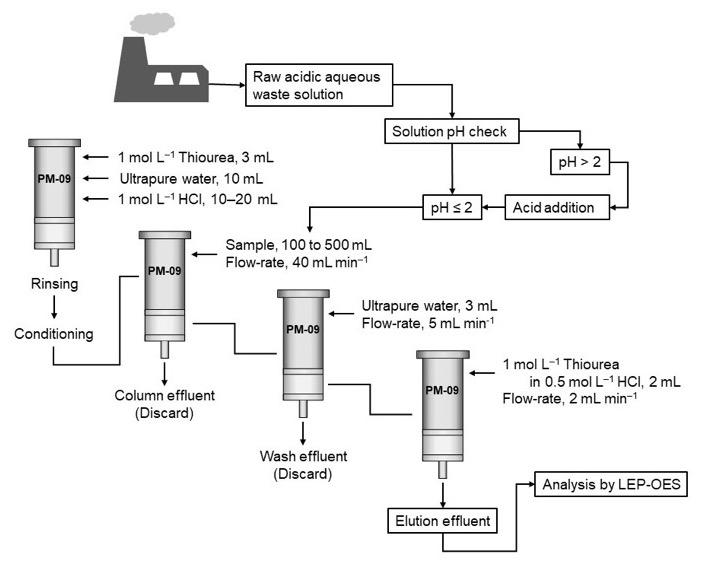
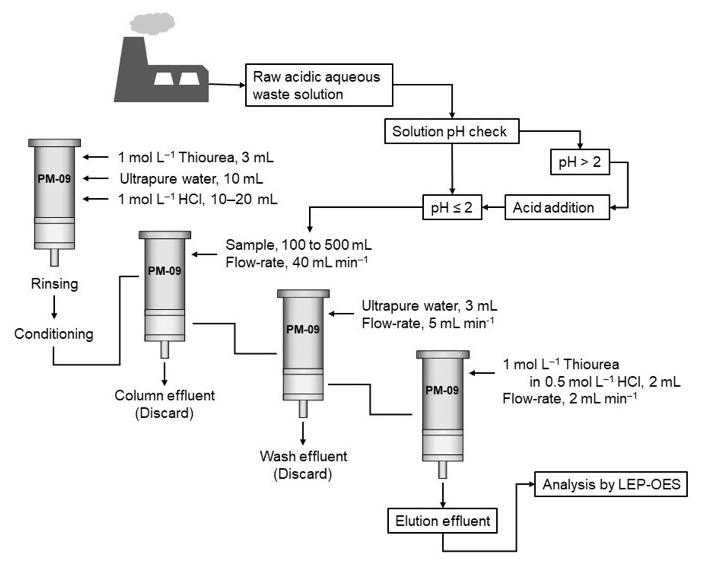
Liquid-electrode plasma-optical emission spectrometry (LEP-OES) has emerged as a tool to implement on-site analysis of elements in aqueous matrices, as it is portable and much less costly than traditional methods. However, when the concentration of noble metals is very low, as is the case for precious metals in waste spills, the sensitivity of the technique become insufficient to produce accurate analysis — one of the problems is that in metallurgical waste leachates there are several ions that interfere with the analysis. In this case, analyte separation and enrichment steps (that is, steps that remove other substances and increase the concentration of the analyte to make detection easier) have to be included in the analysis of the samples for accurate detection of the precious metals.

This is what Suman Barua, Ismail M.M. Rahman, Hiroshi Hasegawa and colleagues from Kanazawa University and Fukushima University did, reporting the first application of LEP-OES in combination with a solid-phase extraction (SPE) system (which is used as the pre-treatment step to eliminate the competing ions and to enrich the noble metals) for the rapid on-site simultaneous analysis of the precious metals gold, palladium and platinum. The SPE parameters were optimized to maximize retention and recovery of the precious metals; the LEP-OES parameters to maximize the emission peaks for the individual elements. The method was tested both on certified reference material for wastewater and on real aqueous waste samples, from which more than 95% of the precious metals were recovered. The high-precision on-site measurements could be performed in less than 15 minutes, opening the way to practical analysis of the precious metal content of wastewaters.

###

Media Contact

Tomoya Sato
[email protected]
81-762-645-076

http://www.kanazawa-u.ac.jp/e/index.html

Related Journal Article

http://dx.doi.org/10.1016/j.snb.2018.05.132

Share12Tweet8Share2ShareShareShare2

Related Posts

Palmitoylation of Tfr1 Drives Platelet Ferroptosis and Exacerbates Liver Damage in Heat Stroke

February 7, 2026

Oxygen-Enhanced Dual-Section Microneedle Patch Improves Drug Delivery and Boosts Photodynamic and Anti-Inflammatory Treatment for Psoriasis

February 7, 2026

Scientists Identify SARS-CoV-2 PLpro and RIPK1 Inhibitors Showing Potent Synergistic Antiviral Effects in Mouse COVID-19 Model

February 7, 2026

Neg-Entropy: The Key Therapeutic Target for Chronic Diseases

February 7, 2026
Please login to join discussion

POPULAR NEWS

  • Robotic Ureteral Reconstruction: A Novel Approach

    Robotic Ureteral Reconstruction: A Novel Approach

    82 shares
    Share 33 Tweet 21
  • Digital Privacy: Health Data Control in Incarceration

    63 shares
    Share 25 Tweet 16
  • Study Reveals Lipid Accumulation in ME/CFS Cells

    57 shares
    Share 23 Tweet 14
  • Breakthrough in RNA Research Accelerates Medical Innovations Timeline

    53 shares
    Share 21 Tweet 13

About

We bring you the latest biotechnology news from best research centers and universities around the world. Check our website.

Follow us

Recent News

Palmitoylation of Tfr1 Drives Platelet Ferroptosis and Exacerbates Liver Damage in Heat Stroke

Oxygen-Enhanced Dual-Section Microneedle Patch Improves Drug Delivery and Boosts Photodynamic and Anti-Inflammatory Treatment for Psoriasis

Scientists Identify SARS-CoV-2 PLpro and RIPK1 Inhibitors Showing Potent Synergistic Antiviral Effects in Mouse COVID-19 Model

Subscribe to Blog via Email

Enter your email address to subscribe to this blog and receive notifications of new posts by email.

Join 73 other subscribers
  • Contact Us

Bioengineer.org © Copyright 2023 All Rights Reserved.

Welcome Back!

Login to your account below

Forgotten Password?

Retrieve your password

Please enter your username or email address to reset your password.

Log In
No Result
View All Result
  • Homepages
    • Home Page 1
    • Home Page 2
  • News
  • National
  • Business
  • Health
  • Lifestyle
  • Science

Bioengineer.org © Copyright 2023 All Rights Reserved.