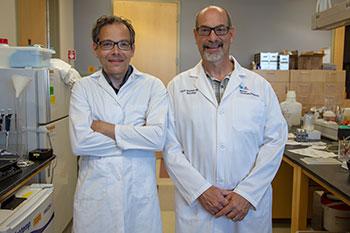
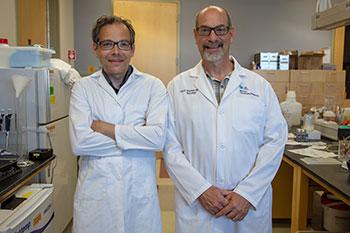
Credit: Photo by Nadia Whitehead / UA College of Medicine – Tucson.
The best-known treatment for Parkinson's disease isn't perfect. Named levodopa, the drug can treat the stiffness and slowness of movement associated with the debilitating disease.
"The problem is levodopa works great for a few years — we call that the 'honeymoon' period — but then you start getting these side effects," says Scott Sherman, MD, PhD, a neurologist at the University of Arizona College of Medicine – Tucson.
Forty percent of patients on levodopa eventually will experience dyskinesia — uncontrollable and involuntary movements of the arms, legs, head or entire body. Severity can range from small, fidget-like motions to larger continuous bursts of movement.
Unless patients stop levodopa treatment altogether, these movements do not go away.
Now, UA researchers will repurpose ketamine, a drug currently used to treat pain and depression, to try to reduce and control these involuntary movements brought on by levodopa.
Led by Dr. Sherman and Torsten Falk, PhD, a neuroscientist in the UA Department of Neurology, the two will launch a small phase I clinical trial this summer at the UA College of Medicine – Tucson. The trial is supported by a three-year $750,000 grant from the Arizona Biomedical Research Commission (ABRC).
Drs. Sherman and Falk first got a glimpse of ketamine's potential in Parkinson's disease treatment more than five years ago.
The two were using ketamine to relieve pain in five hospitalized patients with Parkinson's disease. The treatment worked as expected, but the researchers noticed an unintended side effect: the patients' uncontrolled movements while on levodopa were noticeably reduced. One patient experienced complete resolution of these movements for a period of several weeks.
Intrigued, the researchers continued investigating and have since shown similar results in rodents with Parkinson's disease.
Ketamine has been known to raise blood pressure and cause a feeling of disassociation in humans.
"Disassociation is a sort of 'out-of-body' experience," Dr. Sherman explains. "When people describe it, they have told me that they feel like they are in fish bowl."
In the past, ketamine has been abused by partygoers for this psychedelic effect, but Dr. Sherman is hopeful these side effects will not affect the clinical trial.
"We are going to monitor blood pressure closely to make sure it doesn't get high," he says. "And we know at what dosage ketamine causes this disassociation; we expect that the dosage needed in Parkinson's disease will stay well below that level."
Using 10 patients, this first clinical trial will verify that Dr. Sherman's hunch holds true — that ketamine is tolerable and effective for treating dyskinesia.
In addition to supporting the clinical trial, grant funding from the ABRC will back a separate rodent study that examines exactly how ketamine affects the brain and reduces dyskinesia triggered by levodopa.
"We want to find out exactly what ketamine is doing to have this effect," Dr. Sherman explains.
If the team achieves positive results in both the human and rodent studies, Drs. Sherman and Falk will be one step closer to their goal: establishing that ketamine can help patients with Parkinson's disease.
Dr. Sherman says, "Ketamine has been long overlooked. Now it could prove very useful for Parkinson's patients."
###
About the UA College of Medicine – Tucson
The University of Arizona College of Medicine – Tucson is shaping the future of medicine through state-of-the-art medical education programs, groundbreaking research and advancements in patient care in Arizona and beyond. Founded in 1967, the college boasts more than 50 years of innovation, ranking among the top medical schools in the nation for research and primary care. Through the university's partnership with Banner Health, one of the largest nonprofit health care systems in the country, the college is leading the way in academic medicine. For more information, please visit medicine.arizona.edu.
Follow us: Facebook | Twitter | Instagram | LinkedIn
Media Contact
Nadia Whitehead
[email protected]
915-276-6803
http://uahs.arizona.edu/
Original Source
http://uahs.arizona.edu/news/ua-clinical-trial-repurpose-ketamine-parkinsons-patients