Credit: Wilfried Weber
Scientists from the University of Freiburg have developed materials systems that are composed of biological components and polymer materials and are capable of perceiving and processing information. These biohybrid systems were engineered to perform certain functions, such as the counting signal pulses in order to release bioactive molecules or drugs at the correct time, or to detect enzymes and small molecules such as antibiotics in milk. The interdisciplinary team presented their results in some of the leading journals in the field, including Advanced Materials and Materials Today.
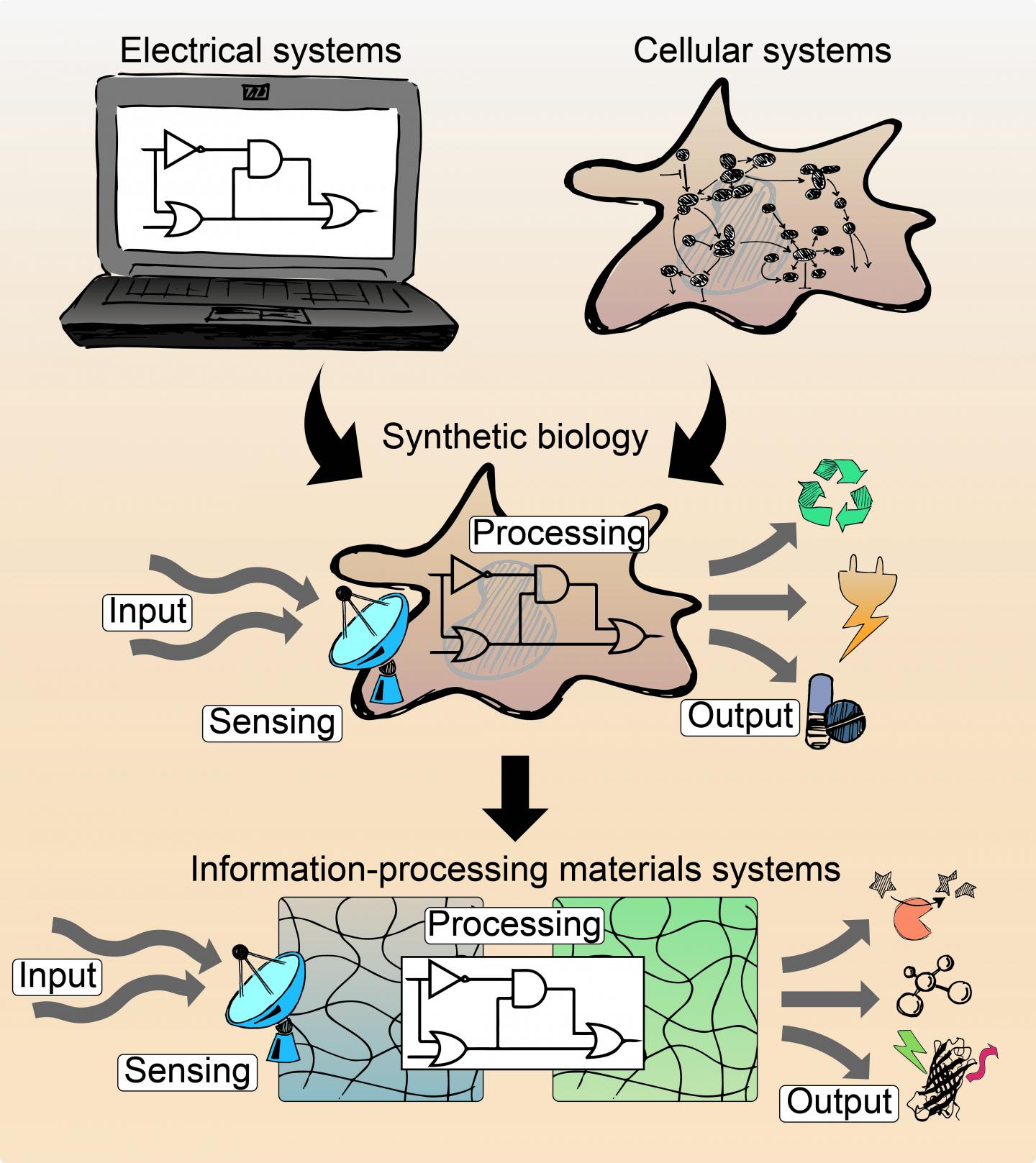
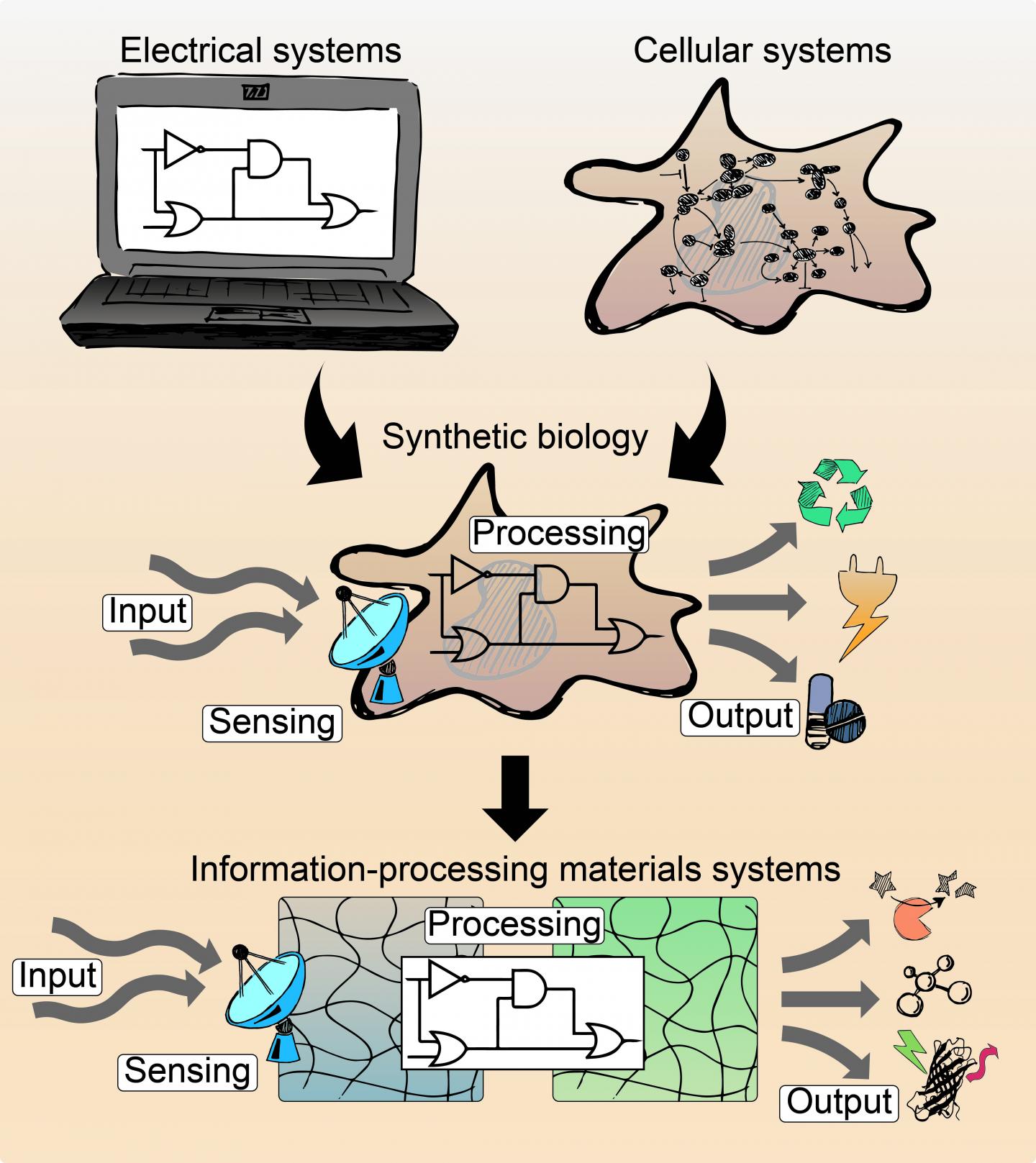
Living systems (such as cells and organisms) and electrical systems (such as computers) respond to different input information, and have diverse output capabilities. However, the fundamental property these complex systems share is the ability to process information. Over the past two decades, scientists have applied the principles of electrical engineering to design and build living cells that perceive and process information and perform desired functions. This field is called synthetic biology, and it has many exciting applications in the medical, biotechnology, energy and environmental sectors.
"Thanks to major progress in our understanding of the components and wiring of biological signalling processes, we are now at a stage where we can transfer biological modules from synthetic biology to materials", explains lead researcher Prof. Wilfried Weber from the Faculty of Biology and the BIOSS Centre for Biological Signalling Studies. A critical step in the development of these smart materials systems was to optimally align the activity of the biological building blocks. Similar to computers, incompatibility of individual components might crash the overall system. Key to overcoming this challenge were quantitative mathematical models developed by Prof. Jens Timmer and Dr. Raphael Engesser from the Faculty of Mathematics and Physics.
"A great thing about these synthetic biology-inspired materials systems is their versatility", says Hanna Wagner, the first author of one of the studies and a doctoral candidate in the Spemann Graduate School of Biology and Medicine (SGBM). The modular design concept put forth in these studies provides a blueprint for engineering biohybrid materials systems that can sense and process diverse physical, chemical or biological signals and perform desired functions, such as the amplification of signals, the storage of information, or the controlled release of bioactive molecules. These innovative materials might therefore have broad applications in research, biotechnology and medicine.
###
Original Publications
- Beyer, H.M./Engesser, R./Hörner, M./Koschmieder, J./Beyer, P./Timmer, J./Zurbriggen, M.D./Weber, W. (2018): Synthetic Biology Makes Polymer Materials Count. In: Advanced Materials. doi: 10.1002/adma.201800472
- Wagner, H.J./Engesser, R./Ermes, K./Geraths, C./Timmer, J./Weber, W. (2018): Characterization of the synthetic biology-inspired implementation of a materials-based positive feedback loop. In: Data in Brief. doi: 10.1016/j.dib.2018.05.074
- Wagner, H.J./Engesser, R./Ermes, K./Geraths, C./Timmer, J./Weber, W. (2018): Synthetic biology-inspired design of signal-amplifying materials systems. In: Materials Today. doi: 10.1016/j.mattod.2018.04.006
Contact:
Prof. Dr. Wilfried Weber
Faculty of Biology / BIOSS Centre for Biological Signalling Studies
Albert Ludwigs University of Freiburg
Tel.: 0761/203-97654
[email protected]
Prof. Dr. Jens Timmer
Faculty of Mathematics and Physics / BIOSS Centre for Biological Signalling Studies
Albert Ludwigs University of Freiburg
Tel.: 0761/203-5829
[email protected]
Media Contact
Prof. Dr. Wilfried Weber
[email protected]
49-761-203-97654
Original Source
https://www.pr.uni-freiburg.de/pm-en/press-releases-2018/biological-signalling-processes-in-intelligent-materials?set_language=en