Credit: Osaka University
Osaka – Inflammation and evasion of the immune system have been reported to be some of the new hallmarks of cancer. Notably, a high-fat diet (HFD) causes obesity and chronic inflammation, and studies conducted on mice have shown that HFD could be associated with progression and survival of prostate cancer. In human studies, inflammation and immune cells are also linked to prostate cancer.
While much is known about how HFD increases serum proinflammatory cytokines (small proteins that are important in cell signaling), it remains unclear whether tumor progression resulted from these cytokines.
In their latest study, which was reported in Clinical Cancer Research, a team of Osaka University-centered researchers successfully determined the mechanisms of the associations of prostate cancer with inflammation and immune responses.
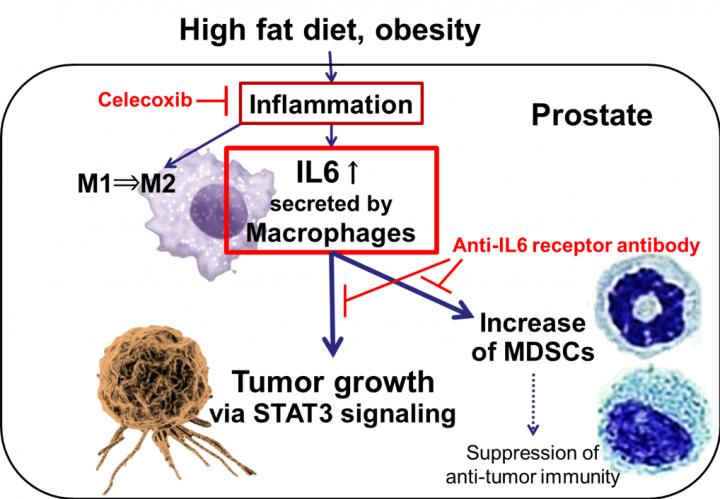
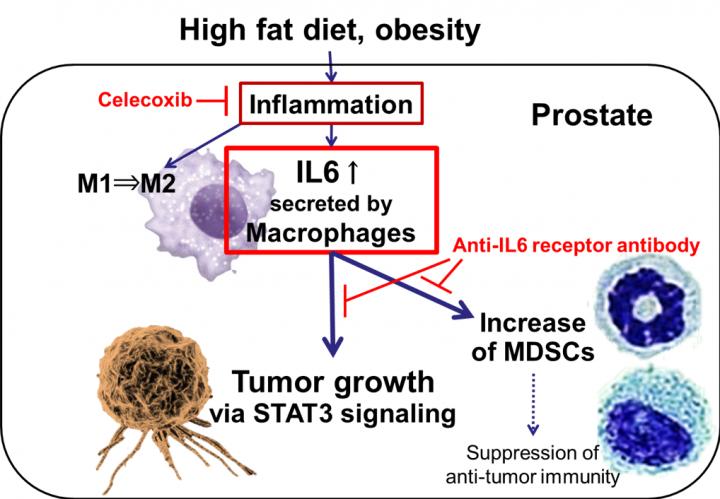
"We administered an HFD and anti-inflammatory drug celecoxib to a genetically engineered autochthonous mouse model, which corresponds to somatic mutations of human prostate cancer model mice," explains study lead author Takuji Hayashi. "Tumor growth was evaluated by tumor weight and Ki67 stain, and local immune cells were assessed by flow cytometry at 22 weeks of age. Further, cytokines that correlated with tumor growth were identified."
The researchers found that HFD accelerated tumor growth and increased the myeloid-derived suppressor cells (MDSCs) fraction and the ratio of M2/M1 macrophage, a major type of immune cells, in the model mice. MDSCs regulate immune responses and tissue repair in healthy individuals and the population rapidly expands during inflammation, infection and cancer. Celecoxib was observed to suppress tumor growth and reduced local MDSCs and M2/M1 macrophage ratio in HFD-fed mic.
Administration of antibody specific to the receptor of cytokine IL6 suppressed tumor growth, and decreased local MDSCs and pSTAT3-positive cell fractions in HFD-fed mice. In response to cytokines and growth factors, STAT3 is phosphorylated (to become pSTAT3) and translocated to the cell nucleus, where it acts as a gene transcription activator. The tumor-infiltrating CD11b-positive cell count was also found to be significantly higher in prostatectomy specimens of obese patients than in those of non-obese patients with prostate cancer.
"Taken together, our results suggest that HFD-induced prostate cancer growth via IL6 signaling could also exist in obese humans," says corresponding author Kazutoshi Fujita. "Anti-inflammatory drugs, such as celecoxib, may have clinical benefits for obese patients with prostate cancer. Additionally, an improvement of dietary habits or an intake of analgesic may lead to prophylaxis and contribute to the treatment of prostate cancer."
###
Osaka University was founded in 1931 as one of the seven imperial universities of Japan and now has expanded to one of Japan's leading comprehensive universities. The University has now embarked on open research revolution from a position as Japan's most innovative university and among the most innovative institutions in the world according to Reuters 2015 Top 100 Innovative Universities and the Nature Index Innovation 2017. The university's ability to innovate from the stage of fundamental research through the creation of useful technology with economic impact stems from its broad disciplinary spectrum.
Website: http://resou.osaka-u.ac.jp/en/top
Media Contact
Saori Obayashi
[email protected]
81-661-055-886
@osaka_univ_e
http://www.osaka-u.ac.jp/en
Original Source
http://resou.osaka-u.ac.jp/en/research/2018/20180710_2 http://dx.doi.org/10.1158/1078-0432.CCR-18-0106