• HOME
  • NEWS
  • EXPLORE
    • CAREER
      • Companies
      • Jobs
    • EVENTS
    • iGEM
      • News
      • Team
    • PHOTOS
    • VIDEO
    • WIKI
  • BLOG
  • COMMUNITY
    • FACEBOOK
    • INSTAGRAM
    • TWITTER
Saturday, February 7, 2026
BIOENGINEER.ORG
No Result
View All Result
  • Login
  • HOME
  • NEWS
  • EXPLORE
    • CAREER
      • Companies
      • Jobs
        • Lecturer
        • PhD Studentship
        • Postdoc
        • Research Assistant
    • EVENTS
    • iGEM
      • News
      • Team
    • PHOTOS
    • VIDEO
    • WIKI
  • BLOG
  • COMMUNITY
    • FACEBOOK
    • INSTAGRAM
    • TWITTER
  • HOME
  • NEWS
  • EXPLORE
    • CAREER
      • Companies
      • Jobs
        • Lecturer
        • PhD Studentship
        • Postdoc
        • Research Assistant
    • EVENTS
    • iGEM
      • News
      • Team
    • PHOTOS
    • VIDEO
    • WIKI
  • BLOG
  • COMMUNITY
    • FACEBOOK
    • INSTAGRAM
    • TWITTER
No Result
View All Result
Bioengineer.org
No Result
View All Result
Home NEWS Science News Health

Pediatric NEXUS head CT DI reliably guides blunt trauma imaging decisions

Bioengineer by Bioengineer
July 17, 2018
in Health
Reading Time: 2 mins read
0
Share on FacebookShare on TwitterShare on LinkedinShare on RedditShare on Telegram
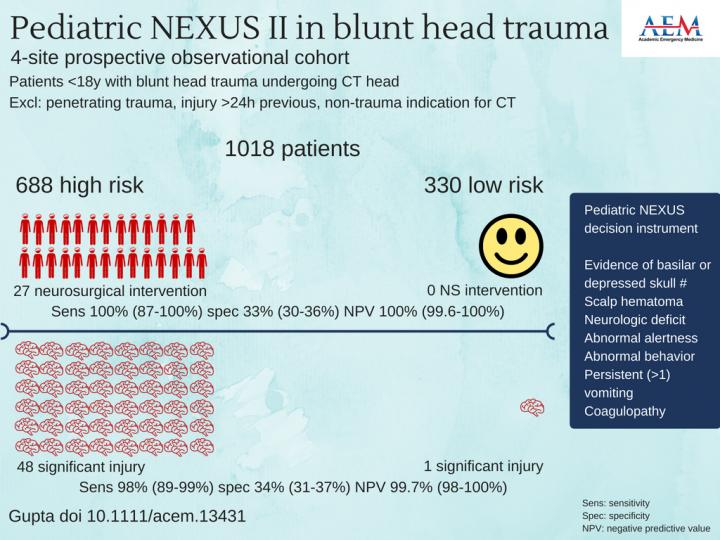
IMAGE

Credit: KIRSTY CHALLEN, B.SC., MBCHB, MRES, PH.D., LANCASHIRE TEACHING HOSPITALS, UNITED KINGDOM

DES PLAINES, IL–The Pediatric NEXUS Head Computed Tomography (CT) Decision Instrument (DI) reliably identifies blunt trauma patients who require head CT imaging and could significantly reduce the use of CT imaging. Those are the findings of a to be published in the July issue of Academic Emergency Medicine, a journal of the Society for Academic Emergency Medicine (SAEM).

The lead author is Malkeet Gupta MD, MS, assistant clinical professor in the Department of Emergency Medicine at UCLA.

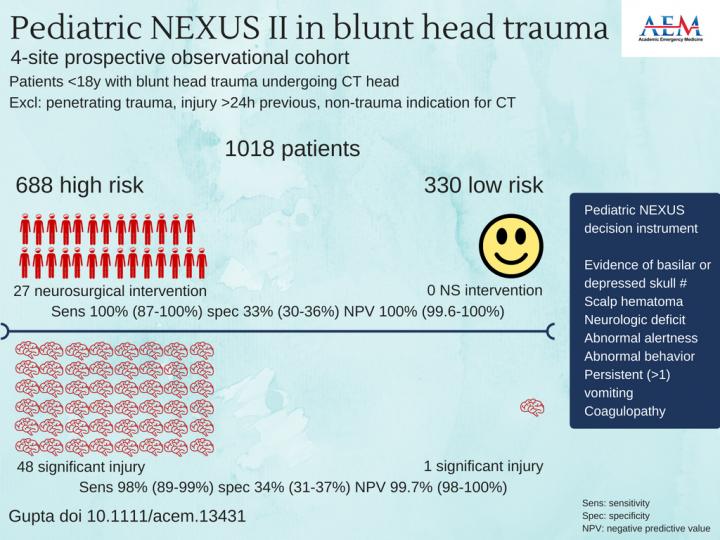
The study by Gupta et al, validates the NEXUS Head Computed Tomography Decision Instrument in pediatric patients and provides clinicians with a highly sensitive tool to guide selective imaging decisions in blunt head injury patients. Unlike other decision instruments, the decision instrument asks providers to use clinical judgment to identify low-risk patients who need no imaging and then to apply the decision instrument to further reduce the planned imaging. This "judgment first, decision instrument second" approach may decrease head CT utilization in low-risk pediatric populations by up to 34%.

The findings of the study are discussed with Dr. Gupta in the featured episode of SGEM Hop (Skeptics Guide to EM Hot Off the Press).

Joshua S. Broder, MD, director of the Emergency Medicine Residency Program and vice-chief for education in the Division of Emergency Medicine at Duke University School of Medicine, commented on the study:

"This study provides another tool in our armamentarium for assessing pediatric patients with traumatic head injury and has the potential to reduce CT utilization. Some elements of the decision instrument are poorly predictive; scalp hematoma alone, for example, does not indicate substantial risk of injury. Changes in nomenclature could help. For example, the term 'high-risk' may not accurately describe patients who fail one or more measures on the instrument, as the rate of significant head injury in this group was approximately 7%. 'Non-low risk' or 'intermediate risk' may more accurately describe some patients who might be safely observed without imaging."

###

The Society for Academic Emergency Medicine (SAEM) is a 501(c)(3) not-for-profit organization dedicated to the improvement of care of the acutely ill and injured patient by leading the advancement of academic emergency medicine through education and research, advocacy, and professional development. To learn more, visit saem.org.

Media Contact

Stacey Roseen
[email protected]
847-257-7227
@SAEMonline

http://saem.org

Related Journal Article

http://dx.doi.org/10.1111/acem.13431

Share12Tweet7Share2ShareShareShare1

Related Posts

Evaluating Pediatric Emergency Care Quality in Ethiopia

February 7, 2026

TPMT Expression Predictions Linked to Azathioprine Side Effects

February 7, 2026

Improving Dementia Care with Enhanced Activity Kits

February 7, 2026

Decoding Prostate Cancer Origins via snFLARE-seq, mxFRIZNGRND

February 7, 2026
Please login to join discussion

POPULAR NEWS

  • Robotic Ureteral Reconstruction: A Novel Approach

    Robotic Ureteral Reconstruction: A Novel Approach

    82 shares
    Share 33 Tweet 21
  • Digital Privacy: Health Data Control in Incarceration

    63 shares
    Share 25 Tweet 16
  • Study Reveals Lipid Accumulation in ME/CFS Cells

    57 shares
    Share 23 Tweet 14
  • Breakthrough in RNA Research Accelerates Medical Innovations Timeline

    53 shares
    Share 21 Tweet 13

About

We bring you the latest biotechnology news from best research centers and universities around the world. Check our website.

Follow us

Recent News

Evaluating Pediatric Emergency Care Quality in Ethiopia

TPMT Expression Predictions Linked to Azathioprine Side Effects

Improving Dementia Care with Enhanced Activity Kits

Subscribe to Blog via Email

Enter your email address to subscribe to this blog and receive notifications of new posts by email.

Join 73 other subscribers
  • Contact Us

Bioengineer.org © Copyright 2023 All Rights Reserved.

Welcome Back!

Login to your account below

Forgotten Password?

Retrieve your password

Please enter your username or email address to reset your password.

Log In
No Result
View All Result
  • Homepages
    • Home Page 1
    • Home Page 2
  • News
  • National
  • Business
  • Health
  • Lifestyle
  • Science

Bioengineer.org © Copyright 2023 All Rights Reserved.