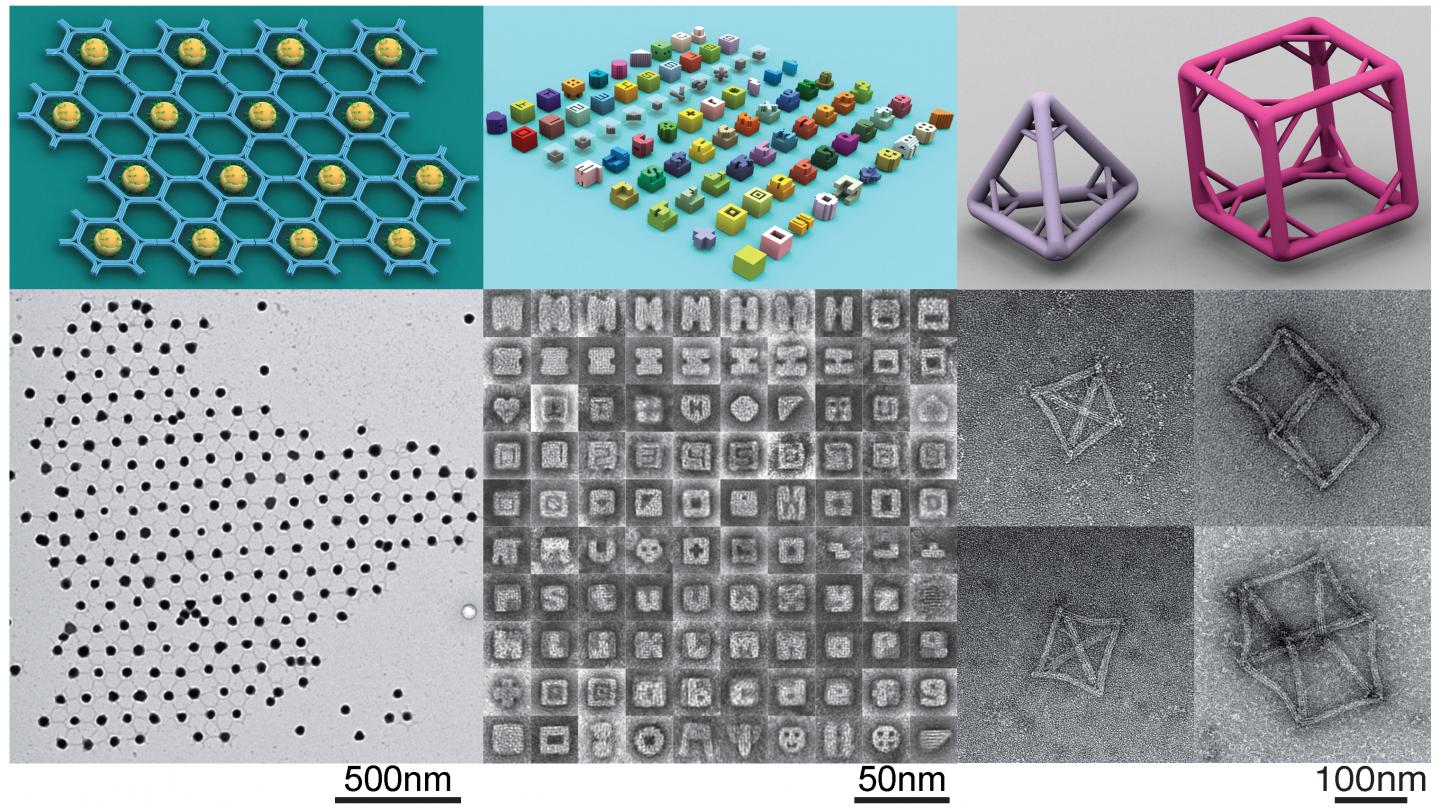
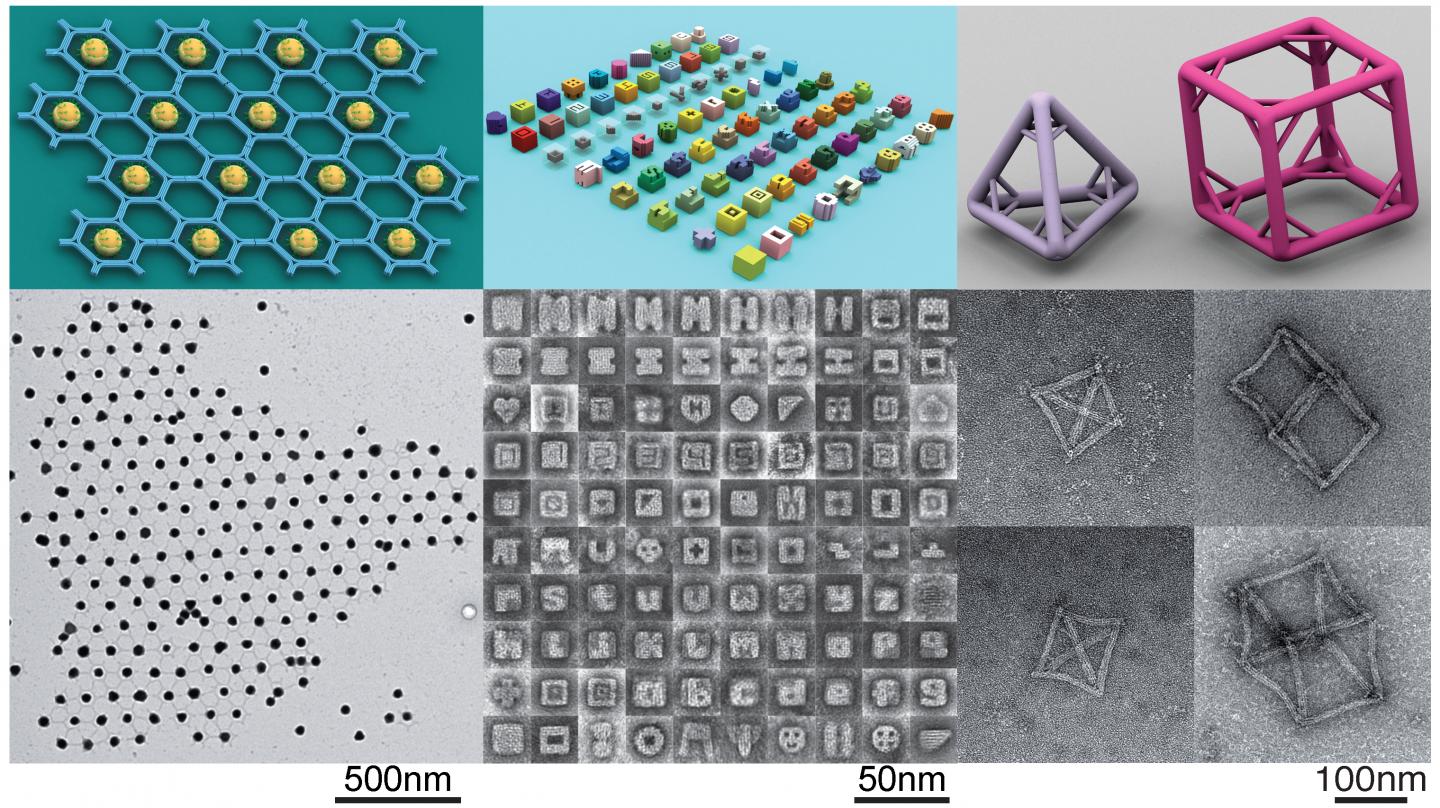
Credit: Yonggang Ke, Biomedical Engineering Department, Emory University and Georgia Tech
To address a worldwide need for data storage that far outstrips today's capabilities, federal agencies and a technology research consortium are investing $12 million in new research through the Semiconductor Synthetic Biology for Information Processing and Storage Technologies (SemiSynBio) program. The goal is to create storage systems that integrate synthetic biology with semiconductor technology.
SemiSynBio, a partnership between the National Science Foundation (NSF) and the Semiconductor Research Corporation (SRC), seeks to lay the groundwork for future information storage systems at the intersection of biology, physics, chemistry, computer science, materials science and engineering.
"We may soon have data storage and processing capabilities that surpass the imagination, thanks largely to federal investments in basic research," said Dawn Tilbury, NSF assistant director for Engineering (ENG). "While current capabilities have improved dramatically over the past decades, materials such as silicon have physical constraints that appear to limit computing at very small scales. Bio-based materials and designs suggest intriguing possibilities to overcome these obstacles — at lower energy cost."
Researchers anticipate that biological structures integrated with semiconductor technology could store 1,000 times more data than current capabilities, and retain the data for more than a century, while consuming much less energy.
"While today's data storage devices are smaller and more powerful than ever before, we have the potential to catalyze a new wave of innovation that will push the boundaries for the future," said Erwin Gianchandani, acting NSF assistant director for Computer and Information Science and Engineering (CISE). "This research will pave the way for devices with much greater storage capacity and much lower power usage. Imagine, for example, having the entire contents of the Library of Congress on a device the size of your fingernail."
Traditional data processing and storage uses ones and zeroes to represent data, also known as a binary code. Synthetic biology offers several potential advantages over those current capabilities. Our own DNA, for example, is composed of four nucleobases that hold genetic information. DNA doesn't degrade over time and is very compact. It could be used to store a massive amount of data in a tiny space over a long period of time.
"The more we learn about the biology of living cells, the more it becomes clear that information processing is a critical part of how biological systems function," said Joanne Tornow, acting NSF assistant director for Biological Sciences (BIO). "SemiSynBio is a profound example of the importance of cross-disciplinary collaboration that brings to bear the strengths of fields from biology to computer science and engineering."
Harnessing such potential will require exploratory research combining expertise in synthetic biology with semiconductor technology.
SemiSynBio builds upon a long history of NSF support for basic research in synthetic biology. SynBERC, the NSF Engineering Research Center dedicated to basic research and accelerated innovation in synthetic biology, was established more than a decade ago and has contributed to the education and preparation of the next generation of leaders in this emerging area. NSF also convened the Ideas Lab in synthetic biology with partners across the foundation and in the U.K. to catalyze innovative research in synthetic biology that crossed disciplinary boundaries, later creating the Systems and Synthetic Biology program that continues to support interdisciplinary efforts in the area.
More recently, NSF has made significant investments to push the frontiers of synthetic biology and molecular programming. NSF has been proactive in considering safety and environmental concerns, as well as ethical, policy and legal issues relevant to synthetic biology research.
These new awards will channel the enthusiasm of a growing number of biologists, physicists, chemists, computer scientists, materials scientists and engineers, and other researchers already making inroads in this area, to foster new breakthroughs and support the training of a new generation of scientists.
This year's awards address a range of potential applications, including storing data by using DNA, automating the design of genetic circuits, creating bioelectronics and exploring methods for molecular communication.
Below are the eight new SemiSynBio projects, their principal investigators and their home institutions.
Highly scalable, random access DNA data storage with nanopore-based reading: Joshua Hihath, University of California-Davis; Manjeri Anantram, University of Washington; Yonggang Ke, Emory University.
An on-chip nanoscale storage system using chimeric DNA: Olgica Milenkovic, University of Illinois at Urbana-Champaign.
Highly scalable random access DNA data storage with nanopore-based reading: Hanlee Ji, Stanford University.
Nucleic Acid Memory: William Hughes, Boise State University.
Very large-scale genetic circuit design automation: Christopher Voight, Massachusetts Institute of Technology; Kate Adamala, University of Minnesota-Twin Cities; Eduardo Sontag, Northeastern University.
Redox-enabled Bio-Electronics for Molecular Communication and Memory (RE-BIONICS): William Bentley, University of Maryland, College Park.
YeastOns: Neural Networks Implemented in Communicating Yeast Cells: Rebecca Schulman, Johns Hopkins University; Eric Klavins, University of Washington; Andrew Ellington, University of Texas at Austin.
Cardiac Muscle-Cell-Based Coupled Oscillator Networks for Collective Computing: Pinar Zorlutuna, University of Notre Dame.
###
The National Science Foundation (NSF) is an independent federal agency that supports fundamental research and education across all fields of science and engineering. In fiscal year (FY) 2018, its budget is $7.8 billion. NSF funds reach all 50 states through grants to nearly 2,000 colleges, universities and other institutions. Each year, NSF receives more than 50,000 competitive proposals for funding and makes about 12,000 new funding awards.
Media Contact
Sarah Bates
[email protected]
703-517-7622
@NSF
http://www.nsf.gov
Original Source
http://bit.ly/SemiSynBio