

• HOME
  • NEWS
  • EXPLORE
    • CAREER
      • Companies
      • Jobs
    • EVENTS
    • iGEM
      • News
      • Team
    • PHOTOS
    • VIDEO
    • WIKI
  • BLOG
  • COMMUNITY
    • FACEBOOK
    • INSTAGRAM
    • TWITTER
Saturday, February 7, 2026
BIOENGINEER.ORG
No Result
View All Result
  • Login
  • HOME
  • NEWS
  • EXPLORE
    • CAREER
      • Companies
      • Jobs
        • Lecturer
        • PhD Studentship
        • Postdoc
        • Research Assistant
    • EVENTS
    • iGEM
      • News
      • Team
    • PHOTOS
    • VIDEO
    • WIKI
  • BLOG
  • COMMUNITY
    • FACEBOOK
    • INSTAGRAM
    • TWITTER
  • HOME
  • NEWS
  • EXPLORE
    • CAREER
      • Companies
      • Jobs
        • Lecturer
        • PhD Studentship
        • Postdoc
        • Research Assistant
    • EVENTS
    • iGEM
      • News
      • Team
    • PHOTOS
    • VIDEO
    • WIKI
  • BLOG
  • COMMUNITY
    • FACEBOOK
    • INSTAGRAM
    • TWITTER
No Result
View All Result
Bioengineer.org
No Result
View All Result
Home NEWS Science News Biology

Using ‘shade balls’ in reservoirs may use up more water than they save

Bioengineer by Bioengineer
July 16, 2018
in Biology
Reading Time: 2 mins read
0
Share on FacebookShare on TwitterShare on LinkedinShare on RedditShare on Telegram
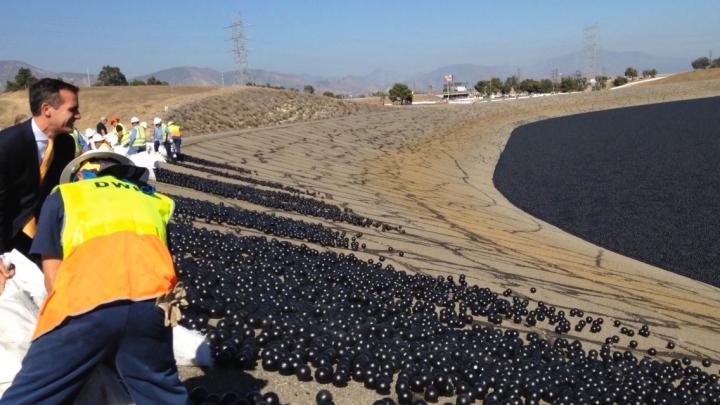
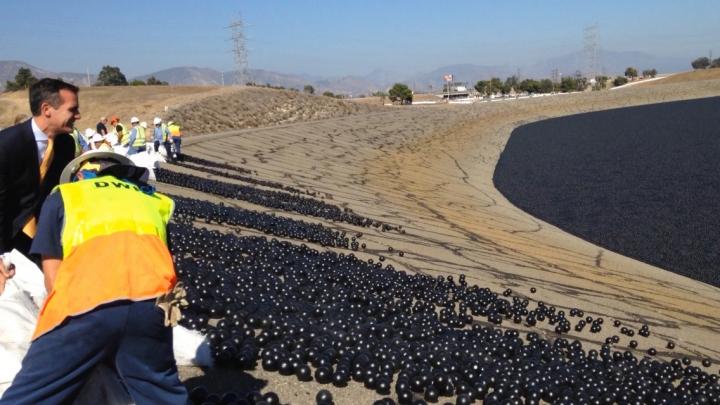
IMAGE

Credit: Eric Garcetti

Preventing reservoir evaporation during droughts with floating balls may not help conserve water overall, due to the water needed to make the balls.

During droughts, communities may rely on water stored in reservoirs. However, significant amounts of water can evaporate from the surface of the reservoir.

Amid California's latest drought, which lasted from 2011-2017, 96 million 'shade balls' were deployed on the Los Angeles reservoir. These floating, black plastic balls cover the water surface to prevent evaporation.

However, a new study published today in Nature Sustainability shows that producing the balls probably used more water elsewhere than was saved during their deployment – which could have knock-on environmental impacts.

The balls were deployed on the reservoir for one and half years during the latter part of the drought. For each drop of water saved by the balls, however, the study estimates that more than one drop would have been used up in another part of the country or the world.

Co-author Dr Kaveh Madani, from the Centre for Environmental Policy at Imperial College London, said: "We are very good at quick technological fixes, but we often overlook the long-term and secondary impacts of our solutions. This is how the engineering community has been solving problems; solving one problem somewhere and creating a new problem elsewhere."

The shade balls are made of a kind of plastic that requires oil, natural gas and electricity to produce, all of which require large quantities of water. Producing 96 million balls of standard 5mm thickness would use up to an estimated 2.9 million cubic metres of water. During their time on the reservoir, the balls are estimated to have saved 1.7 million cubic metres of water.

The study team from Imperial, M.I.T. and the University of Twente predict the balls would have to be deployed for two and half years before the water they saved matched the water they used.

However, this is only if they were preventing evaporation at the same rate even outside the dry period; when not in drought conditions, the balls are expected to be less efficient at preventing evaporation, meaning they would have to be deployed for longer to save as much water as they used.

This is alongside other potentially negative effects on the water, such as affecting life in the reservoir or promoting bacterial growth. In addition, the balls' production could have negative effects on the environment associated with water pollution or carbon emissions.

As more extreme temperatures and more frequent droughts are predicted to occur due to climate change, water management will become an important topic in the coming decades. Dr Madani said: "We are not suggesting that shade balls are bad and must not be used. We are just highlighting the fact that the environmental cost of shade balls must be considered together with their benefits."

###

Media Contact

Hayley Dunning
[email protected]
020-759-42412
@imperialspark

http://www3.imperial.ac.uk/college/news

Original Source

https://www.imperial.ac.uk/news/187247/using-shade-balls-reservoirs-more-water/ http://dx.doi.org/10.1038/s41893-018-0092-2


Share15Tweet8Share2ShareShareShare2

Related Posts

Florida Cane Toad: Complex Spread and Selective Evolution

Florida Cane Toad: Complex Spread and Selective Evolution

February 7, 2026
New Study Uncovers Mechanism Behind Burn Pit Particulate Matter–Induced Lung Inflammation

New Study Uncovers Mechanism Behind Burn Pit Particulate Matter–Induced Lung Inflammation

February 6, 2026

DeepBlastoid: Advancing Automated and Efficient Evaluation of Human Blastoids with Deep Learning

February 6, 2026

Navigating the Gut: The Role of Formic Acid in the Microbiome

February 6, 2026
Please login to join discussion

POPULAR NEWS

  • Robotic Ureteral Reconstruction: A Novel Approach

    Robotic Ureteral Reconstruction: A Novel Approach

    82 shares
    Share 33 Tweet 21
  • Digital Privacy: Health Data Control in Incarceration

    63 shares
    Share 25 Tweet 16
  • Study Reveals Lipid Accumulation in ME/CFS Cells

    57 shares
    Share 23 Tweet 14
  • Breakthrough in RNA Research Accelerates Medical Innovations Timeline

    53 shares
    Share 21 Tweet 13

About

We bring you the latest biotechnology news from best research centers and universities around the world. Check our website.

Follow us

Recent News

Barriers and Boosters of Seniors’ Physical Activity in Karachi

Evaluating Pediatric Emergency Care Quality in Ethiopia

TPMT Expression Predictions Linked to Azathioprine Side Effects

Subscribe to Blog via Email

Enter your email address to subscribe to this blog and receive notifications of new posts by email.

Join 73 other subscribers
  • Contact Us

Bioengineer.org © Copyright 2023 All Rights Reserved.

Welcome Back!

Login to your account below

Forgotten Password?

Retrieve your password

Please enter your username or email address to reset your password.

Log In
No Result
View All Result
  • Homepages
    • Home Page 1
    • Home Page 2
  • News
  • National
  • Business
  • Health
  • Lifestyle
  • Science

Bioengineer.org © Copyright 2023 All Rights Reserved.
