• HOME
  • NEWS
  • EXPLORE
    • CAREER
      • Companies
      • Jobs
    • EVENTS
    • iGEM
      • News
      • Team
    • PHOTOS
    • VIDEO
    • WIKI
  • BLOG
  • COMMUNITY
    • FACEBOOK
    • INSTAGRAM
    • TWITTER
Saturday, February 7, 2026
BIOENGINEER.ORG
No Result
View All Result
  • Login
  • HOME
  • NEWS
  • EXPLORE
    • CAREER
      • Companies
      • Jobs
        • Lecturer
        • PhD Studentship
        • Postdoc
        • Research Assistant
    • EVENTS
    • iGEM
      • News
      • Team
    • PHOTOS
    • VIDEO
    • WIKI
  • BLOG
  • COMMUNITY
    • FACEBOOK
    • INSTAGRAM
    • TWITTER
  • HOME
  • NEWS
  • EXPLORE
    • CAREER
      • Companies
      • Jobs
        • Lecturer
        • PhD Studentship
        • Postdoc
        • Research Assistant
    • EVENTS
    • iGEM
      • News
      • Team
    • PHOTOS
    • VIDEO
    • WIKI
  • BLOG
  • COMMUNITY
    • FACEBOOK
    • INSTAGRAM
    • TWITTER
No Result
View All Result
Bioengineer.org
No Result
View All Result
Home NEWS Science News Biology

Tree shrew tolerance for spicy foods unlocked by researchers

Bioengineer by Bioengineer
July 13, 2018
in Biology
Reading Time: 2 mins read
0
Share on FacebookShare on TwitterShare on LinkedinShare on RedditShare on Telegram
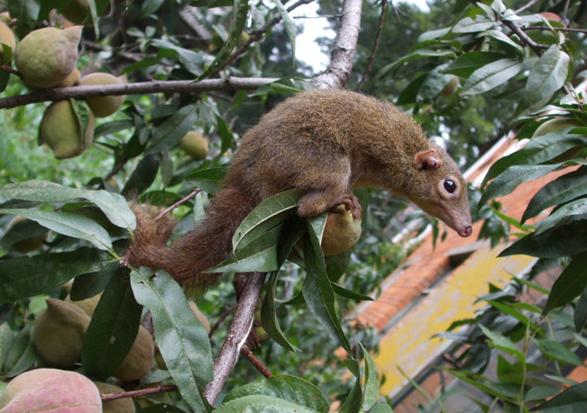
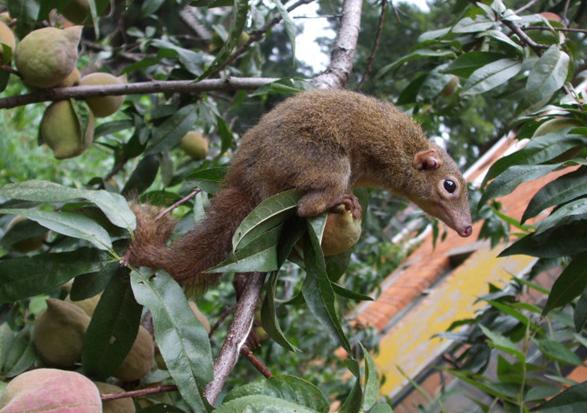
IMAGE

Credit: MA Xiaofeng

Spicy foods elicit a pungent or hot and painful sensation that repels most mammals. However, the tree shrew (Tupaia belangeri chinensis), a species closely related to primates, seems to violate this rule of thumb.

Researchers accidentally observed tree shrews directly and actively consuming chili peppers, despite the deep geographic isolation between the animal and the food.

To understand this tolerance for spicy food, a research group led by Prof. LAI Ren from the Kunming Institute of Zoology of the Chinese Academy of Sciences along with researchers from Zhejiang University performed genomic and functional analyses on the tree shrew and its TRPV1.

The research revealed that a single point mutation in the tree shrew's transient receptor potential vanilloid type-1 (TRPV1, a polymodal nociceptor) ion channel (tsV1) lowers its sensitivity to capsaicinoids, thus enabling tree shrews' unique feeding behavior regarding pungent plants.

The experimental evidence suggests that strong selection for this residue in tsV1 might be driven by Piper boehmeriaefolium, a spicy plant that geographically overlaps with the tree shrew and produces Cap2, a capsaicin analog, in abundance.

Therefore, researchers think that feeding adaptation to P. boehmeriaefolium is the most likely explanation for the fixation of this mutation by positive selection, thus allowing the tree shrew's diet to expand.

This study broadens understanding of the evolutionary and molecular mechanisms of pungency tolerance behavior.

###

This work was supported by funding from the National Science Foundation of China, the Chinese Academy of Sciences and Yunnan Province.

Media Contact

HE Linxi
[email protected]

http://english.cas.cn/

Share14Tweet8Share2ShareShareShare2

Related Posts

Florida Cane Toad: Complex Spread and Selective Evolution

Florida Cane Toad: Complex Spread and Selective Evolution

February 7, 2026
New Study Uncovers Mechanism Behind Burn Pit Particulate Matter–Induced Lung Inflammation

New Study Uncovers Mechanism Behind Burn Pit Particulate Matter–Induced Lung Inflammation

February 6, 2026

DeepBlastoid: Advancing Automated and Efficient Evaluation of Human Blastoids with Deep Learning

February 6, 2026

Navigating the Gut: The Role of Formic Acid in the Microbiome

February 6, 2026
Please login to join discussion

POPULAR NEWS

  • Robotic Ureteral Reconstruction: A Novel Approach

    Robotic Ureteral Reconstruction: A Novel Approach

    82 shares
    Share 33 Tweet 21
  • Digital Privacy: Health Data Control in Incarceration

    63 shares
    Share 25 Tweet 16
  • Study Reveals Lipid Accumulation in ME/CFS Cells

    57 shares
    Share 23 Tweet 14
  • Breakthrough in RNA Research Accelerates Medical Innovations Timeline

    53 shares
    Share 21 Tweet 13

About

We bring you the latest biotechnology news from best research centers and universities around the world. Check our website.

Follow us

Recent News

Personalized Guide to Understanding and Reducing Chemicals

Inflammasome Protein ASC Drives Pancreatic Cancer Metabolism

Phage-Antibiotic Combo Beats Resistant Peritoneal Infection

Subscribe to Blog via Email

Enter your email address to subscribe to this blog and receive notifications of new posts by email.

Join 73 other subscribers
  • Contact Us

Bioengineer.org © Copyright 2023 All Rights Reserved.

Welcome Back!

Login to your account below

Forgotten Password?

Retrieve your password

Please enter your username or email address to reset your password.

Log In
No Result
View All Result
  • Homepages
    • Home Page 1
    • Home Page 2
  • News
  • National
  • Business
  • Health
  • Lifestyle
  • Science

Bioengineer.org © Copyright 2023 All Rights Reserved.