• HOME
  • NEWS
  • EXPLORE
    • CAREER
      • Companies
      • Jobs
    • EVENTS
    • iGEM
      • News
      • Team
    • PHOTOS
    • VIDEO
    • WIKI
  • BLOG
  • COMMUNITY
    • FACEBOOK
    • INSTAGRAM
    • TWITTER
Saturday, February 7, 2026
BIOENGINEER.ORG
No Result
View All Result
  • Login
  • HOME
  • NEWS
  • EXPLORE
    • CAREER
      • Companies
      • Jobs
        • Lecturer
        • PhD Studentship
        • Postdoc
        • Research Assistant
    • EVENTS
    • iGEM
      • News
      • Team
    • PHOTOS
    • VIDEO
    • WIKI
  • BLOG
  • COMMUNITY
    • FACEBOOK
    • INSTAGRAM
    • TWITTER
  • HOME
  • NEWS
  • EXPLORE
    • CAREER
      • Companies
      • Jobs
        • Lecturer
        • PhD Studentship
        • Postdoc
        • Research Assistant
    • EVENTS
    • iGEM
      • News
      • Team
    • PHOTOS
    • VIDEO
    • WIKI
  • BLOG
  • COMMUNITY
    • FACEBOOK
    • INSTAGRAM
    • TWITTER
No Result
View All Result
Bioengineer.org
No Result
View All Result
Home NEWS Science News Biology

New technologies for producing medical therapeutic proteins

Bioengineer by Bioengineer
July 12, 2018
in Biology
Reading Time: 2 mins read
0
Share on FacebookShare on TwitterShare on LinkedinShare on RedditShare on Telegram
IMAGE

Credit: Lobachevsky University

Bacterial systems are some of the simplest and most effective platforms for the expression of recombinant proteins. They are more cost-effective compared to other methods, therefore they are of great interest not only for Lobachevsky University researchers, but also for manufacturers of therapeutically important drugs. However, in addition to the target recombinant proteins, cells also produce a large number of endogenous proteins, including SlyD. It is a small protein consisting of 3 domains. Its C-terminal region is rich in histidine residues, therefore SlyD exhibits a high affinity for the 2-valent ions and is purified together with the target proteins in the course of metal-affinity chromatography. This results in the need for additional purification steps and, as a consequence, increases the cost of the technological process for obtaining therapeutic recombinant proteins.

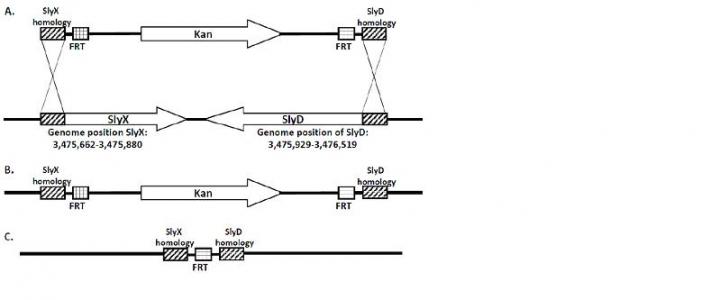
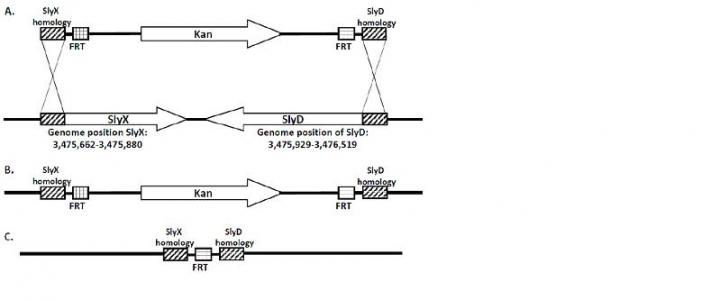
A team of Lobachevsky University researchers under Professor Viktor Novikov, Director of the UNN Center for Molecular Biology and Biomedicine, has obtained a series of E. coli strains deficient in the SlyD/SlyX genes. The strains were engineered using λ-red mediated chromosomal deletion. The schematic showing the procedure for eliminating SlyD/SlyX genes is given in Figure 1.

"The sequence of SlyD/SlyX in the E. coli genome was replaced by a gene responsible for resistance to the antibiotic kanamycin that was flanked on both sides by FRT sites, from where it was later removed by FLP recombinase," Viktor Novikov notes.

Using the example of recombinant bispecific protein MYSTI-2 consisting of two different modules, which are active centers of antibodies against mouse proteins F4/80 and TNF, the scientists compared the activity of proteins isolated from the original and mutant strains. As a result of the study, it was determined that the removal from the E. coli genome of the SlyD and SlyX genes, which presumably encode chaperones that support the spatial structure of Escherichia coli proteins, does not result in a disruption of recombinant proteins' functional activity.

By obtaining original E. coli strains, the researchers were able to solve the problem of contamination of recombinant proteins and to ensure their successful single-stage purification by metal-affinity chromatography.

"The obtained set of slyD/slyX-deficient strains of E. coli can be used to produce in a pure form a wide range of prokaryotic and eukaryotic proteins, including medical therapeutic proteins. This makes the development and production of new medicinal and preventive biological preparations easier, simpler and cheaper," concludes Viktor Novikov.

###

Media Contact

Nikita Avralev
[email protected]

http://www.unn.ru/eng/

Related Journal Article

http://dx.doi.org/10.1016/j.bbrc.2018.04.029

Share12Tweet8Share2ShareShareShare2

Related Posts

Florida Cane Toad: Complex Spread and Selective Evolution

Florida Cane Toad: Complex Spread and Selective Evolution

February 7, 2026
New Study Uncovers Mechanism Behind Burn Pit Particulate Matter–Induced Lung Inflammation

New Study Uncovers Mechanism Behind Burn Pit Particulate Matter–Induced Lung Inflammation

February 6, 2026

DeepBlastoid: Advancing Automated and Efficient Evaluation of Human Blastoids with Deep Learning

February 6, 2026

Navigating the Gut: The Role of Formic Acid in the Microbiome

February 6, 2026
Please login to join discussion

POPULAR NEWS

  • Robotic Ureteral Reconstruction: A Novel Approach

    Robotic Ureteral Reconstruction: A Novel Approach

    82 shares
    Share 33 Tweet 21
  • Digital Privacy: Health Data Control in Incarceration

    63 shares
    Share 25 Tweet 16
  • Study Reveals Lipid Accumulation in ME/CFS Cells

    57 shares
    Share 23 Tweet 14
  • Breakthrough in RNA Research Accelerates Medical Innovations Timeline

    53 shares
    Share 21 Tweet 13

About

We bring you the latest biotechnology news from best research centers and universities around the world. Check our website.

Follow us

Recent News

Phage-Antibiotic Combo Beats Resistant Peritoneal Infection

Boosting Remote Healthcare: Stepped-Wedge Trial Insights

Barriers and Boosters of Seniors’ Physical Activity in Karachi

Subscribe to Blog via Email

Enter your email address to subscribe to this blog and receive notifications of new posts by email.

Join 73 other subscribers
  • Contact Us

Bioengineer.org © Copyright 2023 All Rights Reserved.

Welcome Back!

Login to your account below

Forgotten Password?

Retrieve your password

Please enter your username or email address to reset your password.

Log In
No Result
View All Result
  • Homepages
    • Home Page 1
    • Home Page 2
  • News
  • National
  • Business
  • Health
  • Lifestyle
  • Science

Bioengineer.org © Copyright 2023 All Rights Reserved.