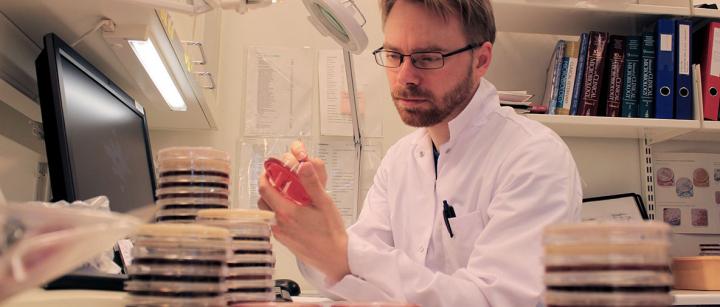
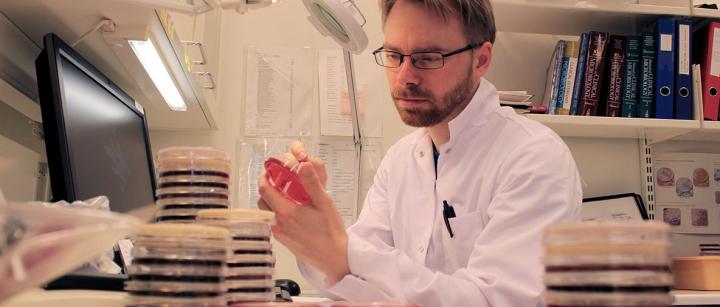
Credit: Thomas Grönthal
In 2015, a New Delhi-metallo-beta-lactamase (NDM) Escherichia coli bacteria was discovered in two Finnish dogs. An article recently published in the journal Eurosurveillance reveals that the dogs' owner did also carry the bacterium. This is presumably the first time in the world that the transmission of NDM-bacteria between a dog and a human has been reported.
"We were able, through the analysis of the genome of the bacteria, to conclude that the bacterial isolates from the dogs and humans were identical, which means that they were transmitted between dogs and humans," says DVM (PhD) Thomas Grönthal, the corresponding author of the study, at the Faculty of veterinary medicine, University of Helsinki.
The bacteria had been transmitted between dogs and humans
The NDM-bacteria that had originally been isolated from ear specimens from two dogs in the same family initiated an investigation about the spread and origin of the bacteria. Specimens were also taken from family members and the dogs. The relatedness of the bacteria were investigated by examining the nucleotide sequence of their genome. The study was a collaboration between the University of Helsinki, the National Institute of Health and Welfare, and the Finnish Food Safety Authority Evira.
An extremely resistant NDM-5 producing bacterial strain was isolated from the family dogs and one of the family members. In addition, both dogs and two family members carried a multidrug-resistant ESBL bacterium. The NDM and ESBL bacterial strains that were isolated from the dogs and humans were identical. The humans were asymptomatic. The origin of the NDM bacteria was not discovered in this study.
The use of antibiotics propagates the selection of resistant strains
"We could not show with certainty in which direction the bacteria had transmitted. However, especially the NDM-bacteria probably moved from human to dog as these bacteria have not previously been identified in animals in Finland," assesses docent and leader of the research Merja Rantala from the University of Helsinki.
"The use of carbapenem antibiotics in animals is prohibited in Finland, but the dogs had received numerous other antibiotics. This gave the NDM-bacteria a competitive edge and enabled them to persist in the dogs," says Rantala.
Are carbapenemase-producing bacteria becoming more common in animals?
This study is presumably the first where the transfer of NDM-bacteria between dogs and humans has been demonstrated. The NDM-5 bacterium is very rare in dogs; it has only been isolated in Algeria previously. Other carbapenem-resistant bacteria have been reported in dogs in the United States, France and Germany. They are, however, being reported in animals at an increasing pace. The research group recommends that laboratories investigating animal specimens should monitor the susceptibility of bacteria to carbapenems and extended spectrum cephalosporins.
###
Media Contact
Merja Rantala
[email protected]
358-504-155-482
@helsinkiuni
http://www.helsinki.fi/university/
Original Source
https://www.helsinki.fi/en/news/life-science/the-transmission-of-ndm-bacteria-between-dogs-and-humans-has-been-established-for-the-first-time http://dx.doi.org/10.2807/1560-7917.ES.2018.23.27.1700497