Credit: Tufts University
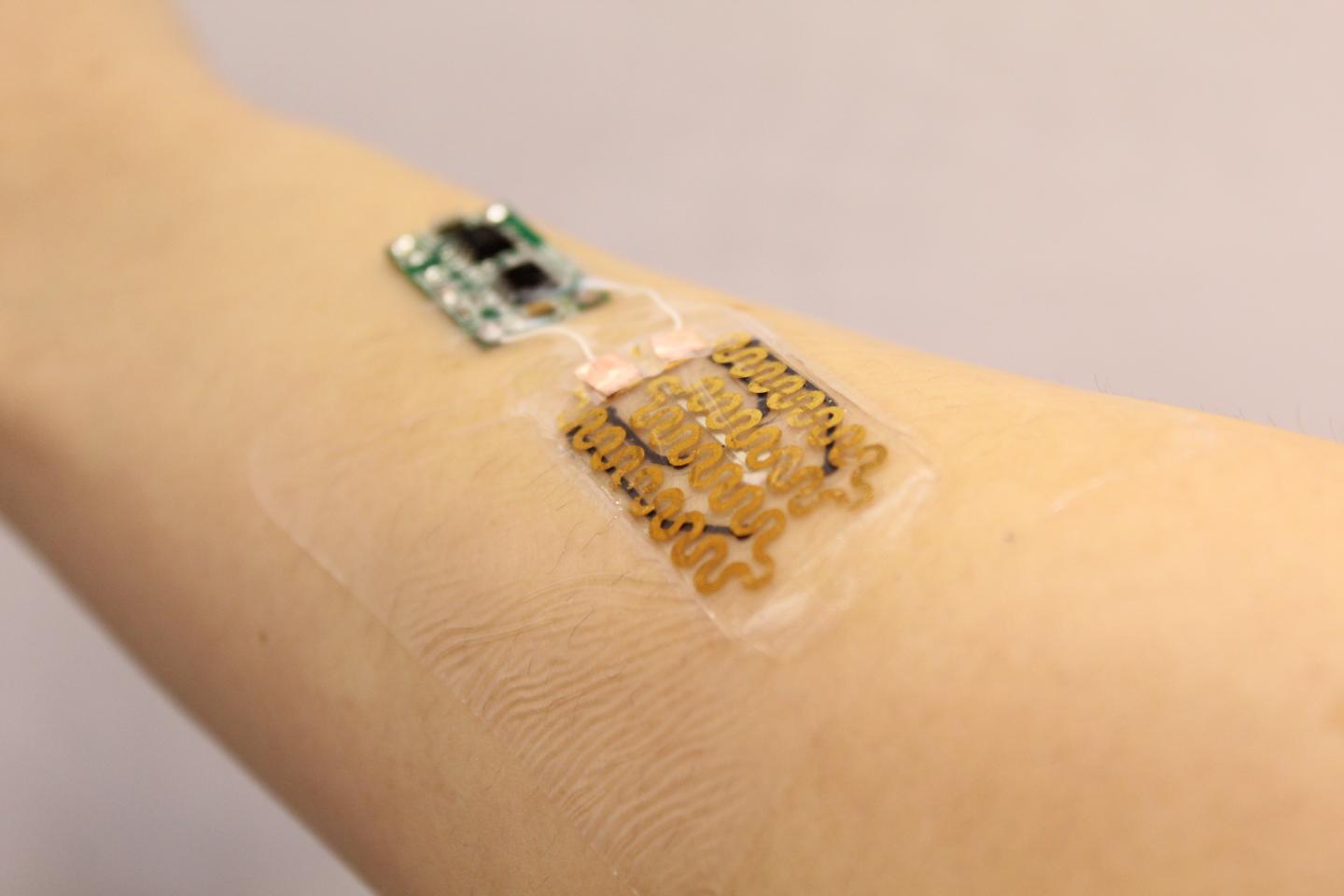
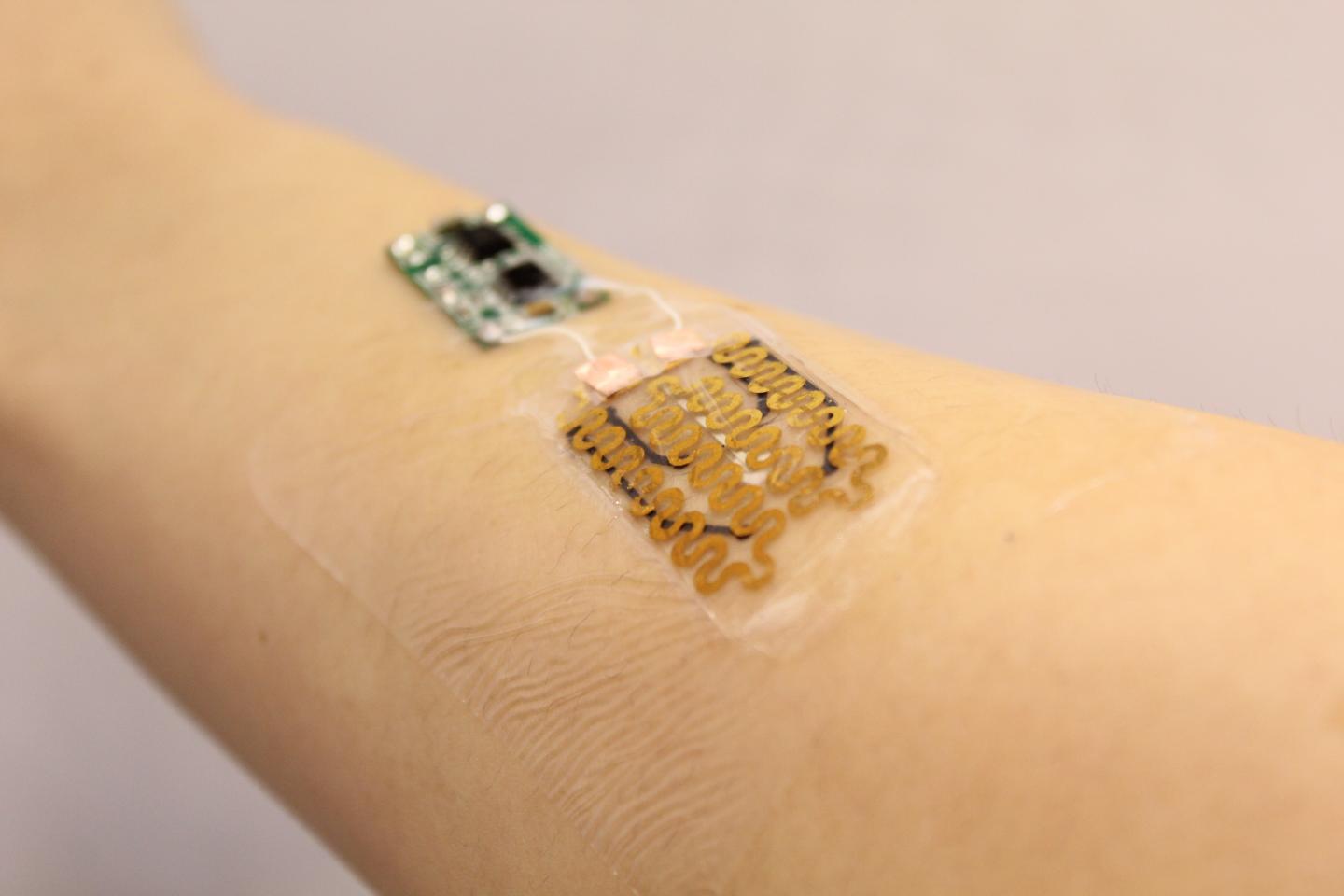
MEDFORD/SOMERVILLE, Mass. (July 6, 2018)–A team of engineers led by Tufts University has developed a prototype bandage designed to actively monitor the condition of chronic wounds and deliver appropriate drug treatments to improve the chances of healing. While the lab-tested bandages remain to be assessed in a clinical context, the research, published today in the journal Small, is aimed at transforming bandaging from a traditionally passive treatment into a more active paradigm to address a persistent and difficult medical challenge.
Chronic skin wounds from burns, diabetes, and other medical conditions can overwhelm the regenerative capabilities of the skin and often lead to persistent infections and amputations. With the idea of providing an assist to the natural healing process, the researchers designed the bandages with heating elements and thermoresponsive drug carriers that can deliver tailored treatments in response to embedded pH and temperature sensors that track infection and inflammation.
Non-healing chronic wounds are a significant medical problem – nearly 15 percent of Medicare beneficiaries require treatment for at least one type of chronic wound or infection at an annual cost of an estimated $28 billion, according to research published in Value in Health. Patients are often older, non-ambulatory, and limited in their ability to provide self-care, yet non-healing wounds are typically treated in an outpatient setting or at home. The smart bandages could provide real time monitoring and delivery of treatment with limited intervention from the patient or caregivers.
"We've been able to take a new approach to bandages because of the emergence of flexible electronics," said Sameer Sonkusale, Ph.D. professor of electrical and computer engineering at Tufts University's School of Engineering and corresponding co-author for the study. "In fact, flexible electronics have made many wearable medical devices possible, but bandages have changed little since the beginnings of medicine. We are simply applying modern technology to an ancient art in the hopes of improving outcomes for an intractable problem."
The pH of a chronic wound is one of the key parameters for monitoring its progress. Normal healing wounds fall within the range of pH 5.5 to 6.5, whereas non-healing infected wounds can have pH well above 6.5. Temperature is also an important parameter, providing information on the level of inflammation in and around the wound. While the smart bandages in this study combine pH and temperature sensors, Sonkusale and his team of engineers have also developed flexible sensors for oxygenation – another marker of healing – which can be integrated into the bandage. Inflammation could also be tracked not just by heat, but by specific biomarkers as well.
A microprocessor reads the data from the sensors and can release drug on demand from its carriers by heating the gel. The entire construct is attached to a transparent medical tape to form a flexible bandage less than 3 mm thick. Components were selected to keep the bandage low cost and disposable, except for the microprocessor, which can be re-used.
"The smart bandage we created, with pH and temperature sensors and antibiotic drug delivery, is really a prototype for a wide range of possibilities," said Sonkusale. "One can imagine embedding other sensing components, drugs, and growth factors that treat different conditions in response to different healing markers."
The smart bandages have been created and tested successfully under in vitro conditions. Pre-clinical studies are now underway to determine their in vivo clinical advantages in facilitating healing compared to traditional bandages and wound care products.
###
This work was supported by the National Science Foundation (EFRI-1240443), the Office of Naval Research Young Investigator award, ONR PECASE Award, and the National Institutes of Health (AR066193, AR066193, EB022403, AR057837, HL137193, EB021857, T32 EB16652 and EB024403).
Mostafalu, P., Tamayol, A., Rahimi, R., Ochoa, M., Khalilpour, A., Kiaee, G., Yazdi, I.K., Bagherifard, S., Dokmeci, M.R., Ziaie, B., Sonkusale, S.R., Khademhosseini, A., "Smart bandage for monitoring and treatment of chronic wounds," Small, (2018). DOI: 10.1002/smll.201703509
About Tufts University
Tufts University, located on campuses in Boston, Medford/Somerville and Grafton, Massachusetts, and in Talloires, France, is recognized among the premier research universities in the United States. Tufts enjoys a global reputation for academic excellence and for the preparation of students as leaders in a wide range of professions. A growing number of innovative teaching and research initiatives span all Tufts campuses, and collaboration among the faculty and students in the undergraduate, graduate and professional programs across the university's schools is widely encouraged.
Media Contact
Mike Silver
[email protected]
781-627-0545
@TuftsUniversity
http://www.tufts.edu
Related Journal Article
http://dx.doi.org/10.1002/smll.201703509