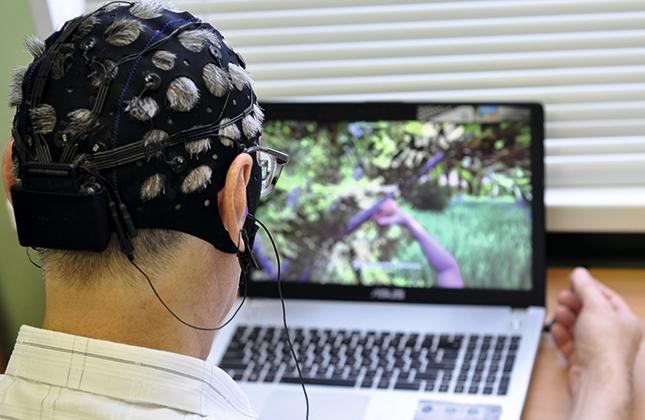
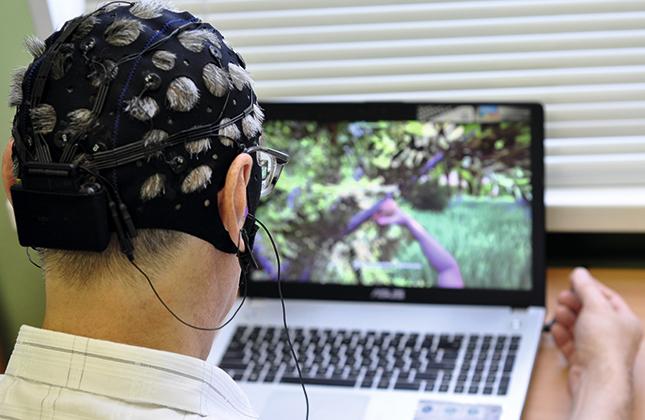
Credit: © iBrain LCC
Scientists of Peter the Great St. Petersburg Polytechnic University (SPbPU) in collaboration with neurophysiologists from Sechenov Institute of evolutionary physiology and biochemistry formed the innovative startup iBrain have developed a unique play structure for post-stroke patients rehabilitation as part of Project 5-100. The leading specialists in the sphere of artificial intelligence augmented physical exercise for restoring motor functions with playing with imagination which enables the patient to move.
Lev Stankevich, Associate Professor, Institute of Computer Science and Technology, Peter the Great St. Petersburg Polytechnic University, who is one of the developers of the play structure, explained that the stroke usually affects the part of the brain which is 'responsible' for motor functions of either left-hand or right-hand (but only one) side of a post-stroke patient's body. However, he says that human brain is very flexible and is capable of recovery bypassing the affected areas. When a person uses the play structure, after a while, other brain regions start to perform functions of the damaged ones, claims the professor.
Prior to starting the exercises, a neurologist and a neurophysiologist conduct standard research revealing the peculiarities of the patient's brain activity. After that the data about the brain activity is gathered: first, the patient must imagine how he/she moves his/her hand, clenches hands, and then tries to make these movements. At this moment scientists record the surface activity of the brain using an electroencephalograph. According to them, the program is being improved on the basis of the data obtained using machine learning methods.
The equipment is compact: after a while, a laptop can be replaced by a tablet or a smartphone. A wireless EEG amplifier is used as part of the play structure. Exercises can be done at home. Rehabilitation takes about 2 months.
Another developer of the play structure, a PhD student of the Institute of Metallurgy, Mechanical Engineering and Transport SPbPU Philipp Gundelakh assumes that gamification is its main advantage. 'We use a specialized game application, when the main character walks in the garden and picks fruits: the more correct 'imaginations' of actual movements a patient produces, the more fruit the character can pick, and the more effective the motional rehabilitation will be,' he said, emphasizing that the patient is 'lured' into the game, and he/she can see the real impact of his/her thoughts.
Currently, another game is being developed, where the character will shoot at targets with mental commands. It is planned to increase the number of games, and users will be able to choose interesting ones. Playing the game with the power of brain signals is truly a special experience.
Clinical trials of the device will start in July in the City Hospital No. 40 of Saint Petersburg. After the trials, rehabilitation centers will be able to acquire this play structure to independently provide rehabilitation for patients on their premises.
Starting from 2013, Russia has been implementing Project 5-100, – a state support program for Russian universities. Its goal is to raise the standing of Russian higher education and have at least five member universities in the top-100 of three respected world rankings. Project 5-100 is enabling 21 Russian universities to move forward in terms of effectively strengthening their education and research, promoting innovations and R&D, facilitating international cooperation, streamlining administration, balancing the authority of the management and academics, nurturing a
As part of Project 5-100, SPbPU invents, applies and distributes world-class cross-disciplinary polytechnic knowledge, supra-sectoral knowledge-intensive and advanced manufacturing technologies. The University actively develops conceptual solutions for organizing business processes for the entire product life cycle using state-of-the-art technology in all industries that dramatically increase the efficiency of design, preparation of production facilities and manufacture of customized products.
iBrain LLC is a new Russian company focusing on the development of new solutions for treating movement disorders. The company's main objective is to develop a novel neurointerface with AI for rehabilitation, monitoring and training which will considerably speed up the process of restoring motor functions, and it will be possible to use the complex at home. The company's employees are multi-skilled: neurophysiologists, doctors, specialists in artificial intelligence and software developers. The company's expertise allows creating a unique innovative technology that considerably improves people's quality of life.
###
Media Contact
Raisa Bestugina
[email protected]
7-812-591-6675
@pgpuspb
http://english.spbstu.ru/