Credit: Theresa Schredelseker
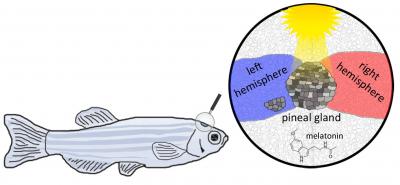
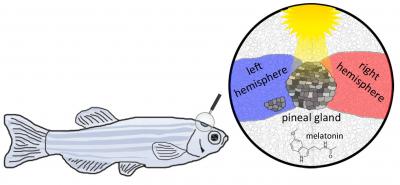
When zebrafish lack a specific protein, the two hemispheres of the brain develop symmetrically, and the sleep hormone melatonin is not produced. These results were recently published by Freiburg biologists Theresa Schredelseker and Prof. Dr. Wolfgang Driever in the journal Development. Their research on the pineal gland have revealed a genetic connection between left-right asymmetry and day-night cycles.
The pineal gland is a small structure that in humans is located deep within the brain but in zebrafish is found directly under the skull. Its primary function, however, is conserved in fish and humans: the nightly release of melatonin. While the human pineal gland detects daylight via the eyes, the fish pineal gland senses light directly. Using sophisticated genetic tools, the researchers generated zebrafish that can no longer produce the Brain-specific homeobox (Bsx) protein. In fish lacking this protein, photosensitive cells of the pineal gland did not develop normally and failed to produce melatonin. Earlier studies demonstrated that melatonin deficiency in zebrafish disrupts sleep-wake cycles. Thus, the fish showed symptoms similar to what people experience as a result of working night shifts or of excessive night-time smart phone usage.
The lack of Bsx has other intriguing consequences in the brain. On the second day of embryonic development, a small group of cells normally migrates away from the pineal gland and almost always to the left part of the brain. These cells cause the surrounding tissue to develop the characteristics of the left half of the brain. When Bsx is lacking, these cells do not form and the brain develops two 'right' halves. Although this study focuses on embryonic development, it also opens up new opportunities for behavioural studies. Recently, for instance, an American research groups found that fish with symmetric brains display behavioural abnormalities that have been interpreted heightened anxiety.
In the last decades, the four-centimetre-long zebrafish has become one of the most popular model organisms for genetic studies. It multiplies and develops rapidly: females lay up to 300 eggs per week, each of which can reach maturity in 12 to 16 weeks. The transparency of the embryos means that cells in the developing embryo can be directly observed even until the early larval stages. As a vertebrate, it possesses many genes that have the same or a similar function in humans.
The research group of Wolfgang Driever investigates signalling processes during zebrafish development within the framework of the Cluster of Excellence BIOSS – Centre for Biological Signalling Studies. The new Bsx-deficient zebrafish line could serve as a model system for future research on defects in pineal gland development and resulting behavioural abnormalities.
###
Original publication:
Theresa Schredelseker, Wolfgang Driever (2018): Bsx controls pineal complex development. In: Development.
http://dev.biologists.org/lookup/doi/10.1242/dev.163477
Contact:
Theresa Schredelseker und Wolfgang Driever
Institute of Biology I (Zoology)
Albert Ludwigs University Freiburg
Tel.: 0761/203-2581
[email protected] or [email protected]
Media Contact
Theresa Schredelseker
[email protected]
49-761-203-2581
Original Source
https://www.pr.uni-freiburg.de/pm-en/press-releases-2018/shining-new-light-on-the-pineal-gland?set_language=en http://dx.doi.org/10.1242/dev.163477