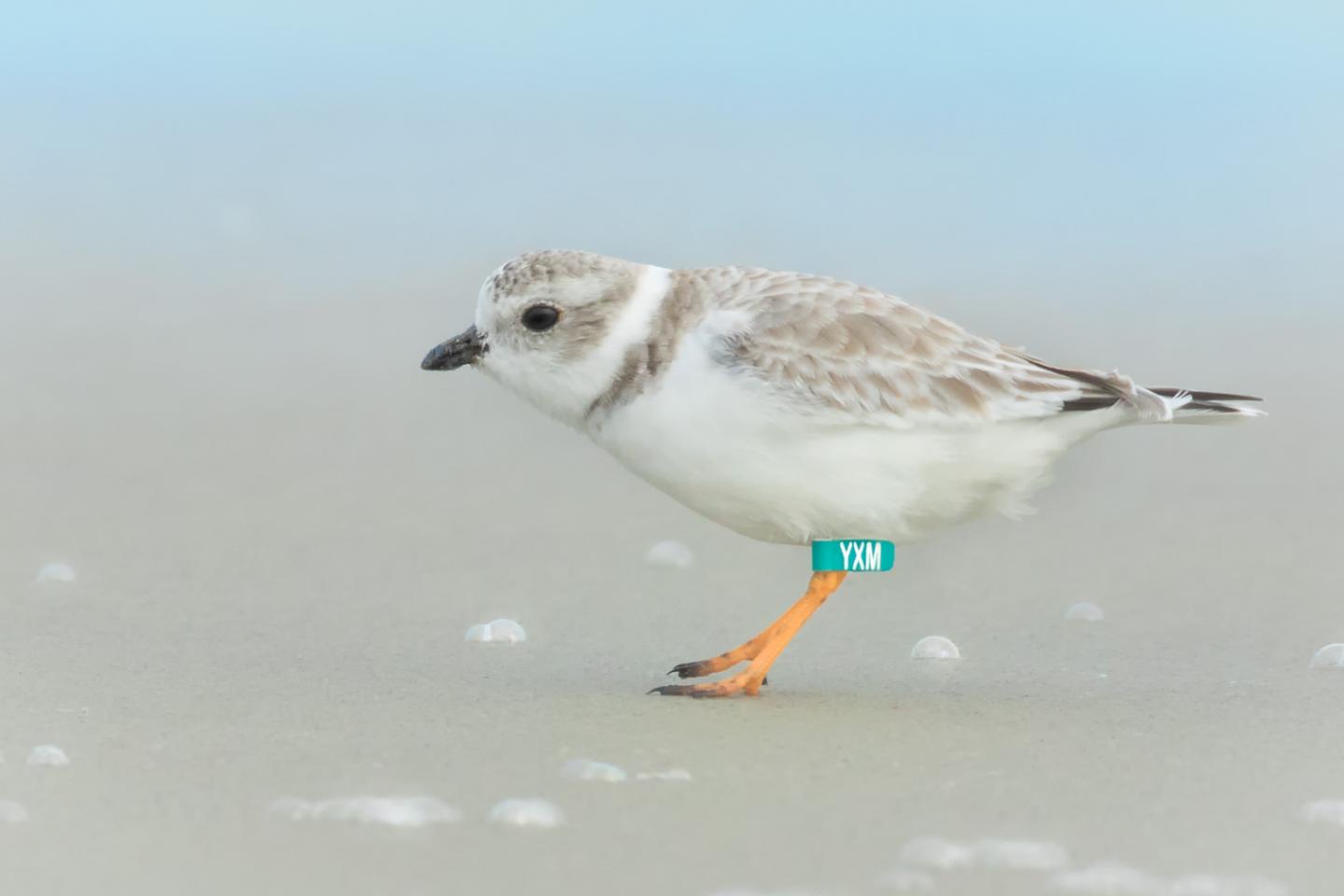
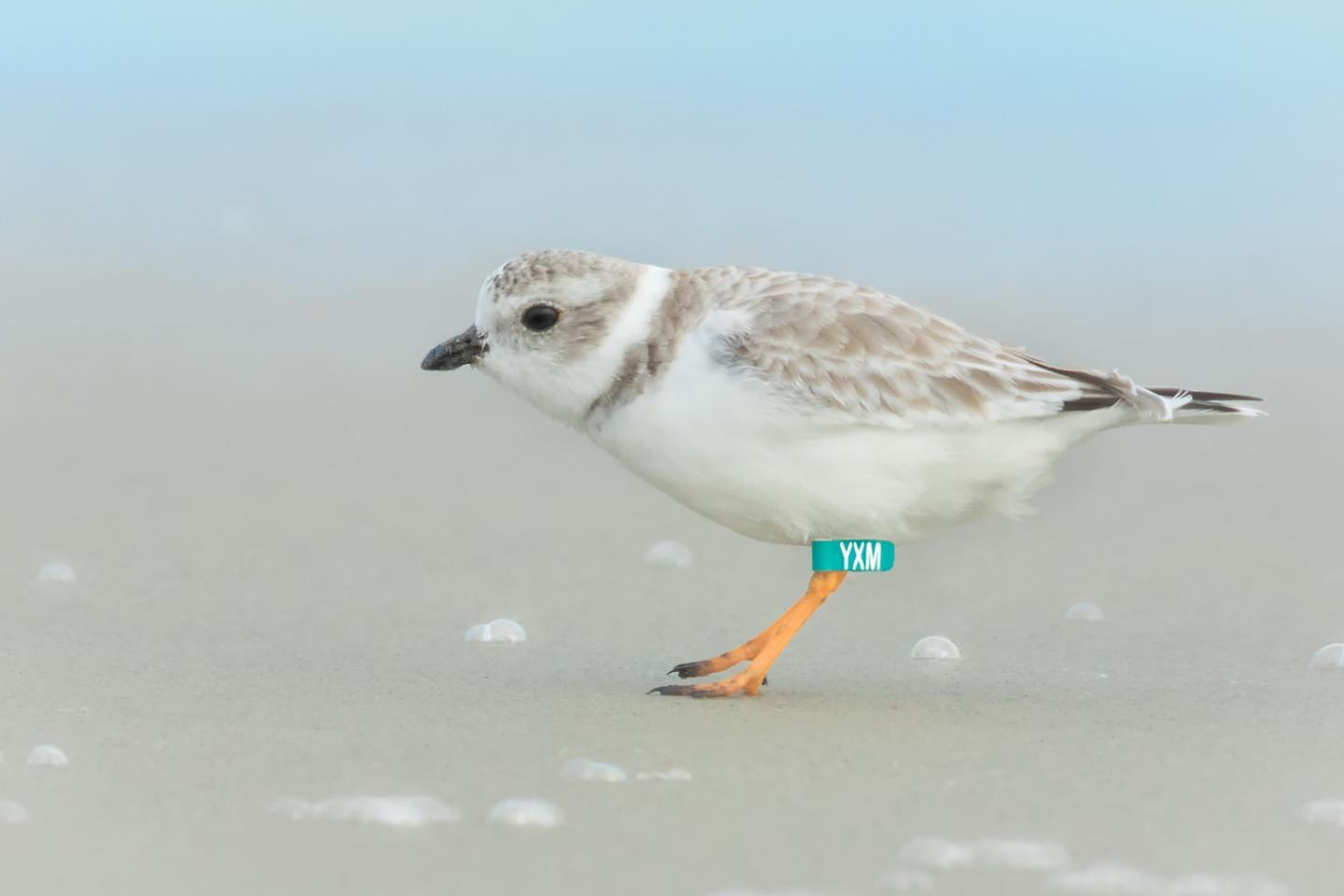
Credit: Daniel Gibson
A new study in The Condor: Ornithological Applications presents negative associations between anthropogenic disturbance (human recreational use of beaches, coastal modifications) and Piping Plovers on their non-breeding grounds. Shorebirds are one of the most threatened bird families in the world. Numerous studies have shown the negative impacts of humans on these birds, whether it be large-scale (e.g., habitat loss, climate change) or small-scale (e.g., ATV use, running with pets, flying kites). This research indicates that there are direct consequences of disturbance. Most Piping Plover research has focused on the breeding season in an attempt to directly influence population numbers, however this study argues that efforts are required throughout the year in all locations to assist Piping Plover conservation.
Virginia Polytechnic Institute and State University's Dan Gibson and colleagues monitored Piping Plovers year-round to determine the health and behavior of individuals. Body condition, survival, and site fidelity were of most interest. Plovers in disturbed areas proved to be significantly lighter in mass, due to the birds not procuring enough food. Given poorer body condition, it should be no surprise that birds in these disturbed areas also had lower survival rates. Piping plovers have strong site fidelity on the breeding grounds and this study supports that fidelity continues on the non-breeding grounds. While physically capable of changing location, it was not common for individuals to do so even if there was a high level of disturbance. The lack of movement by disturbed individuals suggests that aspects of the species' life history (i.e. fidelity) constrained individuals to make seemingly adaptive habitat-use decisions. Some of the strategies used on the breeding grounds (reduced human recreation, roped-off areas, no dogs on beaches) may be beneficial to also do on the non-breeding grounds to ensure year-round conservation and oversight on this threatened shorebird species.
Lead author Dan Gibson comments, "We have a lot of of opportunity to engage with the public in what exactly our research is about. We often try to stress that the impact an individual recreationist has on a shorebird is practically non-existent. However, if every person who uses a beach in a given day influences how these shorebirds feed or rest, those minute impacts can begin to add up over the course of a season that can manifest itself as reductions in individual body condition and ultimately their ability to withstand bad weather conditions or successfully migrate and find a mate. We try to stress that small changes in how we use a beach (e.g., keep dogs on leash, avoid running through groups of birds) can really add up to substantial improvements in the overall quality of coastal habitat for shorebirds."
"This study availed itself of a unique resource that range-wide banding efforts have provided for the study of the demographics of the endangered piping plover," adds College of Environmental Science and Forestry Associate Professor Jonathan Cohen, a shorebird expert who was not involved with the research, "and successfully attempted the difficult task of teasing out the sometimes subtle effect of disturbance in nonbreeding areas on annual vital rates. The finding that this endangered species may not readily abandon habitat that is detrimental for fitness was surprising, and warrants immediate attention from the conservation community."
###
Impacts of anthropogenic disturbance on a non-breeding shorebird's body condition, survival, and site fidelity will be available June 27, 2018 at http://www.bioone.org/doi/full/10.1650/CONDOR-17-148.1. Research contact: Dan Gibson, [email protected]
About the journal: The Condor: Ornithological Applications is a peer-reviewed, international journal of ornithology published by the American Ornithological Society. The journal began in 1899, and in 2016 The Condor had the number one impact factor among 24 ornithology journals.
Media Contact
Dan Gibson
[email protected]
http://americanornithologypubs.org/