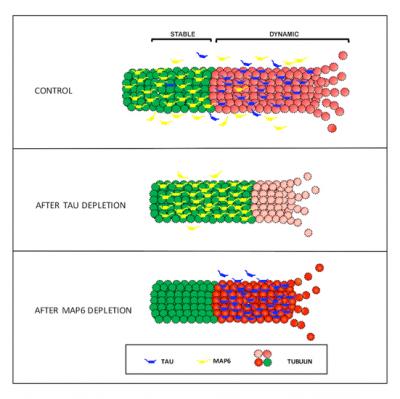
Credit: Drexel University
A new study by researchers from Drexel University College of Medicine reverses the popular scientific dogma that the protein tau stabilizes microtubules within brain cells. The scientists' new research, published this week in Current Biology, suggests just the opposite: Tau's actual role in the neuron is to allow microtubules to grow and remain dynamic.
This is critical because both the stable and dynamic regions of the microtubule must be present in the brain for successful cognitive function, according to Liang Oscar Qiang, PhD, the study's lead author and a research assistant professor in the College of Medicine.
"We think the reason why the brain has so much tau is to ensure that there is always a robust dynamic component to the microtubules," Qiang said. "Otherwise, without tau, too much of the microtubule mass of the brain would be stable."
This new discovery suggests that microtubule-stabilizing drugs currently in clinical trials may not be effective in treating Alzheimer's and other tau-based neurodegenerative diseases, said Peter Baas, PhD, a professor in the Department of Neurobiology and Anatomy at Drexel College of Medicine and the study's principal investigator.
"The popular theory suggests that patients with neurodegenerative diseases are losing microtubules because they are becoming less stable. What our study suggests is that, with the depletion of tau, patients are in fact losing the dynamic regions of microtubule," said Baas. "So, by treating neurodegenerative diseases with microtubule-stabilizing drugs, the potential exists for making matters worse rather than better."
Microtubules are tubular polymers that make up the infrastructure of a cell and also act as railways to transport organelles throughout the cytoplasm. These intracellular structures have a stable region, as well as a region that remains dynamic, which are both important to their role in a cell.
Tau is one of the hallmark proteins of Alzheimer's disease. In the diseased brain, tau breaks away from microtubules and forms neurofibrillary tangles, blocking nutrient transport to neurons and eventually killing them.
Drugs that affect microtubule stability are currently under investigation as potential therapies for Alzheimer's, because it is nearly universally accepted by the scientific community – evidenced by documentation in hundreds of research papers, websites and instructional materials – that the role of tau is to stabilize microtubules in neurons of the brain, specifically in nerve fibers called axons.
Despite this widespread belief, a research group reported almost 20 years ago that tau may not be responsible for microtubule stability. Drexel researchers decided to delve deeper into the question by depleting tau from cultured rat neurons and comparing microtubule levels in their axons after four days.
They found that the volume of microtubules was reduced in the axon, not due to their destabilization, but rather because of preferential loss of the dynamic regions of the microtubules. In fact, depleting tau made the remaining microtubules more stable, instead of less. This alters our basic understanding about tau.
"We found that tau does not stabilize the neuron's microtubules. The real work of tau is to protect the dynamic regions of microtubules from being stabilized and also to allow them to lengthen," said Baas.
In other words, rather than thinking about tau as a railroad tie – needed at regular intervals to stabilize a track – the protein acts more like a bridge pier, allowing microtubules to remain constantly in motion. Otherwise, the bridge would crack.
The researchers also studied MAP6, which they call a "genuine stabilizer of microtubules," from the cultured neurons, and found that MAP6 spreads out on the microtubule when tau is depleted, which explains why the microtubules become more stable when they lose their tau.
The research team's next steps will be to repeat similar experiments in adult rodent brain. If they can replicate their results, they will seek to "restore what is lost" in the neurodegenerative brain by recovering the lost dynamic regions of the microtubules through novel therapeutic approaches.
###
Media Contact
Lauren Ingeno
[email protected]
215-895-2614
@DrexelNews
http://www.Drexel.edu/
Related Journal Article
http://dx.doi.org/10.1016/j.cub.2018.05.045