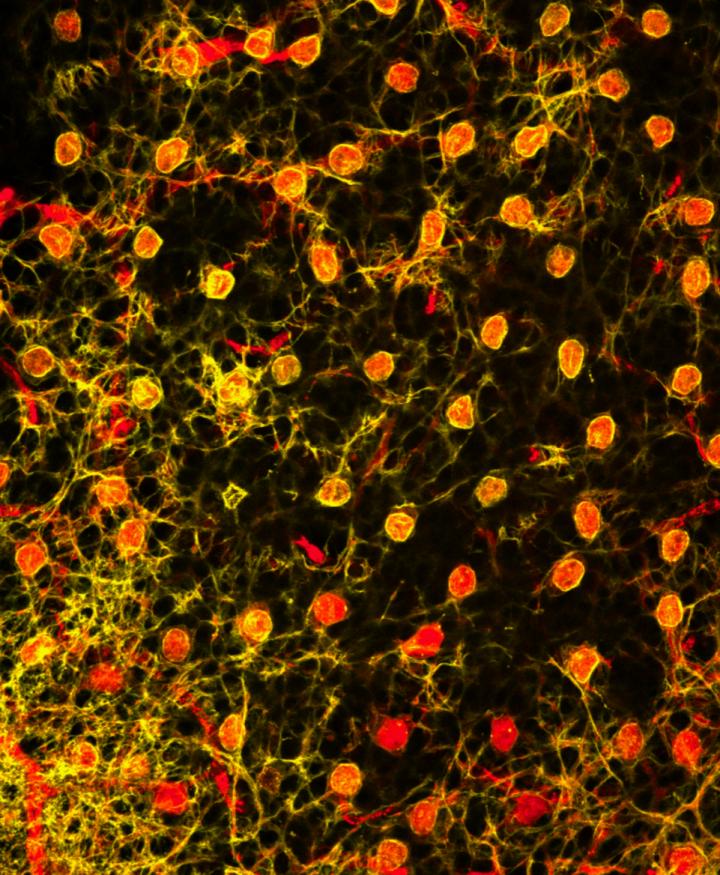
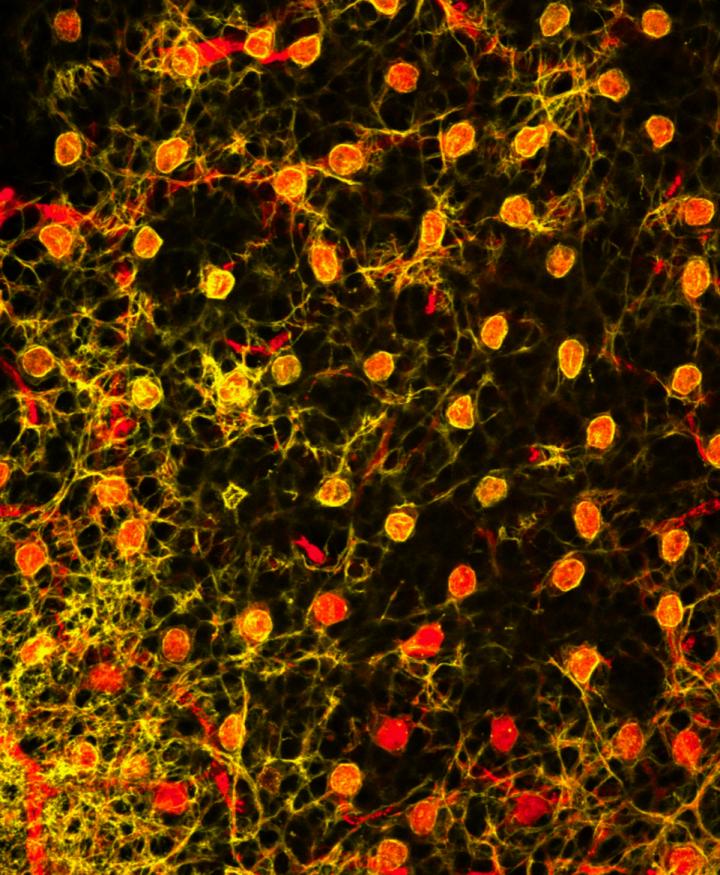
Credit: Drinnenberg et al
Our eye hosts a powerful biological computer, the retina. Understanding how the retina transforms images from the outside world into signals that the brain can interpret would not only result in insights into brain computations, but could also be useful for medicine. As machine learning and artificial intelligence develop, eye diseases will soon be described in terms of the perturbations of computations performed by the retina. Do we have enough knowledge of retinal circuits to understand how a perturbation will affect the computations the retina performs? An international team of scientists has addressed this question in a set of experiments combining genetics, viral and molecular tools, high-density microelectrode arrays, and computer models. The work shows that their newly developed model of the retina can predict with high precision the outcome of a defined perturbation. The work is an important step towards a computer model of the retina that can predict the outcome of retinal diseases.
Vision starts in the retina, where photoreceptor cells capture the light that falls on the eye and transduce it into neuronal activity. Ganglion cells, the output neurons of the retina, then send the visual signals to the brain. However, the retina is much more than just a camera and a cable: Between photoreceptors and ganglion cells, the retina contains intricate neuronal circuits, which are assembled from many different neuronal cell types. These circuits process the incoming signals in a complex way and extract important features of the visual scene. At the output level of the retina, the computations of the retinal circuits result in ~30 different neuronal representations of the visual scene: these are then transmitted in parallel to the brain. Thus, the retina acts like a powerful computing device, shaping visual representation in a profound way.
To understand the mechanisms of vision and to predict the outcomes of visual diseases, it is essential to understand how the ~30 retinal output channels represent the visual world, and how their different functional properties arise from the architecture of the retinal circuits. To address this question, a team of scientists from the Friedrich Miescher Institute (FMI), the Institute of Molecular and Clinical Ophthalmology Basel (IOB), ETH Zurich, and the Ecole Normale Supérieure perturbed a specific retinal circuit element while studying how this perturbation changes the functional properties of the different retinal output channels.
Antonia Drinnenberg, a former graduate student from Botond Roska's group, and lead author of the paper, developed a method to control the activity of horizontal cells. Horizontal cells are a retinal circuit element that provides feedback inhibition at the first visual synapse between photoreceptors and bipolar cells. The method, which involved a specific set of viruses, transgenic mice, and engineered ligand-gated ion channels, allowed her to switch the feedback at the first visual synapse on and off. To measure the effects of this perturbation in the retinal output, she used high density microelectrode arrays developed in Andreas Hierlemann's group and recorded the electrical signals of hundreds of ganglion cells simultaneously. Surprisingly, the perturbation caused a large set of different changes in the output of the retina. "We were astonished by the variety of effects that we observed due to the perturbation of a single, well-defined circuit element," says Drinnenberg. "At first, we suspected that technical issues might underlie this variety." However, after measuring the signals in thousands of ganglion cells and in defined retinal output channels, it became clear that the variety in the horizontal cell contributions that were measured must arise from the specific architecture of the retinal circuitry.
How can a single element of the retinal circuitry lead to such a variety of effects? Felix Franke, co-first author of the paper, and Rava A. da Silveira, a senior author, built a computer model of the retina. The model simulated the different pathways that the signal can take through the retina, and enabled the team to investigate if our current understanding of the retinal circuitry could account for the effects they observed during the experiments. While studying the behavior of the model, the researchers found that the model could reproduce the entire set of changes that they had measured experimentally. In addition, the team found that the model made five further predictions about the role of horizontal cells, which they had previously not seen in the data. "We were surprised to see that the model went further than what we had in mind at the time we built it," says Franke. "All additional predictions turned out to be correct when we conducted additional experiments to test them."
"One way to test our understanding of the retina is to perturb one of its elements, measure all the outputs, and see if our 'understanding', which is a model, can predict the observed changes," explains da Silveira. "The next step is to use the model to predict the outcome of eye diseases," adds Roska.
###
Original publication
Drinnenberg A*, Franke F*, Morikawa RK, Ju?ttner J, Hillier D, Hantz P, Hierlemann A, da Silveira RA**, Roska B**. (2018) How diverse retinal functions arise from feedback at the first visual synapse. Neuron (advance online publication; https://doi.org/10.1016/j.neuron.2018.06.001).
* These authors contributed equally to this work.
** Corresponding authors
Media Contact
Sabine Rosta
[email protected]
41-763-367-774
@IOB_ch
http://www.iob.ch
Original Source
https://iob.ch/news/media/news/publication-in-neuron/?tx_news_pi1%5BactbackPid%5D=34&tx_news_pi1%5Bcontroller%5D=News&tx_news_pi1%5Baction%5D=detail&cHash=6b5b8bbea120d9d7c41661a952463773 http://dx.doi.org/10.1016/j.neuron.2018.06.001