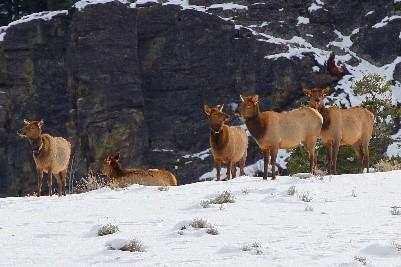
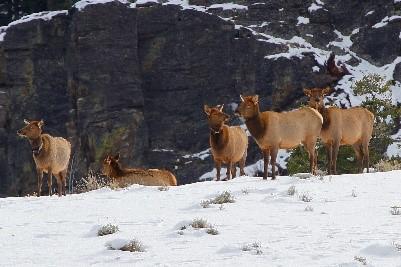
Credit: Credit: Chad Wildermuth
LOGAN, UTAH, USA- After wolves were reintroduced to Yellowstone National Park in the mid-1990s, some scientists thought the large predator reestablished a 'landscape of fear' that caused elk, the wolf's main prey, to avoid risky places where wolves killed them. This fueled the emerging idea that predators affect prey populations and ecosystems not only by eating prey animals, but by scaring them too. But according to findings from Utah State University ecologists Michel Kohl and Dan MacNulty, Yellowstone's 'landscape of fear' is not as scary as first thought.
"Contrary to popular belief, the wolf is not a round-the-clock threat to elk; it mostly hunts at dawn and dusk, and this allows elk to safely access risky places during nightly lulls in wolf activity," says Kohl, who completed a doctoral degree at USU in 2018 and is lead author of the paper. "Despite their Hollywood portrayal as nighttime prowlers, wolves tend to hunker down at night because their vision is not optimized for nocturnal hunting." With colleagues Daniel Stahler, Douglas Smith, and P.J. White of the U.S. National Park Service, Matthew Metz of University of Montana, James Forester of University of Minnesota, Matthew Kauffman of University of Wyoming, and Nathan Varley of University of Alberta, Kohl and MacNulty report their findings in an Early View online article of Ecological Monographs. The article will appear in a future print edition of the Ecological Society of America publication. The team's research is supported, in part, by the National Science Foundation.
The researchers revisited data from 27 GPS radio-collared elk that had been collected in the early years after the reintroduction, 2001-2004, but never fully analyzed. These collars recorded the location of each elk every 4-6 hours. This was the first time GPS technology had been used to track Yellowstone elk, and no one imagined that elk might sync their habitat use to the wolf's 24-hour schedule. Little was known about this schedule until researchers first equipped wolves with GPS collars in 2004.
"In the days before GPS, when we tracked wolves by sight and with VHF radio-telemetry, we knew they hunted mainly in the morning and evening, but we didn't know much about what they did at night" says MacNulty, a veteran Yellowstone wolf researcher and associate professor in USU's Department of Wildland Resources and the USU Ecology Center. "GPS data showed that wolves were about as inactive in the middle of the night as they were in the middle of the day."
Kohl used the GPS data to quantify the 24-hour schedule of wolves, and he compared how elk use of risky places – sites where wolves killed elk – differed between periods of high and low wolf activity. "Elk avoided the riskiest places when wolves were most active, but they had no problem using these same places when wolves were least active," says Kohl. "An elk's perception of a place as dangerous or safe, its landscape of fear, was highly dynamic with 'peaks' and 'valleys' that alternated across the 24-hr cycle in response to the ups and downs of wolf activity."
The ability of elk to regularly use risky places during wolf downtimes has implications for understanding the impact of wolves on elk and the ecosystem at large. "Our results can explain why many other studies found no clear-cut effect of wolf predation risk on elk stress levels, body condition, pregnancy, or herbivory," says MacNulty. "If our results reflect typical elk behavior, then actual killing rather than fear probably drives most, if not all, of the effect of wolves on elk and any cascading effect on the plants that elk eat such as aspen and willow."
This conclusion runs counter to popular views about the ecological importance of fear in Yellowstone and elsewhere. "Although our study is the first to show how a prey animal uses predator downtime to flatten its landscape of fear, I suspect other examples will emerge as more researchers examine the intersection between prey habitat use and predator activity rhythms," says Kohl.
###
Media Contact
Dan MacNulty
[email protected]
435-797-7442
https://qcnr.usu.edu/
Original Source
https://esajournals.onlinelibrary.wiley.com/doi/full/10.1002/ecm.1313 http://dx.doi.org/10.1002/ecm.1313