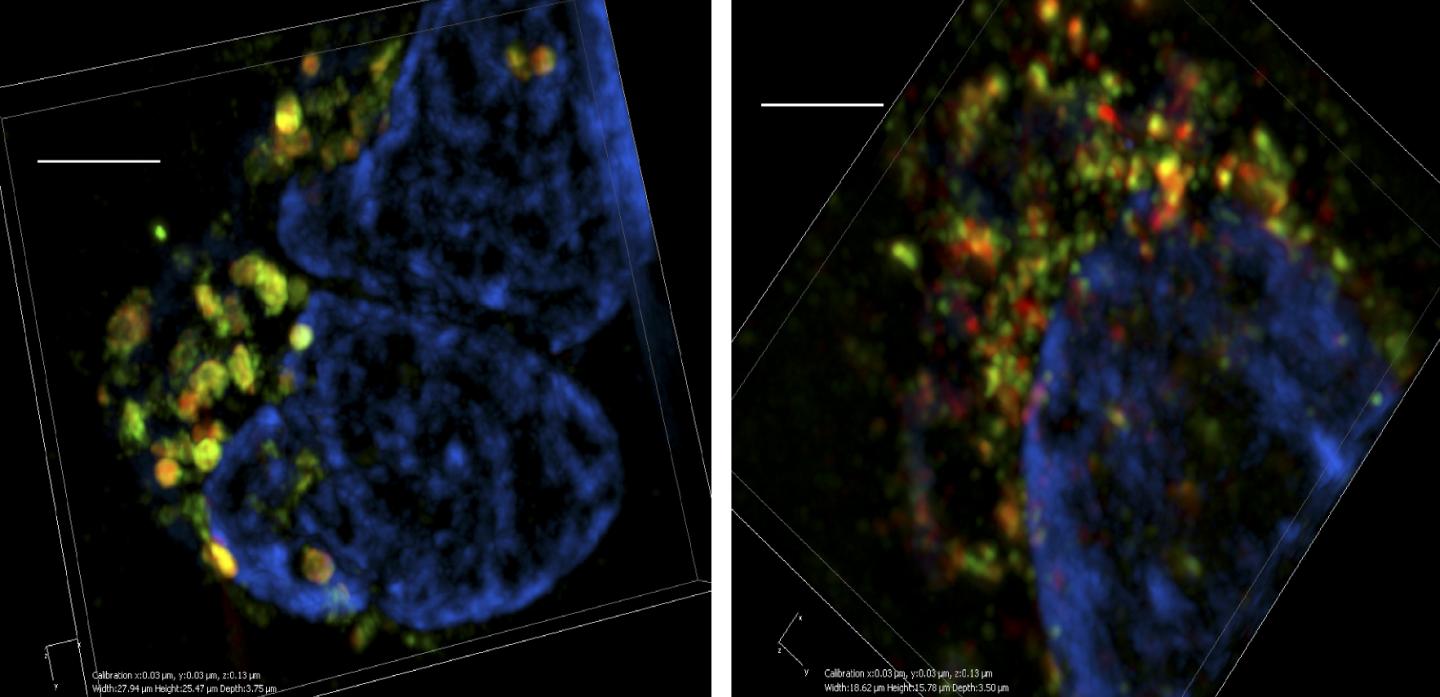
Credit: Messenger et al., 2018
Researchers at the University of Wisconsin-Madison have discovered that a protein called Munc13-4 helps cancer cells secrete large numbers of exosomes–tiny, membrane-bound packages containing proteins and RNAs that stimulate tumor progression. The study, which will be published June 21 in the Journal of Cell Biology, could lead to new therapies that stop tumor growth and metastasis by halting exosome production.
Cancer cells produce large numbers of exosomes, which contribute to tumor progression in many different ways. They can transfer cancer-causing oncogenes to neighboring cells to increase their proliferation; they can contain proteins that reorganize the cancer cells' surroundings and allow them to spread to other tissues; and they can contain signaling factors that disrupt the body's ability to mount an immune response against the tumor.
A team led by Thomas F.J. Martin of the University of Wisconsin-Madison with Scott W. Messenger as lead author found that calcium–which is often increased in cancer cells–stimulated the secretion of exosomes from aggressive breast cancer cells. Exosome release depended on a calcium-binding protein called Munc13-4; removing this protein, or replacing it with a mutant version unable to bind calcium, prevented breast cancer cells from releasing exosomes in response to calcium.
Munc13-4 levels are often elevated in human breast, pancreatic, and lung tumors. Martin and colleagues found that lung and pancreatic cancer cells increased their levels of Munc13-4 and released more exosomes as they became more aggressive.
Exosomes are formed inside large cellular organelles called multivesicular bodies. These organelles then fuse with the cell's plasma membrane to release exosomes outside of the cell. Messenger et al. found that Munc13-4 works with another protein called Rab11 to promote the development of multivesicular bodies capable of fusing with the plasma membrane and releasing exosomes.
Exosomes released from cancer cells carry an enzyme called MT1-MMP, which degrades the extracellular matrix surrounding cancer cells. This helps the cancer cells disperse around the body to form secondary metastatic tumors.
When Martin and colleagues depleted Munc13-4, they reduced the release of MT1-MMP-containing exosomes from breast cancer cells and inhibited the cells' ability to degrade the extracellular matrix.
"Overall, we think that increased expression of Munc13-4, combined with elevated calcium levels, drives enhanced exosome release by highly aggressive cancer cells, and that Munc13-4 is a potential target for therapeutic intervention," Martin says.
###
Messenger et al., 2018. J. Cell Biol. http://jcb.rupress.org/cgi/doi/10.1083/jcb.201710132?PR
About the Journal of Cell Biology
The Journal of Cell Biology (JCB) features peer-reviewed research on all aspects of cellular structure and function. All editorial decisions are made by research-active scientists in conjunction with in-house scientific editors. JCB makes all of its content free online no later than six months after publication. Established in 1955, JCB is published by the Rockefeller University Press. For more information, visit jcb.org.
Visit our Newsroom, and sign up for a weekly preview of articles to be published. Embargoed media alerts are for journalists only.
Follow JCB on Twitter at @JCellBiol and @RockUPress.
Media Contact
Rory Williams
[email protected]
212-327-8603
@RockUPress
http://www.rupress.org/
Related Journal Article
http://dx.doi.org/10.1083/jcb.201710132