Credit: LANL
LOS ALAMOS, N.M., June 19, 2018–A new study by Los Alamos National Laboratory scientists and colleagues confirms that increasing minimum winter temperatures allow beetles to expand their range but reveals that overcrowding can put the brakes on population growth.
"It has long been predicted that warming winters will allow range expansion. This is the first large dataset that demonstrates that warmer winter temperatures are likely allowing mountain pine beetles to establish outside of their native range," said Devin Goodsman, a Los Alamos postdoctoral researcher and first author on the report. "Both competition and winter cold are known to be important causes of mortality, but no previous studies addressed how these mortality factors interact."
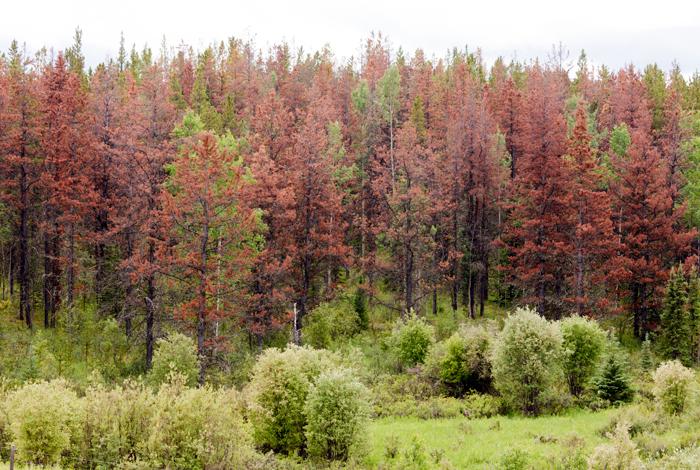
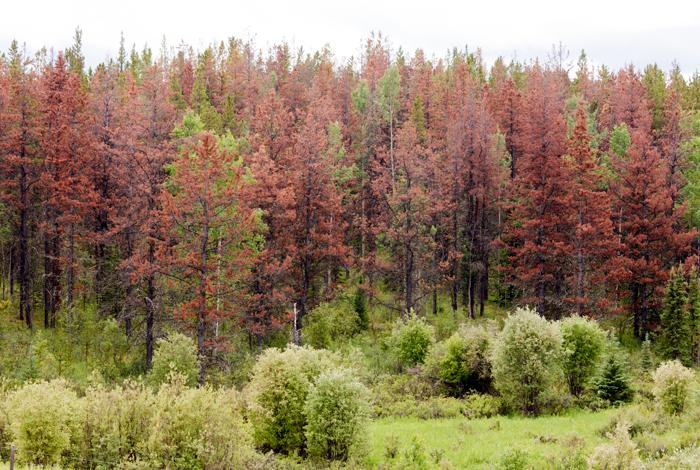
Although the insect is diminutive, the bark beetle's impact is colossal. Massive outbreaks in recent decades have consumed large swaths of Western forests, where 100,000 trees may fall every day. Some regions have lost 90 percent of the conifers. The outbreaks, mounting in size and severity, are now infesting new tree species and expanding beyond the Continental Divide across North America and into boreal forests.
Normally kept in check by long, cold winters, beetle populations are exploding thanks to warming temperatures and longer reproductive seasons. Thousands of these beetles attack an individual tree, and drought and hotter temperatures significantly weaken trees, preventing them from creating adequate protective resin. The beetles release a chemical that alerts others that they've found a fragile tree, and they swarm, feeding and breeding below the bark, impairing the tree's food transport and secreting fungus that feeds larvae and kills the tree. And now, the beetles are attacking healthy trees.
First large-scale study provides new evidence
The study, published in Global Change Biology, is the first of its scope, encompassing a nine-year dataset sampling 10,000 trees across 22 million acres. The study focused on Alberta, recently invaded by beetles from British Columbia, where they have lost the majority of the pine trees. The study was the first to inspect how rising beetle populations can limit the damage, because many hungry larvae compete for nutrients and carbohydrates stored below the bark in the phloem. While the cold temperatures that normally kill the beetles are diminished, analysis revealed that resource competition can be a stronger factor than even the cold on beetle mortality. Even in favorable climates, overcrowding can inhibit outbreaks, sometimes before all susceptible trees have been infected.
###
Funding: This research was funded by the Center for Space and Earth Sciences (CSES) and the Directed Research and Development (LDRD) program at Los Alamos National Laboratory. Additional funding provided by Pacific Northwest National Laboratory's LDRD program.
Paper: The effect of warmer winters on the demography of an outbreak insect is hidden by intraspecific competition. Global Change Biology. Authors include Los Alamos Scientists Devin W. Goodsman, Richard S. Middleton and Chonggang Xu. Additional authors include Guenchik Grosklos (Utah State University), Brian H. Aukema (University of Minnesota), Caroline Whitehouse (Alberta Agriculture and Forestry), Katherine P. Bleiker (Canadian Forest Service) and Nate G. McDowell (Pacific Northwest National Laboratory).
About Los Alamos National Laboratory
Los Alamos National Laboratory, a multidisciplinary research institution engaged in strategic science on behalf of national security, is operated by Los Alamos National Security, LLC, a team composed of Bechtel National, the University of California, BWX Technologies, Inc. and URS Corporation for the Department of Energy's National Nuclear Security Administration.
Los Alamos enhances national security by ensuring the safety and reliability of the U.S. nuclear stockpile, developing technologies to reduce threats from weapons of mass destruction, and solving problems related to energy, environment, infrastructure, health and global security concerns.
Media Contact
Nancy Ambrosiano
[email protected]
505-667-0471
@LosAlamosNatLab
http://www.lanl.gov
Related Journal Article
http://dx.doi.org/10.1111/gcb.14284