Credit: UTA
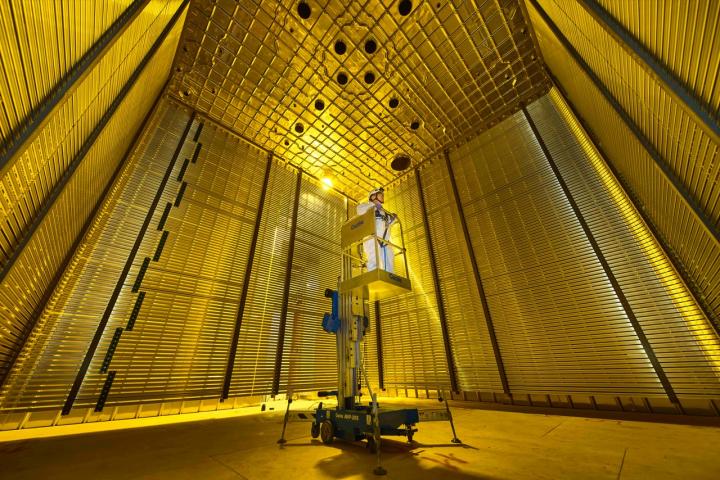
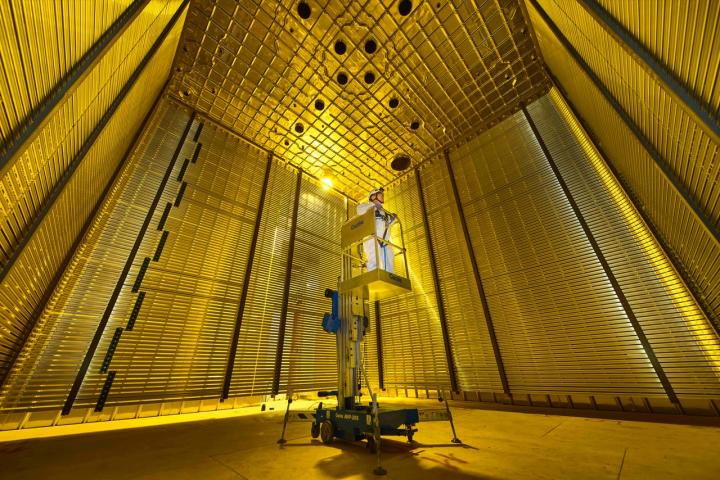
Researchers at The University of Texas at Arlington have built prototypes for an aluminum electric field cage inside a particle detector for an international physics experiment conducted at the European Organization for Nuclear Research in Geneva, Switzerland.
"UTA's key role in the Deep Underground Neutrino Experiment prototype developments in Switzerland demonstrates the high regard in which we are held by the international physics community," said Duane Dimos, UTA vice president for research.
"High-energy physics is a research key area for UTA where we have invested in having one of the largest and best-regarded experimental physics groups in the country," he added.
UTA already played an important role in finding the Higgs boson or "God particle" in 2012 as part of an earlier international experiment carried out at the Large Hadron Collider in Switzerland. The Higgs boson is an invisible force-field that permeates space and endows particles with mass. The discovery led to a Nobel Prize for Peter Higgs and Francis Englert, who led the research.
Last year, UTA had research expenditures of $3.5 million carrying out leading roles in the world's most prestigious new particle physics experiments in the United States and around the world. Total grants over the next decade are expected to surpass $35 million.
"UTA is participating in all the important projects – upgrades to the Large Hadron Collider's ATLAS experiment, the International Linear Collider in Japan, DUNE with the Fermi National Accelerator Laboratory in Illinois and the IceCube experiment in the South Pole," said Kaushik De, UTA physics professor and director of the Center for Excellence in High Energy Physics.
"As a result, we are able to offer our students first-hand experience on international projects at the highest level," he added.
The Deep Underground Neutrino Experiment or DUNE is a U.S.-led international experiment that focuses on neutrinos, subatomic particles that may offer an answer to the lingering mystery of the universe's matter-antimatter imbalance.
Physics tells us that matter is created side by side with antimatter. But if matter and antimatter are produced equally, then all of the matter created in the early universe should have been cancelled out by equal amounts of antimatter, eliminating existence itself instantly. And we wouldn't be here.
Neutrinos and their antimatter antineutrinos oscillate as they move through space, changing "flavor," form and mass. Scientists hope that by observing and comparing the oscillations of neutrinos and antineutrinos some difference will become apparent that could explain the matter-antimatter imbalance and hence how our universe came to exist.
DUNE will consist of two neutrino detectors placed in the world's most intense neutrino beam. One detector will record particle interactions near the source of the beam, at the Fermi National Accelerator Laboratory in Batavia, Illinois. A second, much larger, detector will be installed more than a kilometer underground at the Sanford Underground Research Laboratory in Lead, S.D. — 1,300 kilometers away from the source, according to the project's website.
"Our project is to lead work on the DUNE prototype field cage and detectors being developed in collaboration with many European institutions, while the U.S. research facilities are being built," said Jaehoon Yu, UTA physics professor and lead on the DUNE project for UTA.
"We already have 10 students working on this and several have travelled to Switzerland to work directly on the project," he added.
The UTA-ETH Zurich, a STEM university, co-designed a field cage, which is a scaled-down prototype of the final cage. The field cage is six meters by six meters by six meters. The electric field already has been tested at 150,000 volts in air and will be operated at 300,000 volts during future testing in liquid argon. The field cage is an important part of the Time Projection Chamber, which captures results when high-energy particles collision with argon atoms. Through these collisions, the particles are captured in the detector and physicists can study the nature of neutrinos and the dark matter coming from beams and from cosmogenic sources.
"What is important is that all these detector elements work together," Yu said. "Our teams are given this strategic opportunity because we always deliver on what we promise at the highest quality."
###
Media Contact
Louisa Kellie
[email protected]
817-524-8926
@utarlington
http://www.uta.edu
Original Source
https://www.uta.edu/news/releases/2018/06/Milestone%20CERN.php