

• HOME
  • NEWS
  • EXPLORE
    • CAREER
      • Companies
      • Jobs
    • EVENTS
    • iGEM
      • News
      • Team
    • PHOTOS
    • VIDEO
    • WIKI
  • BLOG
  • COMMUNITY
    • FACEBOOK
    • INSTAGRAM
    • TWITTER
Monday, April 6, 2026
BIOENGINEER.ORG
No Result
View All Result
  • Login
  • HOME
  • NEWS
  • EXPLORE
    • CAREER
      • Companies
      • Jobs
        • Lecturer
        • PhD Studentship
        • Postdoc
        • Research Assistant
    • EVENTS
    • iGEM
      • News
      • Team
    • PHOTOS
    • VIDEO
    • WIKI
  • BLOG
  • COMMUNITY
    • FACEBOOK
    • INSTAGRAM
    • TWITTER
  • HOME
  • NEWS
  • EXPLORE
    • CAREER
      • Companies
      • Jobs
        • Lecturer
        • PhD Studentship
        • Postdoc
        • Research Assistant
    • EVENTS
    • iGEM
      • News
      • Team
    • PHOTOS
    • VIDEO
    • WIKI
  • BLOG
  • COMMUNITY
    • FACEBOOK
    • INSTAGRAM
    • TWITTER
No Result
View All Result
Bioengineer.org
No Result
View All Result
Home NEWS Science News Health

UTSA researchers create method that can quickly and accurately detect infections

Bioengineer by Bioengineer
June 12, 2018
in Health
Reading Time: 2 mins read
0
Share on FacebookShare on TwitterShare on LinkedinShare on RedditShare on Telegram
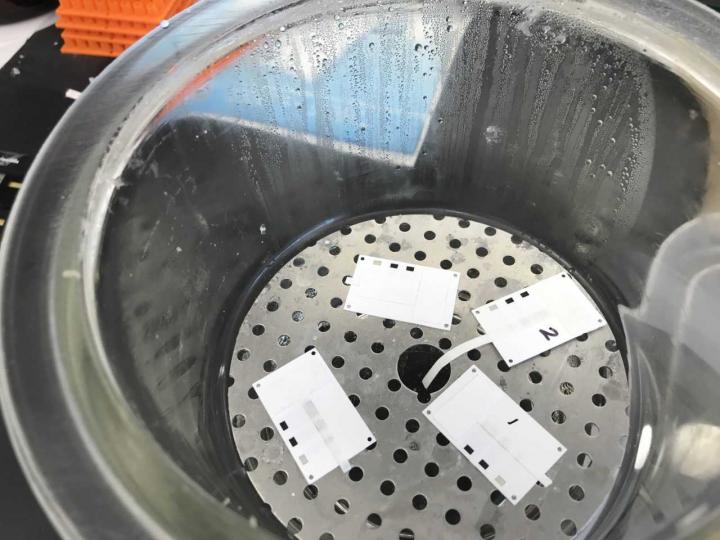
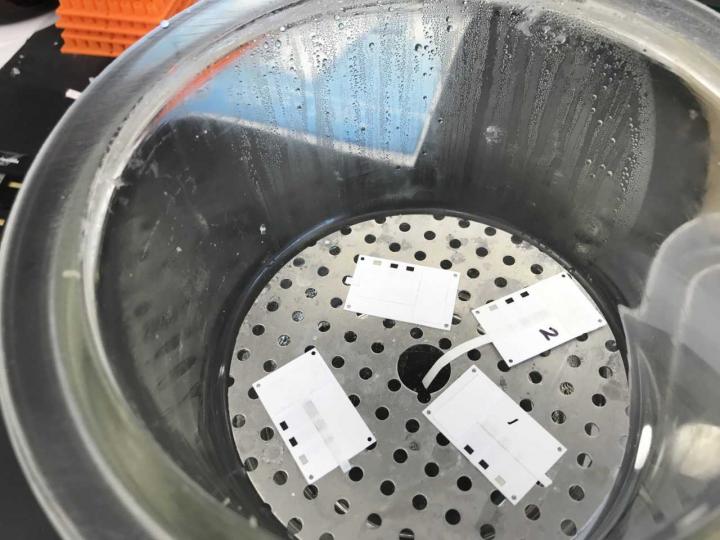
IMAGE

Credit: Photo courtesy of The University of Texas at San Antonio

(SAN ANTONIO, June 12, 2018) — A new study by Waldemar Gorski, professor and chair of the UTSA Department of Chemistry, and Stanton McHardy, associate professor of research in chemistry and director of the UTSA Center for Innovative Drug Discovery, describes a method that could show quickly and accurately whether a person has been infected with harmful bacteria or other pathogens. Additionally, this new method shows the exact severity of infection in a person.

The most common method of testing for infection in medical facilities is currently a strip that turns a certain color when infected fluids come into contact with it.

"The problem with this method is that it's imprecise," Gorski said. "The human eye is forced to judge the level of infection based on the hue and deepness of a color. It's difficult to make an accurate call based on that." Furthermore, roughly a third of samples cannot be tested because the fluids contain blood or are too opaque.

Other methods include microbiology or examining body fluid samples under a microscope and counting white blood cells, also known as leukocytes, which are an indicator of an infection. However, these can be slow processes and require more highly trained personnel.

Gorski, seeing a need for an easier and more rapid method of testing for infection, resolved to test an electrochemical approach, and sought out McHardy, a medicinal chemist. Together, they created molecules that bind to leukocyte enzymes and produce an electrical current to signal the presence of an infection.

Their new molecules are housed on a testing strip. After being contacted with infected bodily fluids, the strip is connected to a computer monitor that displays a clear range of electrochemical responses demonstrating the severity of an infection.

"The signs and symptoms people demonstrate aren't always reflective of the level of the infection they have," McHardy said. "This device could very easily show just how serious an infection is and make diagnosis a much quicker process, possibly preventing a more serious illness."

Gorski believes the method could be especially useful to people who have just undergone surgery, as it could determine definitively whether they have an infection from the procedure before it worsens.

To date, Gorski and McHardy have filed a patent for their invention, published two papers and plan to work with an engineer in the future to streamline its design.

###

Read Waldemar Gorski and Stanton McHardy's study, "Synthesis and Characterization of Pyridine Compounds for Amperometric Measurements of Leukocyte Esterase."

Learn more about the UTSA Department of Chemistry.

Learn more about the UTSA Center for Innovative Drug Discovery.

Media Contact

Christi Fish
[email protected]
210-458-5141
@utsa

http://www.utsa.edu

Original Source

http://www.utsa.edu/today/2018/06/story/McHardyGorskiStudy.html http://dx.doi.org/10.1002/cbic.201800164


Share12Tweet8Share2ShareShareShare2

Related Posts

Frailty, Nutrition, Depression Impact Elderly Quality of Life

April 5, 2026

Real-World Safety of Second-Line Diabetes Drugs in Elderly

April 4, 2026

Protein Monitoring Enhances EASO Obesity Care Timing

April 4, 2026

Measuring Fitness: Insights on Individual Phage Particles

April 4, 2026
Please login to join discussion

POPULAR NEWS

  • blank

    Revolutionary AI Model Enhances Precision in Detecting Food Contamination

    97 shares
    Share 39 Tweet 24
  • Promising Outcomes from First Clinical Trials of Gene Regulation in Epilepsy

    51 shares
    Share 20 Tweet 13
  • Imagine a Social Media Feed That Challenges Your Views Instead of Reinforcing Them

    1008 shares
    Share 398 Tweet 249
  • Popular Anti-Aging Compound Linked to Damage in Corpus Callosum, Study Finds

    44 shares
    Share 18 Tweet 11

About

We bring you the latest biotechnology news from best research centers and universities around the world. Check our website.

Follow us

Recent News

Overview of Photocatalysts and Biocatalysts in Advancing Artificial Photosynthesis

Japanese Health Promotion Questionnaire: Validity Confirmed

Frailty, Depression, Social Participation Linked in Older Adults

Subscribe to Blog via Email

Enter your email address to subscribe to this blog and receive notifications of new posts by email.

Join 78 other subscribers
  • Contact Us

Bioengineer.org © Copyright 2023 All Rights Reserved.

Welcome Back!

Login to your account below

Forgotten Password?

Retrieve your password

Please enter your username or email address to reset your password.

Log In
No Result
View All Result
  • Homepages
    • Home Page 1
    • Home Page 2
  • News
  • National
  • Business
  • Health
  • Lifestyle
  • Science

Bioengineer.org © Copyright 2023 All Rights Reserved.
