

• HOME
  • NEWS
  • EXPLORE
    • CAREER
      • Companies
      • Jobs
    • EVENTS
    • iGEM
      • News
      • Team
    • PHOTOS
    • VIDEO
    • WIKI
  • BLOG
  • COMMUNITY
    • FACEBOOK
    • INSTAGRAM
    • TWITTER
Monday, February 2, 2026
BIOENGINEER.ORG
No Result
View All Result
  • Login
  • HOME
  • NEWS
  • EXPLORE
    • CAREER
      • Companies
      • Jobs
        • Lecturer
        • PhD Studentship
        • Postdoc
        • Research Assistant
    • EVENTS
    • iGEM
      • News
      • Team
    • PHOTOS
    • VIDEO
    • WIKI
  • BLOG
  • COMMUNITY
    • FACEBOOK
    • INSTAGRAM
    • TWITTER
  • HOME
  • NEWS
  • EXPLORE
    • CAREER
      • Companies
      • Jobs
        • Lecturer
        • PhD Studentship
        • Postdoc
        • Research Assistant
    • EVENTS
    • iGEM
      • News
      • Team
    • PHOTOS
    • VIDEO
    • WIKI
  • BLOG
  • COMMUNITY
    • FACEBOOK
    • INSTAGRAM
    • TWITTER
No Result
View All Result
Bioengineer.org
No Result
View All Result
Home NEWS Science News Biology

‘Tricking’ bacteria into hydroxylating benzene

Bioengineer by Bioengineer
June 11, 2018
in Biology
Reading Time: 2 mins read
0
Share on FacebookShare on TwitterShare on LinkedinShare on RedditShare on Telegram
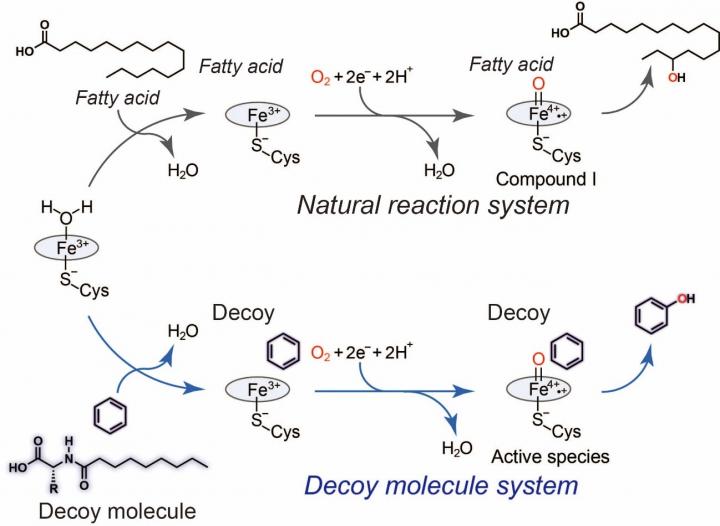
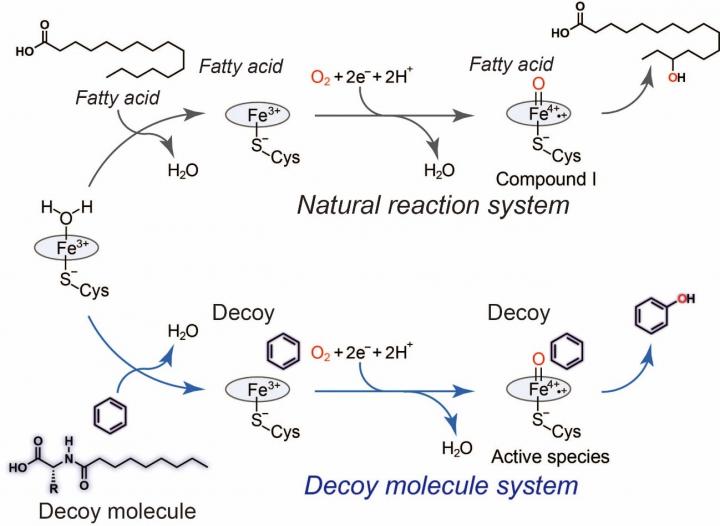
IMAGE

Credit: Osami Shoji and Masayuki Karasawa

Nagoya, Japan – Breaking carbon-hydrogen bonds is notoriously difficult in lab chemistry, yet nature does it effortlessly. Now, scientists have used E.coli bacteria to oxidize the C-H bonds in benzene to generate phenol, with a genetically inserted enzyme (cytochrome P450BM3), that originally evolved to target other molecules, long-chain fatty acids.

Getting enzymes to do novel reactions – effectively hijacking the biochemistry of living cells for our own purposes – is generally tricky, involving harsh conditions or genetic modification of the enzymes themselves.

However, researchers at Nagoya University worked around this by using "decoy" molecules, which mimic the native targets (substrates) of naturally occurring enzymes, to activate the desired reaction.

As reported in Angewandte Chemie International Edition, the research team created a compound – dubbed C7-Pro-Phe – based on amino acids. This decoy molecule resembles the fatty acids that E.coli metabolizes. Insert the decoy into an E.coli cell, and it will be mis-recognized as a fatty acid, triggering activation of the inserted P450 enzyme. Now supply benzene (C6H6), and the bacteria get busy, oxidizing C6H6 to C6H6O (phenol). No need for the usual lab kit – living cells can do complex chemistry quietly and efficiently.

"The advantage of our system is that C7-Pro-Phe can be easily taken up by the bacteria, where it activates P450BM3 in the cell. This effectively turns each bacterium into a whole-cell biocatalyst," study first author Masayuki Karasawa says. "The cell is an optimal setting for the biochemical reaction. The decoys actually remodel the enzyme's active site, giving us control over aspects of the reaction, such as stereoselectivity."

All that is needed is a ready supply of glucose – which can be recycled from waste products – to feed the E.coli.

Because a naturally occurring – rather than genetically modified – variant of the enzyme is expressed by the E.coli, it is likely that other bacteria could also be modified with the same gene to perform this job. Moreover, different decoys might be suitable for different substrates or bacteria. "A combined program of decoy-screening and mutagenesis could create a versatile toolkit for whole-cell reactions using bacteria," co-author Osami Shoji says.

###

The article, "Whole-Cell Biotransformation of Benzene to Phenol Catalysed by Intracellular Cytochrome P450BM3 Activated by External Additives," was published in Angewandte Chemie International Edition at DOI:10.1002/anie.201804924.

Media Contact

Koomi Sung
[email protected]
@NU__Research

http://www.nagoya-u.ac.jp/en/

Original Source

http://en.nagoya-u.ac.jp/research/activities/news/2018/06/tricking-bacteria-into-hydroxylating-benzene.html http://dx.doi.org/10.1002/anie.201804924


Share14Tweet8Share2ShareShareShare2

Related Posts

Unraveling Genome Growth in Acyclania tenebrosa

Unraveling Genome Growth in Acyclania tenebrosa

February 2, 2026
blank

Breakthrough Discovery Illuminates Key Evolutionary Milestone in Vertebrates

February 2, 2026

New Ladybird Beetle Species Discovered on Kyushu University Campus

February 1, 2026

Eosinophils Emerge as Promising Therapeutic Target in Chordoma, Reports Chinese Neurosurgical Journal

February 1, 2026
Please login to join discussion

POPULAR NEWS

  • Enhancing Spiritual Care Education in Nursing Programs

    157 shares
    Share 63 Tweet 39
  • Robotic Ureteral Reconstruction: A Novel Approach

    81 shares
    Share 32 Tweet 20
  • Digital Privacy: Health Data Control in Incarceration

    63 shares
    Share 25 Tweet 16
  • Study Reveals Lipid Accumulation in ME/CFS Cells

    57 shares
    Share 23 Tweet 14

About

We bring you the latest biotechnology news from best research centers and universities around the world. Check our website.

Follow us

Recent News

Unraveling Genome Growth in Acyclania tenebrosa

Modified FOLFIRINOX Plus Nivolumab in Pancreatic Cancer Trial

Circulating Progenitor Cells Detect and Repair Aberrant Cells

Subscribe to Blog via Email

Enter your email address to subscribe to this blog and receive notifications of new posts by email.

Join 73 other subscribers
  • Contact Us

Bioengineer.org © Copyright 2023 All Rights Reserved.

Welcome Back!

Login to your account below

Forgotten Password?

Retrieve your password

Please enter your username or email address to reset your password.

Log In
No Result
View All Result
  • Homepages
    • Home Page 1
    • Home Page 2
  • News
  • National
  • Business
  • Health
  • Lifestyle
  • Science

Bioengineer.org © Copyright 2023 All Rights Reserved.
