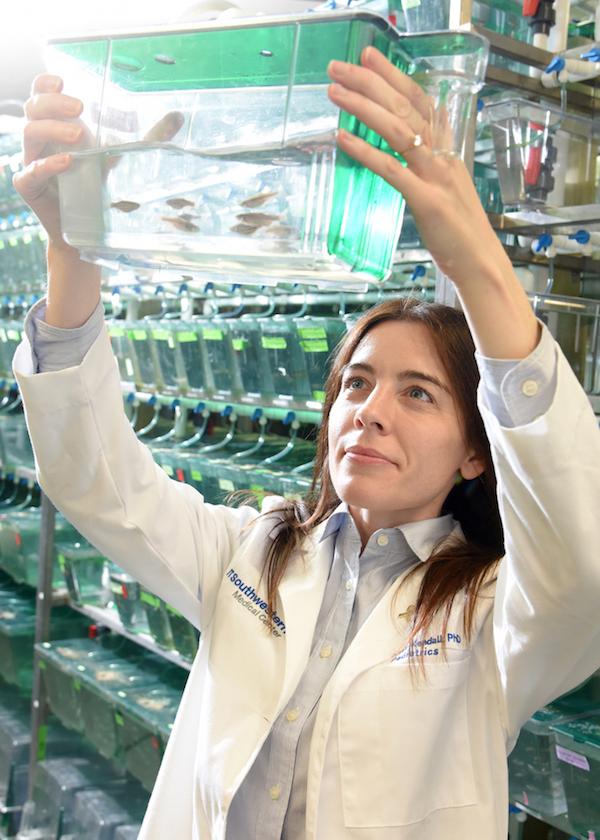
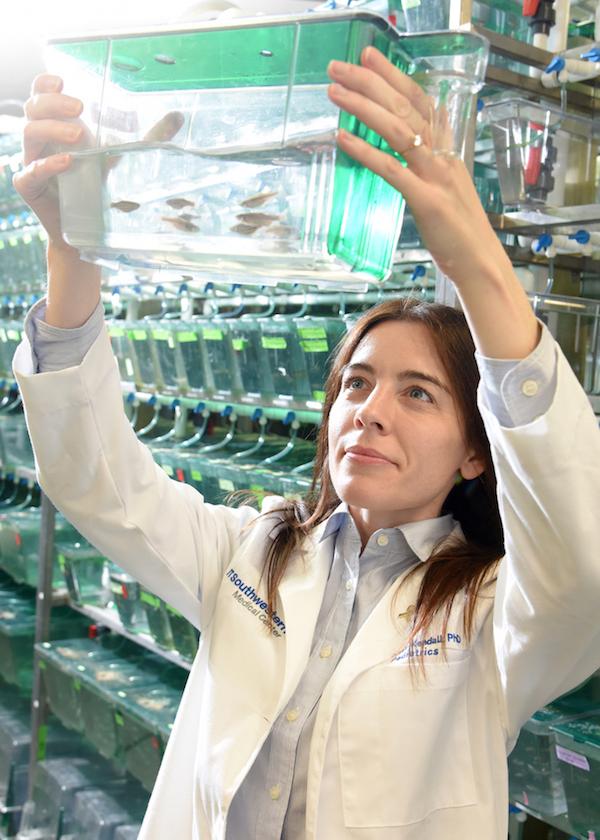
Credit: UT Southwestern
DALLAS – June 5, 2018 -A popular aquarium fish may hold answers to how tumors form in a childhood cancer.
Muscle precursor cells called myoblasts are formed during normal fetal development and mature to become the skeletal muscles of the body. Rarely, a genetic error in which pieces of two chromosomes fuse together occurs in a cell related to this process and triggers those cells to multiply and behave abnormally. A particularly aggressive form of the muscle cancer rhabdomyosarcoma results.
The fused genes create an abnormal protein called PAX3-FOXO1, which blocks the normal maturation of muscle cells by inappropriately turning hundreds if not thousands of genes on and off. The exact mechanism by which PAX3-FOXO1 does this is not known.
Cancer researchers at UT Southwestern Medical Center developed a zebrafish model for the childhood cancer. To do this, Dr. James Amatruda's lab inserted the human PAX3-FOXO1 gene into the DNA of zebrafish. Using this new transgenic zebrafish, the researchers showed that the fused-gene DNA causes rhabdomyosarcoma that is similar to the human disease. They found it does this by turning on another gene, HES3, which leads to overproduction of the skeletal muscle precursor cells and allows for PAX3-FOXO1+ cells to survive during development instead of dying.
"There is a lot of interest in understanding the PAX3-FOXO1 block and in identifying treatments that overcome this block," said Dr. Amatruda, Associate Professor of Pediatrics, Internal Medicine, and Molecular Biology. "Such treatments could potentially cause the tumor to 'mature' and slow its growth without exposing the patient's normal tissue to the side effects of chemotherapy and radiation."
Efforts to directly counter the effects of PAX3-FOXO1 have been unsuccessful, so the HES3 gene provides a potential back door for targeted treatment for this cancer.
Current treatments for rhabdomyosarcoma include surgery, chemotherapy, and radiation. Finding a drug that specifically targets part of the pathway initiated by the PAX3-FOXO1 gene fusion could improve survival rates as well as make treatments more tolerable for young patients.
The zebrafish model of rhabdomyosarcoma the researchers developed is particularly useful because few other options are available. "Gene fusions that function as transcription factors are notoriously difficult to model in animals, hence the limited availability of vertebrate animal models for this disease. Zebrafish are powerful models because their use provides insight into how cancer genes function during development and the fish are a platform for drug discovery efforts," said Dr. Genevieve Kendall, postdoctoral researcher and first author on the study.
The long-term goal of their work is to identify potential drugs for the most aggressive type of rhabdomyosarcoma tumor and to test these treatments in the zebrafish model. The new findings open the possibility of finding drugs that block HES3 or its downstream targets as a therapy for this cancer.
###
The research appears in the journal eLife.
Dr. Amatruda is a member of the Harold C. Simmons Comprehensive Cancer Center, a Horchow Family Scholar in Pediatrics, and holds the Nearburg Family Professorship in Pediatric Oncology Research at UT Southwestern, which is recognizing its 75th year in 2018.
Other UT Southwestern staff and faculty members who contributed to this work include Whitney Murchison and Collette LaVigne, technicians in the Amatruda lab; Dr. Lin Xu, Instructor in Pediatrics and the Department of Clinical Sciences; Dr. Dinesh Rakheja, Associate Professor of Pathology and Pediatrics, and with the Simmons Cancer Center; and Dr. Stephen Skapek, Professor of Pediatrics and with the Simmons Cancer Center. Dr. Skapek holds the Distinguished Chair in Pediatric Oncology Research and Dr. Rakheja holds the John Lawrence and Patsy Louise Goforth Chair in Pathology.
Funding for this research comes from the Cancer Prevention and Research Institute of Texas, La Ligue National Contre le Cancer, a Young Investigator grant from Alex's Lemonade Stand Foundation, a Hartwell Foundation Postdoctoral Fellowship, a QuadW Foundation-AACR Fellowship for Clinical/Translational Sarcoma Research; the Institut Curie; and Curing Kids Cancer.
The Harold C. Simmons Comprehensive Cancer Center, one of 49 NCI-designated Comprehensive Cancer Centers in the U.S. and the only one in North Texas, is among just 30 U.S. cancer research centers to be designated by the NCI as a National Clinical Trials Network Lead Academic Participating Site.
About UT Southwestern Medical Center
UT Southwestern, one of the premier academic medical centers in the nation, integrates pioneering biomedical research with exceptional clinical care and education. The institution's faculty has received six Nobel Prizes, and includes 22 members of the National Academy of Sciences, 16 members of the National Academy of Medicine, and 15 Howard Hughes Medical Institute Investigators. The faculty of more than 2,700 is responsible for groundbreaking medical advances and is committed to translating science-driven research quickly to new clinical treatments. UT Southwestern physicians provide care in about 80 specialties to more than 100,000 hospitalized patients, 600,000 emergency room cases, and oversee approximately 2.2 million outpatient visits a year.
Media Contact
Cathy Frisinger
[email protected]
@UTSWNews
http://www.swmed.edu