• HOME
  • NEWS
  • EXPLORE
    • CAREER
      • Companies
      • Jobs
    • EVENTS
    • iGEM
      • News
      • Team
    • PHOTOS
    • VIDEO
    • WIKI
  • BLOG
  • COMMUNITY
    • FACEBOOK
    • INSTAGRAM
    • TWITTER
Saturday, February 7, 2026
BIOENGINEER.ORG
No Result
View All Result
  • Login
  • HOME
  • NEWS
  • EXPLORE
    • CAREER
      • Companies
      • Jobs
        • Lecturer
        • PhD Studentship
        • Postdoc
        • Research Assistant
    • EVENTS
    • iGEM
      • News
      • Team
    • PHOTOS
    • VIDEO
    • WIKI
  • BLOG
  • COMMUNITY
    • FACEBOOK
    • INSTAGRAM
    • TWITTER
  • HOME
  • NEWS
  • EXPLORE
    • CAREER
      • Companies
      • Jobs
        • Lecturer
        • PhD Studentship
        • Postdoc
        • Research Assistant
    • EVENTS
    • iGEM
      • News
      • Team
    • PHOTOS
    • VIDEO
    • WIKI
  • BLOG
  • COMMUNITY
    • FACEBOOK
    • INSTAGRAM
    • TWITTER
No Result
View All Result
Bioengineer.org
No Result
View All Result
Home NEWS Science News Health

Improving patient transfer from ICU to ward: Resources, communication and culture

Bioengineer by Bioengineer
June 4, 2018
in Health
Reading Time: 2 mins read
0
Share on FacebookShare on TwitterShare on LinkedinShare on RedditShare on Telegram

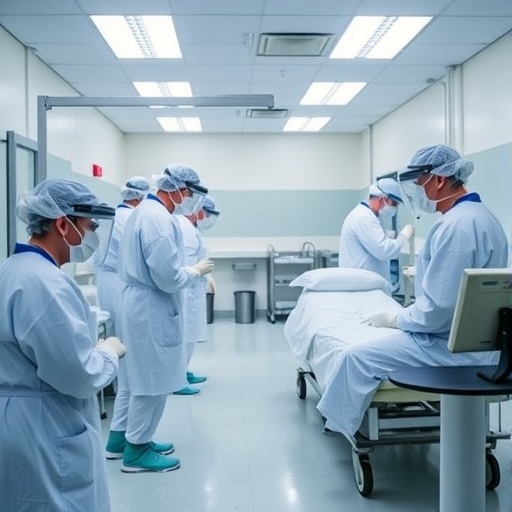
A new study has identified important factors that can improve the transfer of patients from the intensive care unit (ICU) to a general hospital ward, a high-risk transition in which breakdowns in communication, medical errors and adverse events resulting in readmission can occur. The research, published in CMAJ (Canadian Medical Association Journal) includes patient and health care provider perspectives that identify resource availability, communications and institutional culture as key factors to be addressed.

"The transfer of patients from the ICU to a hospital ward is one of the most challenging, high-risk and inefficient transitions of care because the patients are among the sickest in the health care system, they are transitioning from high technological units to less acute environments, and many providers are involved in exchanges of information and responsibility," writes Dr. Jeanna Parsons Leigh, Cumming School of Medicine, University of Calgary, Calgary, Alberta, with coauthors.

The study was conducted in 8 hospitals in 7 cities across Canada. Three broad themes emerged from consultation with patients, families and health care professionals that can hinder or improve, high-quality patient transfers: resource availability, communication and culture.

Suggestions to improve patient transfers from the ICU to ward include

  • Standardized discharge communication tools to ensure open, continuous communication between patients or families and health care providers
  • Standardized discharge communication tools for use among health care providers
  • Multiple forms of communication, including both verbal and written tools, to document transfer and ensure continuity of care
  • Procedures to manage delays in transferring patients and coordinate care.

The study provides qualitative information on the experiences of patients, families and health care professionals who are involved in this high-risk health care transition.

The authors note that as some participants were interviewed up to two years after the relevant ICU admission, the time elapsed may have affected their recall.

"Patients, family and provider experiences with transfers from intensive care unit to hospital ward: a multi-centre qualitative study" is published June 4, 2018

###

Media Contact

Kim Barnhardt
[email protected]
@CMAJ

http://www.cmaj.ca/
Share12Tweet8Share2ShareShareShare2

Related Posts

Inflammasome Protein ASC Drives Pancreatic Cancer Metabolism

February 7, 2026

Phage-Antibiotic Combo Beats Resistant Peritoneal Infection

February 7, 2026

Boosting Remote Healthcare: Stepped-Wedge Trial Insights

February 7, 2026

Barriers and Boosters of Seniors’ Physical Activity in Karachi

February 7, 2026
Please login to join discussion

POPULAR NEWS

  • Robotic Ureteral Reconstruction: A Novel Approach

    Robotic Ureteral Reconstruction: A Novel Approach

    82 shares
    Share 33 Tweet 21
  • Digital Privacy: Health Data Control in Incarceration

    63 shares
    Share 25 Tweet 16
  • Study Reveals Lipid Accumulation in ME/CFS Cells

    57 shares
    Share 23 Tweet 14
  • Breakthrough in RNA Research Accelerates Medical Innovations Timeline

    53 shares
    Share 21 Tweet 13

About

We bring you the latest biotechnology news from best research centers and universities around the world. Check our website.

Follow us

Recent News

Inflammasome Protein ASC Drives Pancreatic Cancer Metabolism

Phage-Antibiotic Combo Beats Resistant Peritoneal Infection

Boosting Remote Healthcare: Stepped-Wedge Trial Insights

Subscribe to Blog via Email

Enter your email address to subscribe to this blog and receive notifications of new posts by email.

Join 73 other subscribers
  • Contact Us

Bioengineer.org © Copyright 2023 All Rights Reserved.

Welcome Back!

Login to your account below

Forgotten Password?

Retrieve your password

Please enter your username or email address to reset your password.

Log In
No Result
View All Result
  • Homepages
    • Home Page 1
    • Home Page 2
  • News
  • National
  • Business
  • Health
  • Lifestyle
  • Science

Bioengineer.org © Copyright 2023 All Rights Reserved.