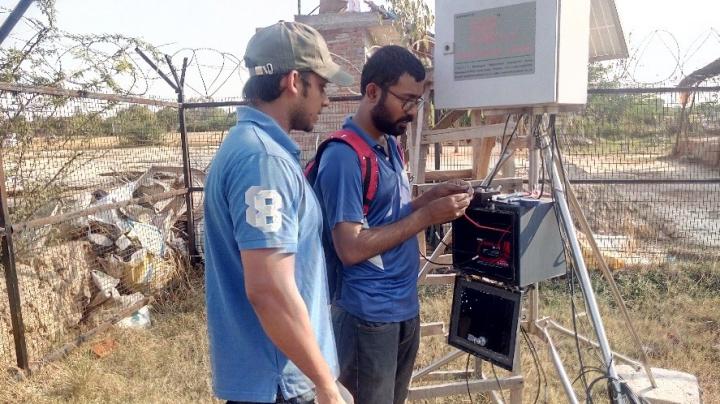
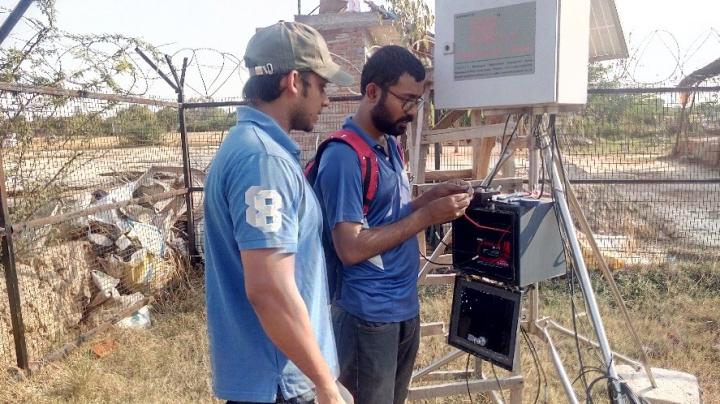
Credit: Surya Gupta
- Leicester team to use satellite data to examine how changes in water availability and agricultural practises threaten the sustainability of crop yield and production
- Project will drive strategies to optimise agriculture practises in the region
- Researcher exchanges between India and UK planned
International scientists, including researchers from the University of Leicester, are using space sensors to monitor the health of land around the River Ganges in India, home to approximately 500 million people.
The Ganges flows through India and Bangladesh. UK and Indian scientists are using sensors on space-borne and unmanned aerial vehicle (UAV) platforms to map an area – a new Critical Zone Observatory (CZO) – on the banks of the Ganges Basin.
The CZO encompasses agriculturally-rich land, however climate unpredictability combined with ground-water depletion and high levels of poverty are directly threatening the livelihoods of farming communities living within the Ganges Basin.
The project, funded by UKRI Science and Technology Facilities Council (STFC) through the UK's Global Challenges Research Fund, will bring together UK and Indian expertise to generate new scientific observations which will advance our understanding of sustainable land-use, secure and resilient food systems and water security.
The CZO was set up by Rajiv Sinha and colleagues from the Indian Institute of Technology Kanpur (IITK) as part of an international effort to determine how land and atmosphere interactions within the CZO ecosystem are impacted by human-induced and environmental disturbances. The CZO, supported by the Indian Ministry of Earth Sciences (MoES), has a network of hydro-meteorological instrumentation with data being collected for more than a year. The CZO will be augmented with high-resolution thermal infrared sensors and measurements through the STFC project.
Space scientists Harjinder Sembhi and Darren Ghent, of the Department of Physics and Astronomy at the University of Leicester, will monitor the CZO using land surface temperatures (LST) derived from data collected by the SLSTR (Sea and Land Surface Temperature Radiometer) instrument, flown on board the European Sentinel 3A mission and calibrated at the STFC RAL Space Centre Calibration Facility.
Project leader Harjinder Sembhi said: "This project is about using high-quality SLSTR observations to characterise how vegetation is impacted by agriculture practises (such as irrigation regimes and crop rotation) and identify how the changing climate is impacting the landscape. With our NGO partners, The Flow Partnership-UK and The Energy and Resources Institute, we will disseminate information through stakeholder engagement with policy-makers and farming communities and co-develop evidence-based strategies to make future policy recommendations."
The Leicester team and IITK scientist Sachidanand Tripathi will install high-quality radiometers at the CZO to provide the first opportunity to assess the quality of SLSTR measurements in the Indo-Gangetic Plain (IGP). Co-investigator Darren Ghent, who leads the SLSTR LST activities within the Sentinel-3 Mission Performance Centre, says this validation will strengthen the capability within the UK to assess the performance of the Sentinel-3 operational LST data product and facilitate the evaluation of the instrument and algorithms in higher temperature environments which can inform the STFC calibration team.
Co-investigator Martin Wooster from King's College London will work with IITK to generate the first in-depth mapping of CZO vegetation, crop residue burning and surface properties using high-resolution thermal and hyperspectral cameras flown on UAVs. The scientific observations collected during a dedicated measurement campaign will be implemented into land and hydrological models to derive downstream flux and emission estimates.
In addition to significant scientific outputs, this project will provide opportunities for researcher exchange that will boost capacity building in the area of space sensors for monitoring of the land and atmosphere.
###
Additional information:
STFC https://stfc.ukri.org/index.cfm
The Global Challenges Research Fund
The Global Challenges Research Fund (GCRF) supports cutting-edge research and innovation that addresses the global issues faced by developing countries. It harnesses the expertise of the UK's world-leading researchers, focusing on: funding challenge-led disciplinary and interdisciplinary research; strengthening capability for research, innovation and knowledge exchange; and providing an agile response to emergencies where there is an urgent research or on-the-ground need. It is a £1.5 billion fund which forms part of the UK Government's Official Development Assistance (ODA) commitment and is overseen by the Department for Business, Energy and Industrial Strategy (BEIS), and delivered through 17 delivery partners including the Research Councils, the UK Academies, the UK Space Agency and funding bodies.
https://www.ukri.org/research/global-challenges-research-fund/
Earth Observation Science, University of Leicester
The Earth Observation Science (EOS) group, part of the Department of Physics and Astronomy and the Leicester Institute for Space and Earth Observation, is a nationally and internationally recognised multi-disciplinary team with a heritage in remote sensing and instrumentation for Earth surface and atmospheric science. The University of Leicester also hosts the National Centre for Earth Observation, a NERC research centre with more than 80 scientists distributed across leading UK universities and research organisations and led by Professor John Remedios.
https://www2.le.ac.uk/departments/physics/research/eos
Key Contacts:
Harjinder Sembhi (Principle Investigator, University of Leicester), contact [email protected]
https://www2.le.ac.uk/departments/physics/research/eos/harjinder-sembhi
Darren Ghent (Sentinel-3 LST Algorithm Manager, NCEO-Leicester), contact [email protected]
Find out more about LST data here: http://www.globtemperature.info
Martin Wooster (NCEO-Kings)
http://wildfire.geog.kcl.ac.uk/wildfire-research-group/martin-wooster/
Minni Jain (The Flow Partnership)
http://www.theflowpartnership.org
Rajiv Sinha and Sachichand Tripathi (IIT Kanpur)
http://home.iitk.ac.in/~rsinha/ http://home.iitk.ac.in/~snt/
Sumit Sharma (The Energy and Resources Institute)
http://www.teriin.org/profile/sumit-sharma
Media Contact
Darren Ghent
[email protected]
@UoLNewsCentre
http://www.leicester.ac.uk