Credit: Richard Gross
Alzheimer's disease patients lose up to 60% of a component called plasmalogen from the membranes of the cells in their brains, but it's still not known how or why. In a paper to be published in the June 1 issue of the Journal of Biological Chemistry, researchers at Washington University in St. Louis provide the first report of an enzyme that breaks down plasmalogens, a breakthrough in understanding the molecular processes that occur during Alzheimer's and other diseases.
Plasmalogens are particularly abundant in the heart and brain, where they are involved in structuring cell membranes and mediating signals. Plasmalogens are phospholipids defined by a particular chemical bond, called a vinyl-ether linkage. Because of the technical difficulties of studying plasmalogens, however, many aspects of their biology are unknown, including how the vinyl-ether bond is broken to break down plasmalogens in cells.
"These molecules, plasmalogens, have been swept under the rug because nobody likes to think about them," said Richard Gross, the professor at Washington University who oversaw the new study. "(They're) hard to work with. They're susceptible to light, they're stable in only certain solvents, they have a limited lifespan after they're synthesized unless extreme precautions are taken, and they're expensive to make and synthesize."
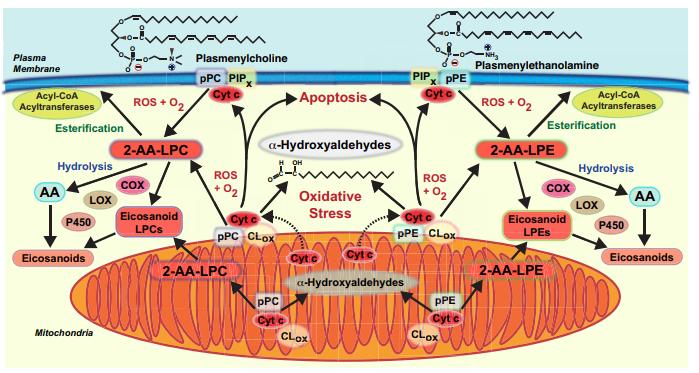
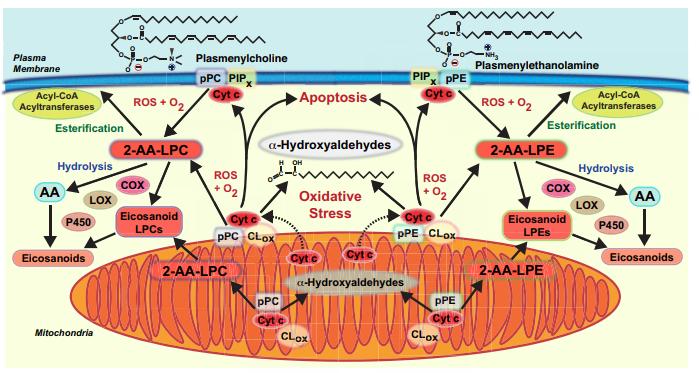
In the new study, Gross' team performed painstaking experiments to find the elusive mechanism by which plasmalogens are enzymatically degraded. Cytochrome c is typically found in mitochondria where it facilitates electron transport, but it is released into the cell under stressful conditions. Gross' team showed that cytochrome c released from the mitochondria can catalyze the breakdown of plasmalogens in the cell. Further, the products of this reaction are two different lipid signaling molecules which were not previously known to originate from plasmalogen breakdown.
"That was one thing that surprised us," Gross said of the signaling products. "The second thing that surprised us was the ease (with which the bond is broken)…The implication is that there is probably a lot of plasmalogen (breakdown) that's going on in conditions of oxidative stress." The results tie in with another observation about the brain cells of Alzheimer's disease patients, which is that they often have dysfunctional mitochondria and a resultant release of cytochrome c. Gross is now interested in delving deeper into how and why plasmalogen loss occurs in Alzheimer's patients, particularly those who develop the disease in old age, not due to familial mutations. Gross speculates that as people age, the accumulation of reactive oxygen species leads to cytochrome c release, activation of its peroxidase activity and plasmalogen breakdown in many membranes.
The results also have implications for understanding disorders in the heart and other plasmalogen-rich tissues, integrating studies of mitochondria, cell membranes and cell signaling under stressful conditions.
"This is like a quantum jump into the future," Gross said.
###
The study was funded by the National Institutes of Health.
About the Journal of Biological Chemistry
JBC is a weekly peer-reviewed scientific journal that publishes research "motivated by biology, enabled by chemistry" across all areas of biochemistry and molecular biology. The read the latest research in JBC, visit http://www.jbc.org/.
About the American Society for Biochemistry and Molecular Biology
The ASBMB is a nonprofit scientific and educational organization with more than 12,000 members worldwide. Most members teach and conduct research at colleges and universities. Others conduct research in various government laboratories, at nonprofit research institutions and in industry. The Society's student members attend undergraduate or graduate institutions. For more information about ASBMB, visit http://www.asbmb.org.
Media Contact
Sasha Mushegian
[email protected]
240-283-6616
@asbmb
http://www.asbmb.org
Related Journal Article
http://dx.doi.org/10.1074/jbc.RA117.001629