• HOME
  • NEWS
  • EXPLORE
    • CAREER
      • Companies
      • Jobs
    • EVENTS
    • iGEM
      • News
      • Team
    • PHOTOS
    • VIDEO
    • WIKI
  • BLOG
  • COMMUNITY
    • FACEBOOK
    • INSTAGRAM
    • TWITTER
Saturday, February 7, 2026
BIOENGINEER.ORG
No Result
View All Result
  • Login
  • HOME
  • NEWS
  • EXPLORE
    • CAREER
      • Companies
      • Jobs
        • Lecturer
        • PhD Studentship
        • Postdoc
        • Research Assistant
    • EVENTS
    • iGEM
      • News
      • Team
    • PHOTOS
    • VIDEO
    • WIKI
  • BLOG
  • COMMUNITY
    • FACEBOOK
    • INSTAGRAM
    • TWITTER
  • HOME
  • NEWS
  • EXPLORE
    • CAREER
      • Companies
      • Jobs
        • Lecturer
        • PhD Studentship
        • Postdoc
        • Research Assistant
    • EVENTS
    • iGEM
      • News
      • Team
    • PHOTOS
    • VIDEO
    • WIKI
  • BLOG
  • COMMUNITY
    • FACEBOOK
    • INSTAGRAM
    • TWITTER
No Result
View All Result
Bioengineer.org
No Result
View All Result
Home NEWS Science News Health

Soy lecithin NSAID combo drug protects against cancer with fewer side effects, UTHealth reports

Bioengineer by Bioengineer
May 29, 2018
in Health
Reading Time: 2 mins read
0
Share on FacebookShare on TwitterShare on LinkedinShare on RedditShare on Telegram
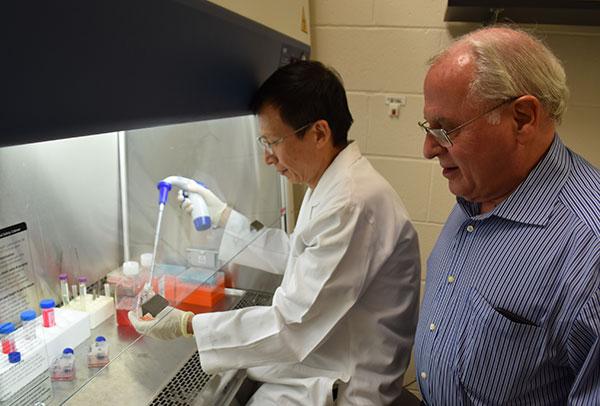
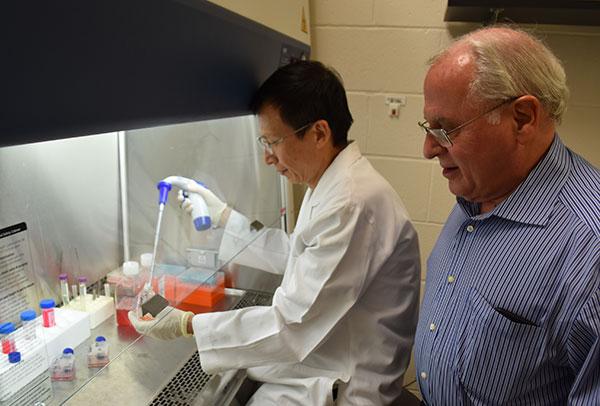
IMAGE

Credit: PHOTO CREDIT Rob Cahill, UTHealth

When scientists at The University of Texas Health Science Center at Houston (UTHealth) applied a chemical found in soybeans to a non-steroidal anti-inflammatory drug (NSAID), they increased its anticancer properties and reduced its side effects. Findings of the preclinical study of phosphatidylcholine, also called lecithin, appear in the journal Oncology Letters.

"The results support the potential use of NSAIDs associated with phosphatidylcholine for the prevention and treatment of colorectal cancer," said Lenard Lichtenberger, Ph.D., the study's lead investigator and a professor of integrative biology and pharmacology at McGovern Medical School at UTHealth.

The NSAID indomethacin associated with phosphatidylcholine was studied in a head-to-head comparison with three other NSAIDs (one of them aspirin). According to the results, the combination provided superior colorectal cancer protection with less gastrointestinal bleeding. The study was conducted in a mouse model and in laboratory experiments.

Colorectal cancer is the third leading cause of cancer-related death in the United States and is expected to claim 50,630 lives this year.

NSAIDs work by decreasing the production of substances that promote inflammation, pain and fever. They are used to prevent heart disease and reduce arthritis pain. NSAIDs, notably aspirin, also guard against colorectal cancer.

"Many cancers are inflammation based," he said. "The anti-inflammatory drugs also have the potential use for cancer therapy."

However, when taken on a daily basis for months to years, NSAIDs can cause problems, Lichtenberger said. "The intestinal injury is worse than the stomach ulcers, for non-aspirin NSAIDs like indomethacin," he said.

"This is our latest preclinical study on the use of phosphatidylcholine to mitigate the side effects of using NSAIDs and protect against a number of cancers," he said.

###

Lichtenberger's coauthors from UTHealth included Tri Phan, Dexing Fang, Ph.D., and Elizabeth Dial, Ph.D.

The study, titled "Chemoprevention with phosphatidycholine non-steroidal anti-inflammatory drugs in vivo and in vitro," was supported by National Institutes of Health grants (R03 CA171613 and R41CA171408).

Lichtenberger is on the faculty of McGovern Medical School and The University of Texas MD Anderson Cancer Center UTHealth Graduate School of Biomedical Sciences.

Media Contact

Robert Cahill
[email protected]
713-500-3030

http://www.uthouston.edu

Share19Tweet7Share2ShareShareShare1

Related Posts

Evaluating Pediatric Emergency Care Quality in Ethiopia

February 7, 2026

TPMT Expression Predictions Linked to Azathioprine Side Effects

February 7, 2026

Improving Dementia Care with Enhanced Activity Kits

February 7, 2026

Decoding Prostate Cancer Origins via snFLARE-seq, mxFRIZNGRND

February 7, 2026
Please login to join discussion

POPULAR NEWS

  • Robotic Ureteral Reconstruction: A Novel Approach

    Robotic Ureteral Reconstruction: A Novel Approach

    82 shares
    Share 33 Tweet 21
  • Digital Privacy: Health Data Control in Incarceration

    63 shares
    Share 25 Tweet 16
  • Study Reveals Lipid Accumulation in ME/CFS Cells

    57 shares
    Share 23 Tweet 14
  • Breakthrough in RNA Research Accelerates Medical Innovations Timeline

    53 shares
    Share 21 Tweet 13

About

We bring you the latest biotechnology news from best research centers and universities around the world. Check our website.

Follow us

Recent News

Evaluating Pediatric Emergency Care Quality in Ethiopia

TPMT Expression Predictions Linked to Azathioprine Side Effects

Improving Dementia Care with Enhanced Activity Kits

Subscribe to Blog via Email

Enter your email address to subscribe to this blog and receive notifications of new posts by email.

Join 73 other subscribers
  • Contact Us

Bioengineer.org © Copyright 2023 All Rights Reserved.

Welcome Back!

Login to your account below

Forgotten Password?

Retrieve your password

Please enter your username or email address to reset your password.

Log In
No Result
View All Result
  • Homepages
    • Home Page 1
    • Home Page 2
  • News
  • National
  • Business
  • Health
  • Lifestyle
  • Science

Bioengineer.org © Copyright 2023 All Rights Reserved.