Credit: Li Lab, CSHL
Cold Spring Harbor, NY — Neuroscientists at Cold Spring Harbor Laboratory (CSHL) have identified a neural circuit in the amygdala, the brain's seat of emotion processing, that gives rise to anxiety. Their insight has revealed the critical role of a molecule called dynorphin, which could serve as a target for treatment of anxiety-related disorders including post-traumatic stress disorder (PTSD).
Though they are distinct, fear and anxiety operate hand in hand, as anxiety almost always follows brief fearful experiences and can in turn influence fear responses to a perceived threat. However, very intense fearful experiences, especially those that are life threatening, are often "over-learned" and can lead to an unhealthy level of anxiety or to anxiety disorders. Such brain disorders are the most common, affecting about 18% of the adult US population.
Previous studies indicate that two regions in the amygdala–the central amygdala and the BNST (bed nucleus of the stria terminalis)–coordinate short-term and long-term responses to various kinds of threatening stimuli. "What we haven't known are the underlying circuit and cellular mechanisms in these regions that control the generation of anxiety," says CSHL Professor Bo Li, who led the research.
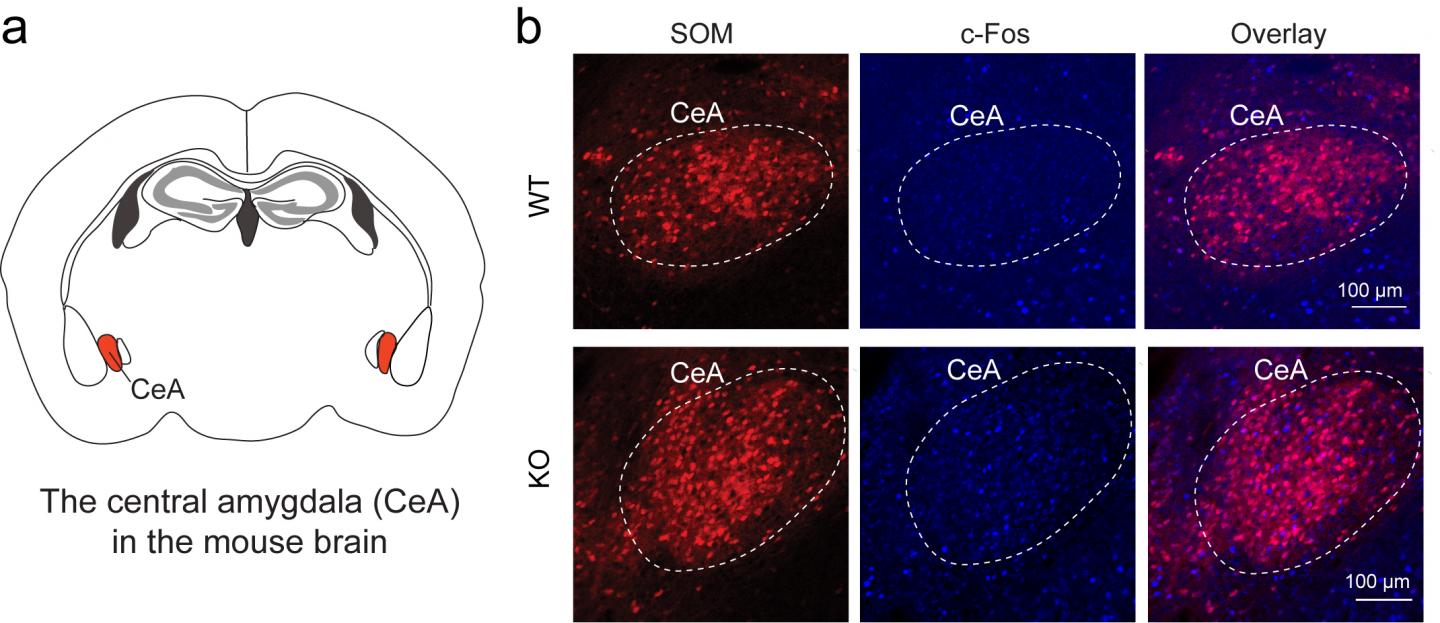
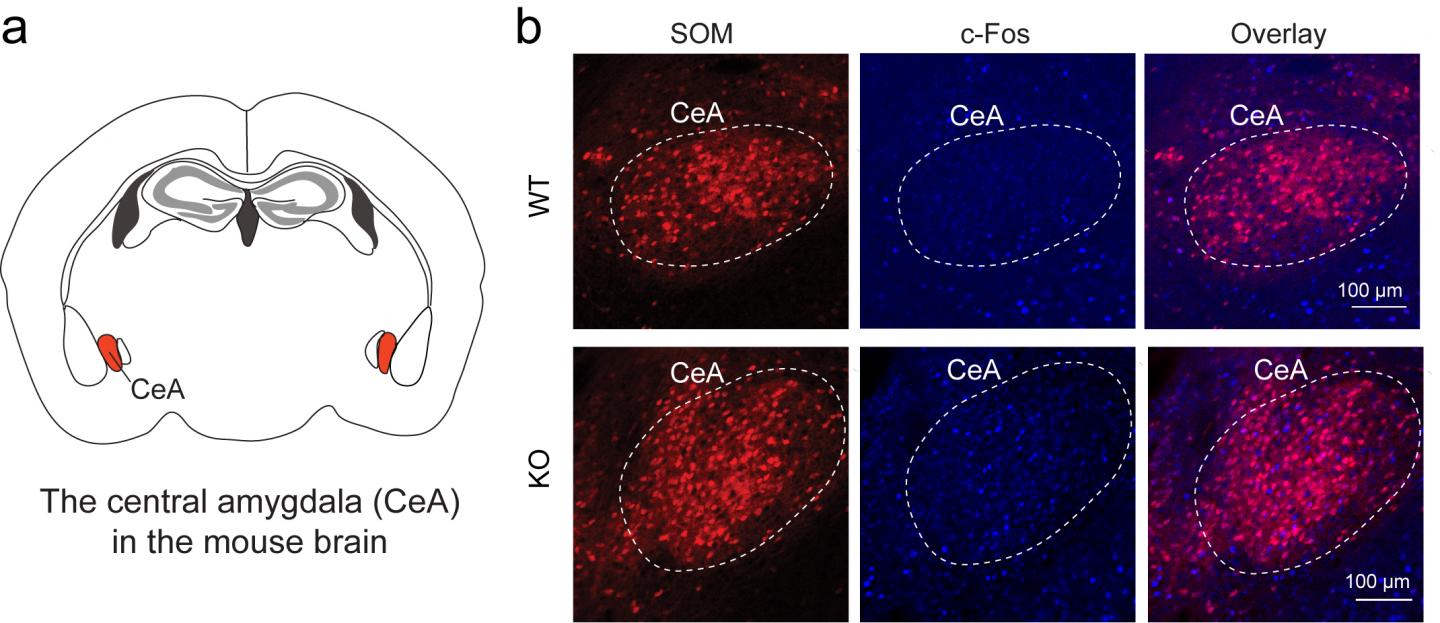
The central amygdala forges strong inhibitory connections with the BNST. To learn about what happens to these connections during anxiety, his team genetically manipulated one specific type of neuron called SOM+ because of a peptide they express called somatostatin. Li's prior work showed that these "SOM+" neurons are necessary for the learning of fear responses. The team knocked out a gene called Erbb4 in SOM+ neurons – a gene that's been linked to disorders including bipolar disorder and schizophrenia.
Sandra Ahrens, a postdoctoral investigator in the Li lab, led experiments showing that when Erbb4 was deleted from SOM+ neurons in the central amygdala, mice displayed heightened anxiety. The team traced the mechanism behind this anxiety within a circuit that runs between the central amygdala and the BNST.
The process leading to anxiety began with increased excitation of SOM+ neurons in the central amygdala. This led to a large increase in signaling by dynorphin, a peptide made by these neurons. This aberrant signaling interfered with normal inhibition of SOM+ neurons in the BNST and resulted in their becoming overactive. The net result was a display of anxious behavior.
Dynorphin signaling was in this way identified as the driver of elevated anxiety. The team not only showed this in mice with neurons lacking Erbb4, but also, importantly, in genetically normal mice that were exposed to stress. "That's why we think this is an important circuit in anxiety," says Li. "By manipulating it in mice, we are actually able to ameliorate anxiety."
Li states: "Our results suggest that dynorphin can drive anxiety and therefore could be a cellular target for treating increased anxiety induced by stress. Our next step is to understand whether the receptors for dynorphin are expressed in the SOM+ neurons in the central amygdala itself or if they're expressed by some other inputs onto the BNST."
###
Funding: National Institutes of Health; NARSAD/Brain and Behavior Research Foundation; Louis Feil Trust; Stanley Family Foundation; Simons Foundation; Human Frontier Science Program; Wodecroft Foundation; CSHL and Northwell Health Affiliation; CSHL Cancer Center Support Grant.
Citation: Ahrens S et al, "A central extended amygdala circuit that modulates anxiety" appears online ahead of print May 29, 2018 in The Journal of Neuroscience.
About Cold Spring Harbor Laboratory
Founded in 1890, Cold Spring Harbor Laboratory has shaped contemporary biomedical research and education with programs in cancer, neuroscience, plant biology and quantitative biology. Home to eight Nobel Prize winners, the private, not-for-profit Laboratory employs 1,100 people including 600 scientists, students and technicians. The Meetings & Courses Program annually hosts more than 12,000 scientists. The Laboratory's education arm also includes an academic publishing house, a graduate school and the DNA Learning Center with programs for middle and high school students and teachers. For more information, visit http://www.cshl.edu
Media Contact
Peter Tarr
[email protected]
917-435-5068
@genomeresearch
Cold Spring Harbor Laboratory – Advancing the frontiers of biology through education and research