

• HOME
  • NEWS
  • EXPLORE
    • CAREER
      • Companies
      • Jobs
    • EVENTS
    • iGEM
      • News
      • Team
    • PHOTOS
    • VIDEO
    • WIKI
  • BLOG
  • COMMUNITY
    • FACEBOOK
    • INSTAGRAM
    • TWITTER
Sunday, May 17, 2026
BIOENGINEER.ORG
No Result
View All Result
  • Login
  • HOME
  • NEWS
  • EXPLORE
    • CAREER
      • Companies
      • Jobs
        • Lecturer
        • PhD Studentship
        • Postdoc
        • Research Assistant
    • EVENTS
    • iGEM
      • News
      • Team
    • PHOTOS
    • VIDEO
    • WIKI
  • BLOG
  • COMMUNITY
    • FACEBOOK
    • INSTAGRAM
    • TWITTER
  • HOME
  • NEWS
  • EXPLORE
    • CAREER
      • Companies
      • Jobs
        • Lecturer
        • PhD Studentship
        • Postdoc
        • Research Assistant
    • EVENTS
    • iGEM
      • News
      • Team
    • PHOTOS
    • VIDEO
    • WIKI
  • BLOG
  • COMMUNITY
    • FACEBOOK
    • INSTAGRAM
    • TWITTER
No Result
View All Result
Bioengineer.org
No Result
View All Result
Home NEWS Science News Biology

The mystery of masculinization in Daphnia magna unraveled

Bioengineer by Bioengineer
May 29, 2018
in Biology
Reading Time: 2 mins read
0
Share on FacebookShare on TwitterShare on LinkedinShare on RedditShare on Telegram
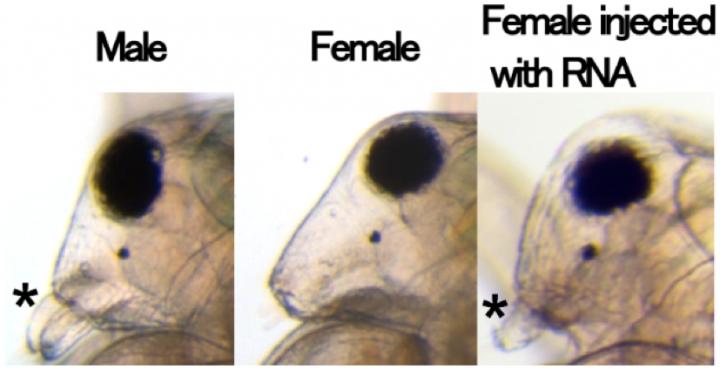
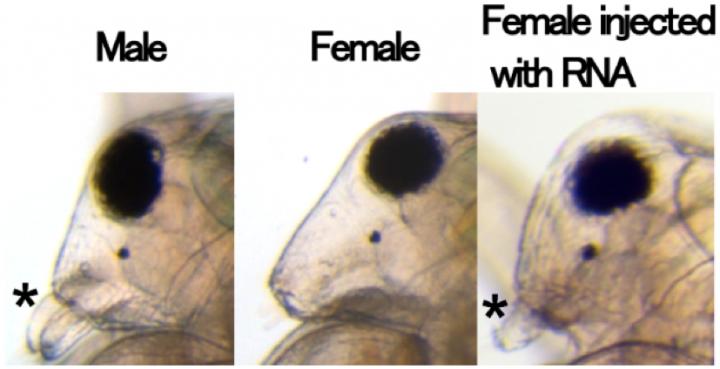
IMAGE

Credit: Osaka University

The messenger RNA (mRNA) that conveys genetic information has a region that can be translated into protein (translated region). A noncoding area (ncRNA), which has no translated region (TR), has not been thought to be important; however, recent studies revealed that ncRNAs are transcribed from thousands of loci in genomes.

Of the ncRNA, the number of long noncoding RNAs (lncRNAs), RNAs with greater than 200 bases, is said to be over 20,000 in human. However, commonality and diversity in the mechanism of IncRNAs, as well as conservation of their function among living organisms, have not been clarified.

Researchers led by Hajime Watanabe at Osaka University discovered lncRNAs to activate the male-determining gene doublesex1 (Dsx1) necessary for sex determination in the crustacean Daphnia magna. Their research results were published in Current Biology.

The researchers had found that proteins produced from the TR of the Dsx1 gene induced masculinization in the crustacean Daphnia magna. (Figure 1 top)

"In this study, we discovered an interesting phenomenon: masculinization is also caused by the untranslated regions (UTRs) on a strand of mRNA. The UTRs do not form the protein-coding region of the Dsx1 gene," said lead author Yasuhiko Kato. (Figure 1 center, Figure 2)

Proposing the hypothesis that a sequence in the UTR of the Dsx1 gene also serves as part of lncRNAs and naming the RNA doublesex1 alpha promoter-associated long RNA (DAPALR), the researchers examined the synthesis and function of the RNA. As a result, they found that the UTR overlapping with part of DAPALR-activated Dsx1, by which Dsx1 proteins were produced, causing masculinization. (Figure 1 bottom, Figure 3)

Their achievements will contribute to the understanding of the functional mechanism of lncRNAs as well as diversity in and evolution of the sex-determining mechanism.

###

Osaka University was founded in 1931 as one of the seven imperial universities of Japan and now has expanded to one of Japan's leading comprehensive universities. The University has now embarked on open research revolution from a position as Japan's most innovative university and among the most innovative institutions in the world according to Reuters 2015 Top 100 Innovative Universities and the Nature Index Innovation 2017. The university's ability to innovate from the stage of fundamental research through the creation of useful technology with economic impact stems from its broad disciplinary spectrum.

Website: http://resou.osaka-u.ac.jp/en/top

Media Contact

Saori Obayashi
[email protected]
81-661-055-886
@osaka_univ_e

http://www.osaka-u.ac.jp/en

Original Source

http://resou.osaka-u.ac.jp/en/research/2018/20180525_1 http://dx.doi.org/10.1016/j.cub.2018.04.029


Share13Tweet8Share2ShareShareShare2

Related Posts

Uncovering C. elegans Immunity via Genetic Screens — Biology

Uncovering C. elegans Immunity via Genetic Screens

May 16, 2026
Single mother must adapt swiftly — the survival of her colony depends on it — Biology

Single mother must adapt swiftly — the survival of her colony depends on it

May 15, 2026

Why Are Nearly Everyone Right-Handed? It Might Be Linked to How We Learned to Walk

May 15, 2026

Excessive Neuronal Activity Initiates Severe Autoimmune Brain Disorder

May 15, 2026
Please login to join discussion

POPULAR NEWS

  • Research Indicates Potential Connection Between Prenatal Medication Exposure and Elevated Autism Risk

    844 shares
    Share 338 Tweet 211
  • New Study Reveals Plants Can Detect the Sound of Rain

    730 shares
    Share 291 Tweet 182
  • Salmonella Haem Blocks Macrophages, Boosts Infection

    62 shares
    Share 25 Tweet 16
  • Breastmilk Balances E. coli and Beneficial Bacteria in Infant Gut Microbiomes

    58 shares
    Share 23 Tweet 15

About

We bring you the latest biotechnology news from best research centers and universities around the world. Check our website.

Follow us

Recent News

Detecting Illicit Bitcoin Transactions with Temporal Graph Learning

New Study Reveals the Massive Economic Impact of Tuberculosis

Age Discrimination Affects Healthcare Use in India

Subscribe to Blog via Email

Enter your email address to subscribe to this blog and receive notifications of new posts by email.

Join 82 other subscribers
  • Contact Us

Bioengineer.org © Copyright 2023 All Rights Reserved.

Welcome Back!

Login to your account below

Forgotten Password?

Retrieve your password

Please enter your username or email address to reset your password.

Log In
No Result
View All Result
  • Homepages
    • Home Page 1
    • Home Page 2
  • News
  • National
  • Business
  • Health
  • Lifestyle
  • Science

Bioengineer.org © Copyright 2023 All Rights Reserved.