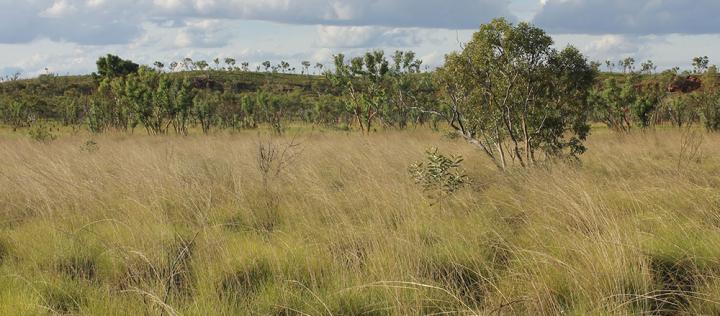
Credit: Courtesy of Terrestrial Ecosystem Research Network
A new study has uncovered when and why the native vegetation that today dominates much of Australia first expanded across the continent. The research should help researchers better predict the likely impact of climate change and rising carbon dioxide levels on such plants here and elsewhere. The dominant vegetation, so-called C4 plants, includes a wide variety of tropical, subtropical and arid-land grasses. , C4 plants also include important worldwide crops such as sugarcane, corn, sorghum and millet. The research has just been published online in the journal Geophysical Research Letters.
C4 refers to the metabolic pathway that certain plants use to conduct photosynthesis, as opposed to the method used by the C3 plants, which dominate cooler, higher-latitude regions. C4 organisms comprise about a quarter of the world's plant life today. In many hotter regions, they came to dominate about 6 million to 10 million years ago. They apparently evolved to photosynthesize under warm, dry, conditions, and low levels of atmospheric carbon dioxide, which developed at that time. They have a special ability to take advantage of strong summer rainfall.
To figure when the plants spread across the Australian landscape, the researchers analyzed fossilized pollen and waxy substances found in leaves that had been swept off the continent, to be preserved in deep-sea sediments. Surprisingly, in northwest Australia C4 plants did not expand at the same time as they did on other continents, in spite of regionally arid conditions and falling atmospheric CO2, both of which should have promoted C4 vegetation. Instead, the researchers found, the vegetation expanded only 3.5 million years ago long after the other regions. The authors say that the rise of C4 plants in Australia was likely the result of a strengthened summer monsoon that developed around that time.
"Our results suggest that there was not a single factor that drove the transformation of tropical ecosystems around the globe," said coauthor Pratigya Polissar, a research scientist at Columbia University's Lamont-Doherty Earth Observatory.
In the future, human influence on the atmosphere is likely to play an important role in the distribution of C4-dominated ecosystems. Rising carbon dioxide will place C4 plants at a disadvantage; on the other hand, rising temperature and changes in the season and amount of rainfall could favor them, said project leader Francesca McInerney of the University of Adelaide. In Australia, C4 plants are critical to grazing, soil carbon storage and biodiversity, she pointed out.
"Understanding how changing CO2 levels and other environmental factors affected these plants in the past can help us evaluate and plan for effects from increasing CO2 levels and climate change today," said Polissar.
###
The study's lead author is Jake Andrae, a PhD. candidate at the University of Adelaide. The other authors are S. Howard and P.A. Hall, also of Adelaide; J.M.K. Sniderman of the University of Melbourne; and Sam Phelps of Lamont-Doherty.
Scientist contact: Pratigya Polissar [email protected]
Media Contact
Kevin Krajick
[email protected]
212-854-9729
@earthinstitute
http://www.earth.columbia.edu
Related Journal Article
http://dx.doi.org/10.1029/2018GL077833