

• HOME
  • NEWS
  • EXPLORE
    • CAREER
      • Companies
      • Jobs
    • EVENTS
    • iGEM
      • News
      • Team
    • PHOTOS
    • VIDEO
    • WIKI
  • BLOG
  • COMMUNITY
    • FACEBOOK
    • INSTAGRAM
    • TWITTER
Saturday, February 7, 2026
BIOENGINEER.ORG
No Result
View All Result
  • Login
  • HOME
  • NEWS
  • EXPLORE
    • CAREER
      • Companies
      • Jobs
        • Lecturer
        • PhD Studentship
        • Postdoc
        • Research Assistant
    • EVENTS
    • iGEM
      • News
      • Team
    • PHOTOS
    • VIDEO
    • WIKI
  • BLOG
  • COMMUNITY
    • FACEBOOK
    • INSTAGRAM
    • TWITTER
  • HOME
  • NEWS
  • EXPLORE
    • CAREER
      • Companies
      • Jobs
        • Lecturer
        • PhD Studentship
        • Postdoc
        • Research Assistant
    • EVENTS
    • iGEM
      • News
      • Team
    • PHOTOS
    • VIDEO
    • WIKI
  • BLOG
  • COMMUNITY
    • FACEBOOK
    • INSTAGRAM
    • TWITTER
No Result
View All Result
Bioengineer.org
No Result
View All Result
Home NEWS Science News Biology

3D images of cancer cells in the body

Bioengineer by Bioengineer
May 15, 2018
in Biology
Reading Time: 2 mins read
0
Share on FacebookShare on TwitterShare on LinkedinShare on RedditShare on Telegram
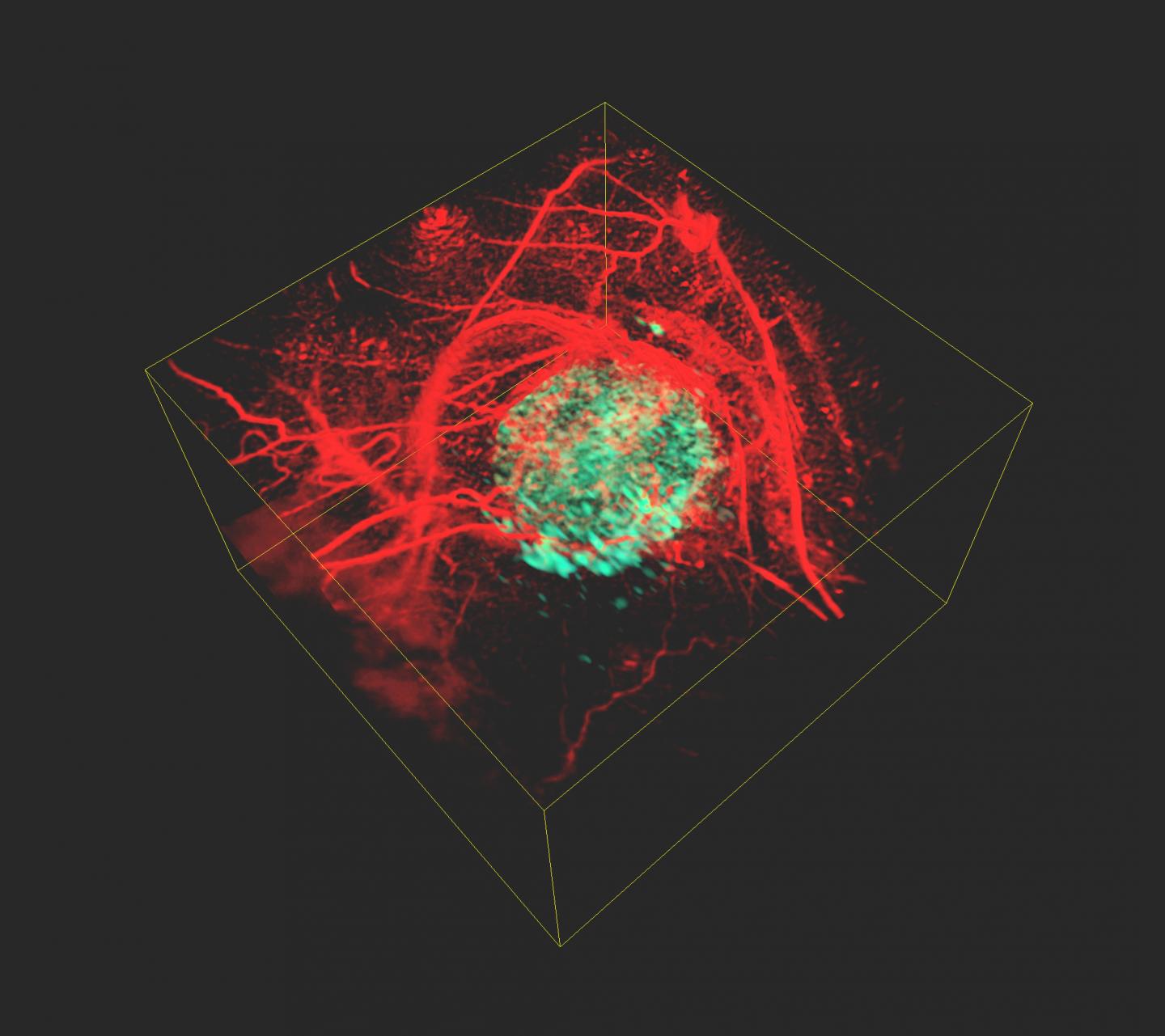
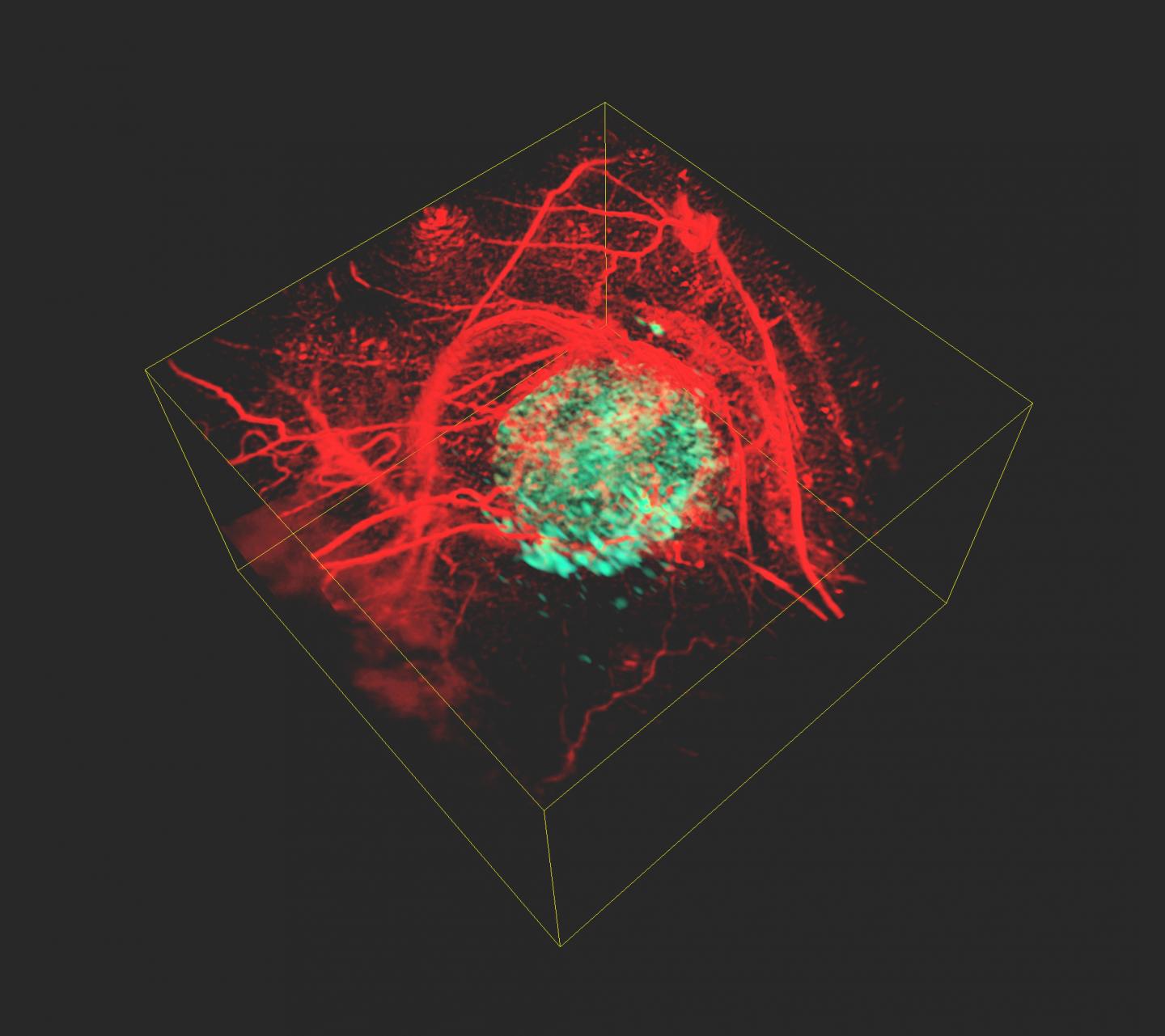
IMAGE

Credit: Jan Laufer / MLU

Making tumour cells glow: Medical physicists at Martin Luther University Halle-Wittenberg (MLU) have developed a new method that can generate detailed three-dimensional images of the body's interior. This can be used to more closely investigate the development of cancer cells in the body. The research group presents its findings in Communication Physics, a journal published by the Nature Publishing Group.

Clinicians and scientists are in need of a better understanding of cancer cells and their properties in order to provide targeted cancer treatment. Individual cancer cells are often examined in test tubes before the findings are tested in living organisms. "Our aim is to visualise cancer cells inside the living body to find out how they function, how they spread and how they react to new therapies," says medical physicist Professor Jan Laufer from MLU. He specialises in the field of photoacoustic imaging, a process that uses ultrasound waves generated by laser beams to produce high-resolution, three-dimensional images of the body's interior.

"The problem is that tumour cells are transparent. This makes it difficult to use optical methods to examine tumours in the body," explains Laufer whose research group has developed a new method to solve this problem: First the scientists introduce a specific gene into the genome of the cancer cells. "Once inside the cells, the gene produces a phytochrome protein, which originates from plants and bacteria. There it serves as a light sensor," Laufer continues. In the next step, the researchers illuminate the tissue with short pulses of light at two different wavelengths using a laser. Inside the body, the light pulses are absorbed and converted into ultrasonic waves. These waves can then be measured outside the organism and two images of the body's interior can be reconstructed based on this data. "The special feature of phytochrome proteins is that they alter their structure and thus also their absorption properties depending on the wavelength of the laser beams. This results in changes to the amplitude of the ultrasound waves that are generated in the tumour cells. None of the other tissue components, for example blood vessels, have this property – their signal remains constant," Laufer says. By calculating the difference between the two images, a high-resolution, three-dimensional image of the tumour cells is created, which is free of the otherwise overwhelming background contrast.

The development of Halle's medical physicists can be applied to a wide range of applications in the preclinical research and the life sciences. In addition to cancer research, the method can be used to observe cellular and genetic processes in living organisms.

###

Media Contact

Tom Leonhardt
[email protected]
49-345-552-1438

http://www.uni-halle.de

Original Source

http://pressemitteilungen.pr.uni-halle.de/index.php?modus=pmanzeige&pm_id=2875 http://dx.doi.org/10.1038/s42005-017-0003-2


Share12Tweet8Share2ShareShareShare2

Related Posts

Florida Cane Toad: Complex Spread and Selective Evolution

Florida Cane Toad: Complex Spread and Selective Evolution

February 7, 2026
New Study Uncovers Mechanism Behind Burn Pit Particulate Matter–Induced Lung Inflammation

New Study Uncovers Mechanism Behind Burn Pit Particulate Matter–Induced Lung Inflammation

February 6, 2026

DeepBlastoid: Advancing Automated and Efficient Evaluation of Human Blastoids with Deep Learning

February 6, 2026

Navigating the Gut: The Role of Formic Acid in the Microbiome

February 6, 2026
Please login to join discussion

POPULAR NEWS

  • Robotic Ureteral Reconstruction: A Novel Approach

    Robotic Ureteral Reconstruction: A Novel Approach

    82 shares
    Share 33 Tweet 21
  • Digital Privacy: Health Data Control in Incarceration

    63 shares
    Share 25 Tweet 16
  • Study Reveals Lipid Accumulation in ME/CFS Cells

    57 shares
    Share 23 Tweet 14
  • Breakthrough in RNA Research Accelerates Medical Innovations Timeline

    53 shares
    Share 21 Tweet 13

About

We bring you the latest biotechnology news from best research centers and universities around the world. Check our website.

Follow us

Recent News

Barriers and Boosters of Seniors’ Physical Activity in Karachi

Evaluating Pediatric Emergency Care Quality in Ethiopia

TPMT Expression Predictions Linked to Azathioprine Side Effects

Subscribe to Blog via Email

Enter your email address to subscribe to this blog and receive notifications of new posts by email.

Join 73 other subscribers
  • Contact Us

Bioengineer.org © Copyright 2023 All Rights Reserved.

Welcome Back!

Login to your account below

Forgotten Password?

Retrieve your password

Please enter your username or email address to reset your password.

Log In
No Result
View All Result
  • Homepages
    • Home Page 1
    • Home Page 2
  • News
  • National
  • Business
  • Health
  • Lifestyle
  • Science

Bioengineer.org © Copyright 2023 All Rights Reserved.