• HOME
  • NEWS
  • EXPLORE
    • CAREER
      • Companies
      • Jobs
    • EVENTS
    • iGEM
      • News
      • Team
    • PHOTOS
    • VIDEO
    • WIKI
  • BLOG
  • COMMUNITY
    • FACEBOOK
    • INSTAGRAM
    • TWITTER
Saturday, February 7, 2026
BIOENGINEER.ORG
No Result
View All Result
  • Login
  • HOME
  • NEWS
  • EXPLORE
    • CAREER
      • Companies
      • Jobs
        • Lecturer
        • PhD Studentship
        • Postdoc
        • Research Assistant
    • EVENTS
    • iGEM
      • News
      • Team
    • PHOTOS
    • VIDEO
    • WIKI
  • BLOG
  • COMMUNITY
    • FACEBOOK
    • INSTAGRAM
    • TWITTER
  • HOME
  • NEWS
  • EXPLORE
    • CAREER
      • Companies
      • Jobs
        • Lecturer
        • PhD Studentship
        • Postdoc
        • Research Assistant
    • EVENTS
    • iGEM
      • News
      • Team
    • PHOTOS
    • VIDEO
    • WIKI
  • BLOG
  • COMMUNITY
    • FACEBOOK
    • INSTAGRAM
    • TWITTER
No Result
View All Result
Bioengineer.org
No Result
View All Result
Home NEWS Science News Biology

Flowing cells in a wavy microchannel for effective size-based cell sorting

Bioengineer by Bioengineer
May 15, 2018
in Biology
Reading Time: 2 mins read
0
Share on FacebookShare on TwitterShare on LinkedinShare on RedditShare on Telegram
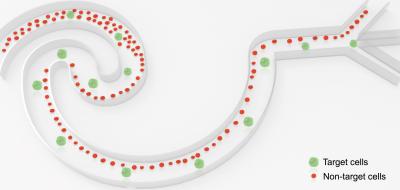
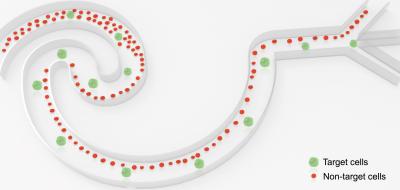
IMAGE

Credit: SUTD

Nearly half a century ago scientists have noticed an interesting phenomenon that small particles flowing through a long tube can stay at a specific position along the cross-section of a tube. This is known as inertial focusing. Later, along with the development of microfluidic technology in recent decades, inertial focusing (one type of passive microfluidic manipulation technology) has emerged as one of the most powerful and precise cell manipulation techniques, exhibiting immense commercial potentials in the bioengineering and pharmaceutical industries. Assistant Professor Dr Ye Ai's research team from the Singapore University of Technology and Design (SUTD) recently developed a novel, credit card sized inertial cell focusing and sorting microfluidic device with a channel of 125 μm wide (roughly half of a single fingernail's thickness), providing the potential of rare cell isolation from complex clinical samples.

Currently cancer is becoming one of the leading causes of human death. One of the major difficulties towards achieving radical cure in cancer is due to malignant metastasis, which directly causes overwhelming obstacles in therapeutic management and early diagnosis. The ability to isolate rare circulating tumor cells (CTCs), the seeds for cancer metastasis, enables much less invasive approach for cancer diagnosis and prognosis. New microfluidic technologies for high throughput, high accuracy cell sorting of complex biological samples are highly sought after to address the challenge in rare cell isolation.

In this research, Dr Ai's team presented a novel inertial focusing and sorting device with a series of reverse wavy channel structures consisting of semi-circular sections that generate a periodically reversed hydrodynamic flow perpendicular to the main flow direction. The balance between two kinds of hydrodynamic forces resulted in a size-dependent lateral particle movement across the channel, which finally achieved size-based separation of target cells from non-target cells. The principal investigator, SUTD's Dr Ai said: "Compared to active methods, the passive inertial focusing with the use of hydrodynamic forces exhibit the merits of a simplified setup, high-throughput and low-energy consumption. Moreover, the linear array of these repeated wavy channel units also facilitates easy horizontal (2D) and vertical (3D) parallelization of multiple channels, which provides great potential for high-throughput cell sorting in practical biomedical applications." The team has applied the developed sorting technology for high-throughput isolation of cancer cells from whole blood samples.

###

This work has been published in Nature's Microsystems & Nanoengineering journal, which is focused on research in all aspects of Micro and Nano Systems. Two SUTD graduate students (Yinning Zhou and Zhichao Ma) participated in this research project.

Media Contact

Melissa Koh
[email protected]
65-649-98742

http://www.sutd.edu.sg

Related Journal Article

http://dx.doi.org/10.1038/s41378-018-0005-6
Share12Tweet8Share2ShareShareShare2

Related Posts

New Study Uncovers Mechanism Behind Burn Pit Particulate Matter–Induced Lung Inflammation

New Study Uncovers Mechanism Behind Burn Pit Particulate Matter–Induced Lung Inflammation

February 6, 2026

DeepBlastoid: Advancing Automated and Efficient Evaluation of Human Blastoids with Deep Learning

February 6, 2026

Navigating the Gut: The Role of Formic Acid in the Microbiome

February 6, 2026

AI-Enhanced Optical Coherence Photoacoustic Microscopy Revolutionizes 3D Cancer Model Imaging

February 6, 2026
Please login to join discussion

POPULAR NEWS

  • Robotic Ureteral Reconstruction: A Novel Approach

    Robotic Ureteral Reconstruction: A Novel Approach

    82 shares
    Share 33 Tweet 21
  • Digital Privacy: Health Data Control in Incarceration

    63 shares
    Share 25 Tweet 16
  • Study Reveals Lipid Accumulation in ME/CFS Cells

    57 shares
    Share 23 Tweet 14
  • Breakthrough in RNA Research Accelerates Medical Innovations Timeline

    53 shares
    Share 21 Tweet 13

About

We bring you the latest biotechnology news from best research centers and universities around the world. Check our website.

Follow us

Recent News

Palmitoylation of Tfr1 Drives Platelet Ferroptosis and Exacerbates Liver Damage in Heat Stroke

Oxygen-Enhanced Dual-Section Microneedle Patch Improves Drug Delivery and Boosts Photodynamic and Anti-Inflammatory Treatment for Psoriasis

Scientists Identify SARS-CoV-2 PLpro and RIPK1 Inhibitors Showing Potent Synergistic Antiviral Effects in Mouse COVID-19 Model

Subscribe to Blog via Email

Enter your email address to subscribe to this blog and receive notifications of new posts by email.

Join 73 other subscribers
  • Contact Us

Bioengineer.org © Copyright 2023 All Rights Reserved.

Welcome Back!

Login to your account below

Forgotten Password?

Retrieve your password

Please enter your username or email address to reset your password.

Log In
No Result
View All Result
  • Homepages
    • Home Page 1
    • Home Page 2
  • News
  • National
  • Business
  • Health
  • Lifestyle
  • Science

Bioengineer.org © Copyright 2023 All Rights Reserved.