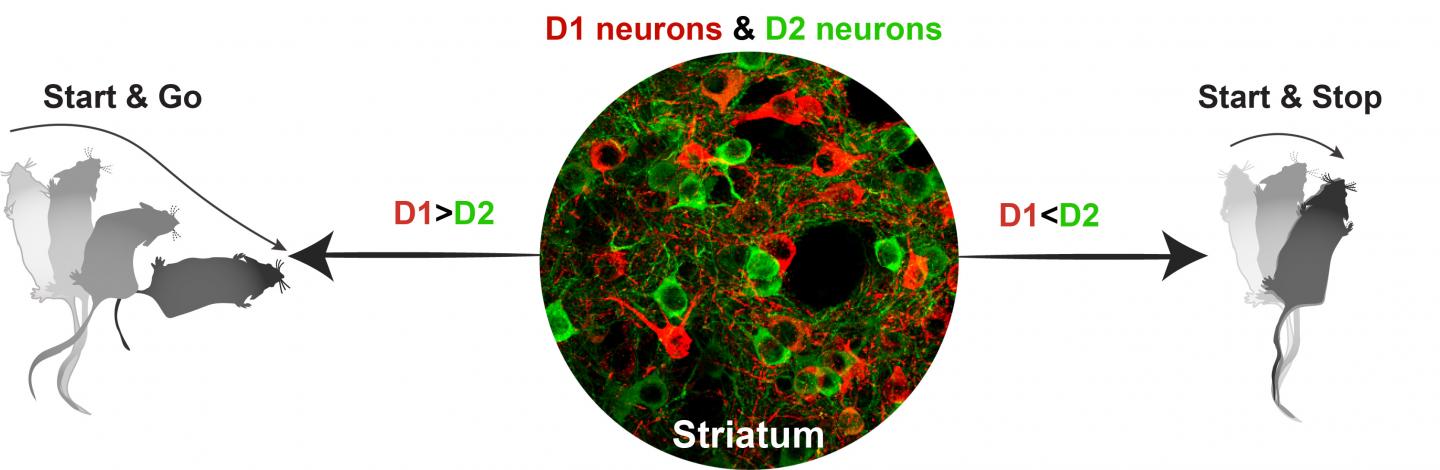
Credit: NIEHS
A new tool developed by researchers at the National Institutes of Health has determined, for the first time, how two distinct sets of neurons in the mouse brain work together to control movement. The method, called spectrally resolved fiber photometry (SRFP), can be used to measure the activity of these neuron groups in both healthy mice and those with brain disease. The scientists plan to use the technique to better understand what goes wrong in neurological disorders, such as Parkinson's disease (PD). The study appeared online May 3 in the journal Neuron.
According to Guohong Cui, M.D., Ph.D., head of the In Vivo Neurobiology Group at the National Institute of Environmental Health Sciences (NIEHS), part of NIH, the project began because he wanted to find out why patients with PD have problems with movement. Typically, PD motor symptoms include tremor, muscle stiffness, slowness of movement, and impaired balance.
Cui explained that an animal's ability to move was controlled by two groups of neurons in the brain called the direct pathway (D1) and indirect pathway (D2). Based on clinical studies of patients with PD and primate models, some researchers hypothesized that the loss of the neurotransmitter dopamine in the midbrain resulted in an imbalance of neural activities between D1 and D2. Since previous methods could not effectively distinguish different cell types in the brain, the hypothesis remained under debate. However, using SRFP, Cui's team was able to label D1 and D2 neurons with green and red fluorescent sensors to report their neural activity.
"Our method allowed us to simultaneously measure neural activity of both pathways in a mouse as the animal performed tasks," Cui said. "In the future, we could potentially use SRFP to measure the activity of several cell populations utilizing various colors and sensors."
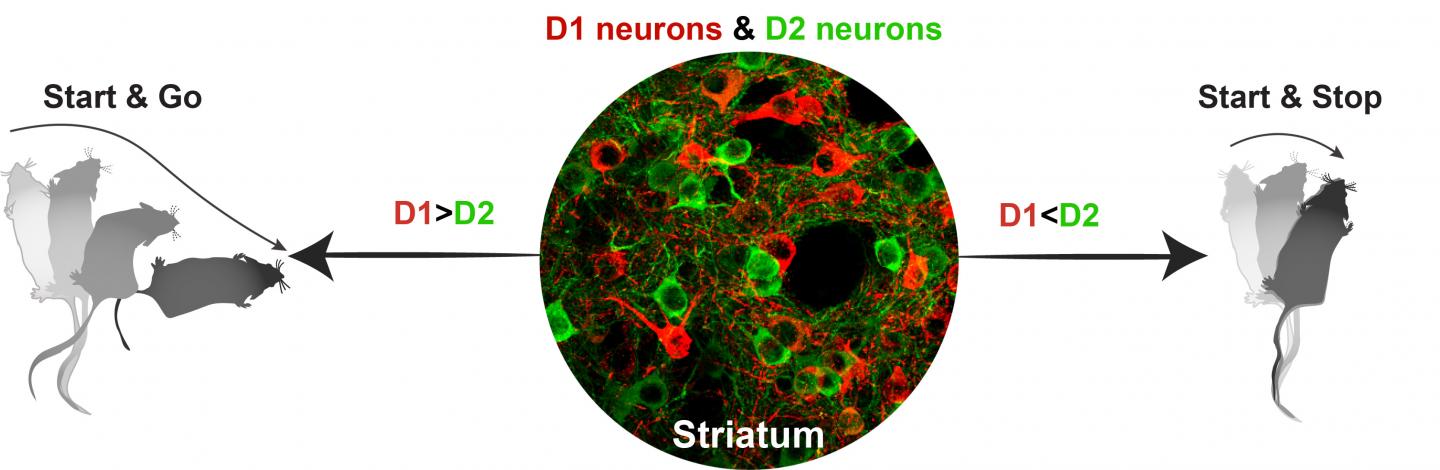
With SRFP, Cui and colleagues found that when neural activity in D1 neurons is stronger than D2 neurons, the animal does a start and go, which means it starts and moves to another location. But, when the activity of D2 neurons is stronger than D1 neurons, the mouse does a start and stop, meaning it initiates a movement, but stops immediately.
Cui said both movements are normal for mice and analyzing them may help researchers predict what kind of movement the animal will make based on its neural activity. This advance may help explain what happens in the brains of mice with PD.
Two of Cui's team members, NIEHS Visiting Fellows Chengbo Meng, Ph.D., and Jingheng Zhou, Ph.D., share first-authorship of the Neuron article.
"The traditional method of electrophysiological recording is good when you want to measure electrical outputs of neurons, but it cannot tell you what type of neurons are generating those signals," Meng said. "SRFP is more specific, because we can distinguish between groups of neurons and see their activity."
While Cui's group is mainly interested in understanding PD, Zhou said SRFP will help researchers studying other brain conditions, such as Alzheimer's disease, stroke, multiple sclerosis, and addiction.
###
About the National Institute of Environmental Health Sciences: NIEHS supports research to understand the effects of the environment on human health and is part of the National Institutes of Health. For more information on NIEHS or environmental health topics, visit http://www.niehs.nih.gov or subscribe to a news list.
About the National Institutes of Health (NIH): NIH, the nation's medical research agency, includes 27 Institutes and Centers and is a component of the U.S. Department of Health and Human Services. NIH is the primary federal agency conducting and supporting basic, clinical, and translational medical research, and is investigating the causes, treatments, and cures for both common and rare diseases. For more information about NIH and its programs, visit http://www.nih.gov.
Grant Number:
ZIAES103310
Reference: Meng C, Zhou J, Papaneri A, Peddada T, Xu K, Cui G. 2018. Spectrally resolved fiber photometry for multi-component analysis of brain circuits. Neuron; doi: 10.1016/j.neuron.2018.04.012 [Online 3 May 2018]. https://www.ncbi.nlm.nih.gov/pubmed/29731250
Media Contact
Robin Arnette
[email protected]
919-541-5143
@niehs
http://www.niehs.nih.gov
Original Source
https://www.niehs.nih.gov/news/newsroom/releases/2018/may14/index.cfm http://dx.doi.org/10.1016/j.neuron.2018.04.012