• HOME
  • NEWS
  • EXPLORE
    • CAREER
      • Companies
      • Jobs
    • EVENTS
    • iGEM
      • News
      • Team
    • PHOTOS
    • VIDEO
    • WIKI
  • BLOG
  • COMMUNITY
    • FACEBOOK
    • INSTAGRAM
    • TWITTER
Thursday, May 21, 2026
BIOENGINEER.ORG
No Result
View All Result
  • Login
  • HOME
  • NEWS
  • EXPLORE
    • CAREER
      • Companies
      • Jobs
        • Lecturer
        • PhD Studentship
        • Postdoc
        • Research Assistant
    • EVENTS
    • iGEM
      • News
      • Team
    • PHOTOS
    • VIDEO
    • WIKI
  • BLOG
  • COMMUNITY
    • FACEBOOK
    • INSTAGRAM
    • TWITTER
  • HOME
  • NEWS
  • EXPLORE
    • CAREER
      • Companies
      • Jobs
        • Lecturer
        • PhD Studentship
        • Postdoc
        • Research Assistant
    • EVENTS
    • iGEM
      • News
      • Team
    • PHOTOS
    • VIDEO
    • WIKI
  • BLOG
  • COMMUNITY
    • FACEBOOK
    • INSTAGRAM
    • TWITTER
No Result
View All Result
Bioengineer.org
No Result
View All Result
Home NEWS Science News Biology

Measuring the hardness of living tissues without damage

Bioengineer by Bioengineer
May 14, 2018
in Biology
Reading Time: 2 mins read
0
Share on FacebookShare on TwitterShare on LinkedinShare on RedditShare on Telegram
IMAGE

Credit: Yohei Kondo

During development, when a fertilized egg transforms its shape dramatically into an animal's body, cell populations forming tissues are in a fluid state and thus the tissue can be easily deformed. Cells also generate mechanical forces during development that contribute to the shaping of the tissues and organs. An important question is how organisms secure/proceed with proper tissue and organ formation in these conditions. In order to understand the process of tissue and organ formations, it is essential to understand how physical characteristics of tissues responding to mechanical stresses influence the process of organogenesis.

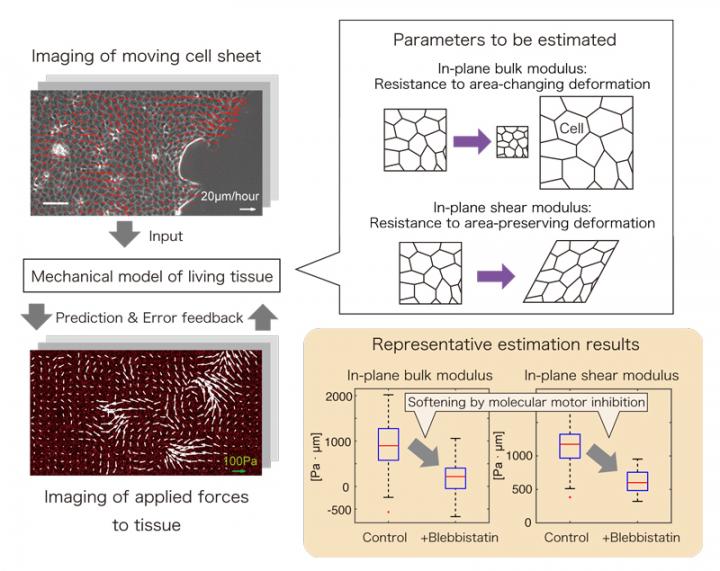
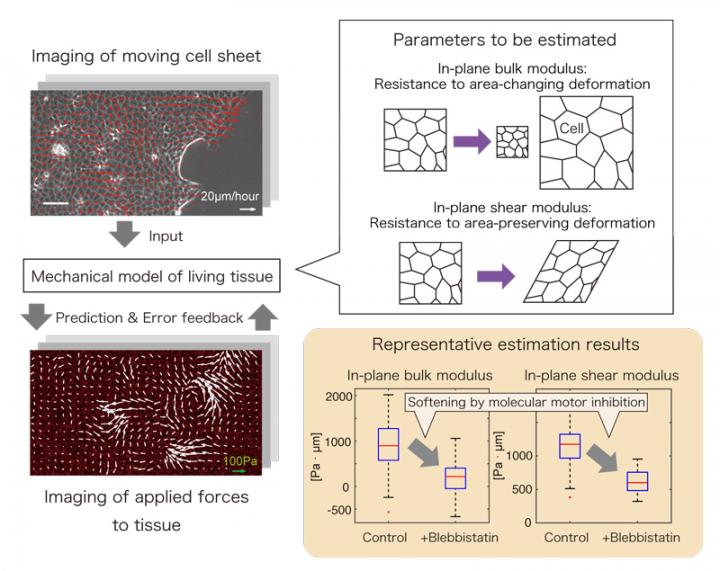
To tackle this problem, a research team from the National Institute for Basic Biology (NIBB) and Kyoto University has proposed a unique non-invasive (i.e. without leaving any damage behind) way of measuring the hardness of tissues by combining physical modeling of the tissues with statistical estimation.

The member of the research team, Professor Kazuhiro Aoki said, "Although many in our field use conventional ways of testing hardness of tissues, such as cutting or applying pressure to embryonic tissues which are rather soft, the resulting tissue damage was a big concern because it hampers normal morphogenesis." Assistant Professor Yohei Kondo said, "Our proposed methodology involves measuring the spontaneous deformation of the cell population as well as the mechanical forces applied over the tissue. Based upon the information acquired from these observations, the hardness of the tissue is then able to be estimated."

The effectiveness of the proposed technique has been experimentally validated with monolayer-cultured cells. The research group also revealed that the hardness/stiffness of the tissues can be changed depending on not only the physical properties of materials composing the cells, but also on the cell activities controlled by molecular motor, etc. The group hopes that this work will serve as an important step towards further understanding of the mechanism of organogenesis. The results of this research were published in the journal, PLoS Computational Biology.

###

PLoS Computational Biology

"Inverse tissue mechanics of cell monolayer expansion" by Yohei Kondo, Kazuhiro Aoki, and Shin Ishii

DOI: 10.1371/journal.pcbi.1006029

Media Contact

NIBB's Office of Public Relations
[email protected]

http://www.nins.jp/english/

Original Source

http://www.nibb.ac.jp/en/press/2018/04/05.html http://dx.doi.org/10.1371/journal.pcbi.1006029

Share12Tweet7Share2ShareShareShare1

Related Posts

Early Delivery Improves Outcomes for Mothers and Babies in Hypertensive Pregnancies — Biology

Early Delivery Improves Outcomes for Mothers and Babies in Hypertensive Pregnancies

May 21, 2026
How Atlantic Herring Rewired Their Reproductive Strategy to Thrive in Changing Oceans — Biology

How Atlantic Herring Rewired Their Reproductive Strategy to Thrive in Changing Oceans

May 20, 2026

Study Finds Young Fraser River Chinook Salmon Swimming in Chemical Mixture

May 20, 2026

Thousands of UK Beekeepers Contribute Honey to Advance Environmental Science

May 20, 2026
Please login to join discussion

POPULAR NEWS

  • blank

    New Study Reveals Plants Can Detect the Sound of Rain

    733 shares
    Share 292 Tweet 183
  • ESMO 2025: mRNA COVID Vaccines Enhance Efficacy of Cancer Immunotherapy

    304 shares
    Share 122 Tweet 76
  • Research Indicates Potential Connection Between Prenatal Medication Exposure and Elevated Autism Risk

    846 shares
    Share 338 Tweet 212
  • Breastmilk Balances E. coli and Beneficial Bacteria in Infant Gut Microbiomes

    58 shares
    Share 23 Tweet 15

About

We bring you the latest biotechnology news from best research centers and universities around the world. Check our website.

Follow us

Recent News

Pathogen lncRNA Hijacks Rice miRNA for Virulence

Oral Semaglutide Lowers Cardiometabolic Risks in Obesity

Nomogram Predicts 30-Day Mortality in Elderly HLH

Subscribe to Blog via Email

Enter your email address to subscribe to this blog and receive notifications of new posts by email.

Join 82 other subscribers
  • Contact Us

Bioengineer.org © Copyright 2023 All Rights Reserved.

Welcome Back!

Login to your account below

Forgotten Password?

Retrieve your password

Please enter your username or email address to reset your password.

Log In
No Result
View All Result
  • Homepages
    • Home Page 1
    • Home Page 2
  • News
  • National
  • Business
  • Health
  • Lifestyle
  • Science

Bioengineer.org © Copyright 2023 All Rights Reserved.