• HOME
  • NEWS
  • EXPLORE
    • CAREER
      • Companies
      • Jobs
    • EVENTS
    • iGEM
      • News
      • Team
    • PHOTOS
    • VIDEO
    • WIKI
  • BLOG
  • COMMUNITY
    • FACEBOOK
    • INSTAGRAM
    • TWITTER
Saturday, February 7, 2026
BIOENGINEER.ORG
No Result
View All Result
  • Login
  • HOME
  • NEWS
  • EXPLORE
    • CAREER
      • Companies
      • Jobs
        • Lecturer
        • PhD Studentship
        • Postdoc
        • Research Assistant
    • EVENTS
    • iGEM
      • News
      • Team
    • PHOTOS
    • VIDEO
    • WIKI
  • BLOG
  • COMMUNITY
    • FACEBOOK
    • INSTAGRAM
    • TWITTER
  • HOME
  • NEWS
  • EXPLORE
    • CAREER
      • Companies
      • Jobs
        • Lecturer
        • PhD Studentship
        • Postdoc
        • Research Assistant
    • EVENTS
    • iGEM
      • News
      • Team
    • PHOTOS
    • VIDEO
    • WIKI
  • BLOG
  • COMMUNITY
    • FACEBOOK
    • INSTAGRAM
    • TWITTER
No Result
View All Result
Bioengineer.org
No Result
View All Result
Home NEWS Science News Health

Providing clinicians feedback on their Opioid prescribing data alters future prescribing

Bioengineer by Bioengineer
May 7, 2018
in Health
Reading Time: 2 mins read
0
Share on FacebookShare on TwitterShare on LinkedinShare on RedditShare on Telegram
IMAGE

Credit: Kirsty Challen, B.Sc., MBCHB, MRES, PH.D., Lancashire Teaching Hospitals, United Kingdom.

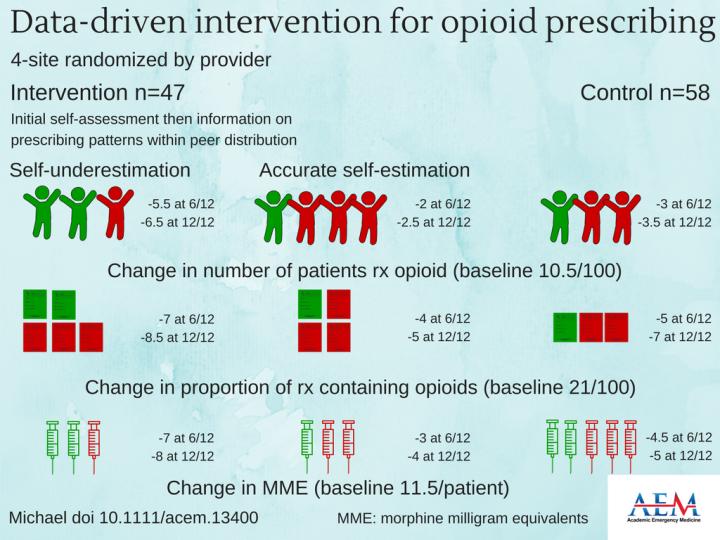
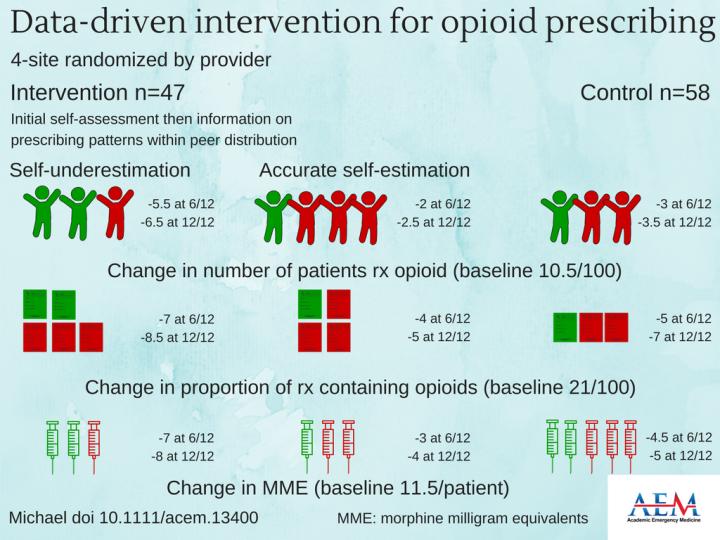
DES PLAINES, IL — Asking emergency department (ED) providers to self-identify their opioid prescribing practices and then providing them with timely, clinically relevant, individualized, and actionable feedback on their actual opioid prescribing data, significantly decreases future opioid prescribing among providers who underestimate their baseline prescribing. That is the finding of a study to be published in the May 2018 issue of Academic Emergency Medicine (AEM), a journal of the Society for Academic Emergency Medicine (SAEM).

The lead author of the study is Sean S. Michael, MD, assistant professor of emergency medicine at the University of Colorado Denver School of Medicine.

The study, by Michael, et al, found that providers who initially underestimated opiate prescription rates had statistically significant decreases in opiate prescribing when compared to providers who were more accurate in initial self-assessment of prescribing rates. The randomized trial exposes important gaps in providers' self-perceptions of opioid prescribing and demonstrates that a simple, data-driven intervention using query-reveal methodology may decrease future prescribing, particularly among providers who underestimate their own prescribing practices.

The findings suggest that current and future interventions in which provider adherence to guidelines is expected, including opioid interventions outside the emergency department and other quality and safety initiatives, should directly address the potential barrier of inaccurate provider self-awareness.

Gail D'Onofrio, MD, MS, professor and chair, Yale School of Medicine Department of Emergency Medicine, who is internationally known for her work in developing and testing interventions for department patients with unhealthy alcohol and other drug use, commented:

"The results have real world applicability. A simple intervention enhancing safe prescribing is one of several opportunities the emergency physician has to combat the current opioid epidemic."

###

The Society for Academic Emergency Medicine (SAEM) is a 501(c)(3) not-for-profit organization dedicated to the improvement of care of the acutely ill and injured patient by leading the advancement of academic emergency medicine through education and research, advocacy, and professional development. To learn more, visit saem.org.

Media Contact

Stacey Roseen
[email protected]
847-257-7227
@SAEMonline

http://saem.org

Related Journal Article

http://dx.doi.org/10.1111/acem.13400

Share13Tweet8Share2ShareShareShare2

Related Posts

Evaluating Pediatric Emergency Care Quality in Ethiopia

February 7, 2026

TPMT Expression Predictions Linked to Azathioprine Side Effects

February 7, 2026

Improving Dementia Care with Enhanced Activity Kits

February 7, 2026

Decoding Prostate Cancer Origins via snFLARE-seq, mxFRIZNGRND

February 7, 2026
Please login to join discussion

POPULAR NEWS

  • Robotic Ureteral Reconstruction: A Novel Approach

    Robotic Ureteral Reconstruction: A Novel Approach

    82 shares
    Share 33 Tweet 21
  • Digital Privacy: Health Data Control in Incarceration

    63 shares
    Share 25 Tweet 16
  • Study Reveals Lipid Accumulation in ME/CFS Cells

    57 shares
    Share 23 Tweet 14
  • Breakthrough in RNA Research Accelerates Medical Innovations Timeline

    53 shares
    Share 21 Tweet 13

About

We bring you the latest biotechnology news from best research centers and universities around the world. Check our website.

Follow us

Recent News

Evaluating Pediatric Emergency Care Quality in Ethiopia

TPMT Expression Predictions Linked to Azathioprine Side Effects

Improving Dementia Care with Enhanced Activity Kits

Subscribe to Blog via Email

Enter your email address to subscribe to this blog and receive notifications of new posts by email.

Join 73 other subscribers
  • Contact Us

Bioengineer.org © Copyright 2023 All Rights Reserved.

Welcome Back!

Login to your account below

Forgotten Password?

Retrieve your password

Please enter your username or email address to reset your password.

Log In
No Result
View All Result
  • Homepages
    • Home Page 1
    • Home Page 2
  • News
  • National
  • Business
  • Health
  • Lifestyle
  • Science

Bioengineer.org © Copyright 2023 All Rights Reserved.