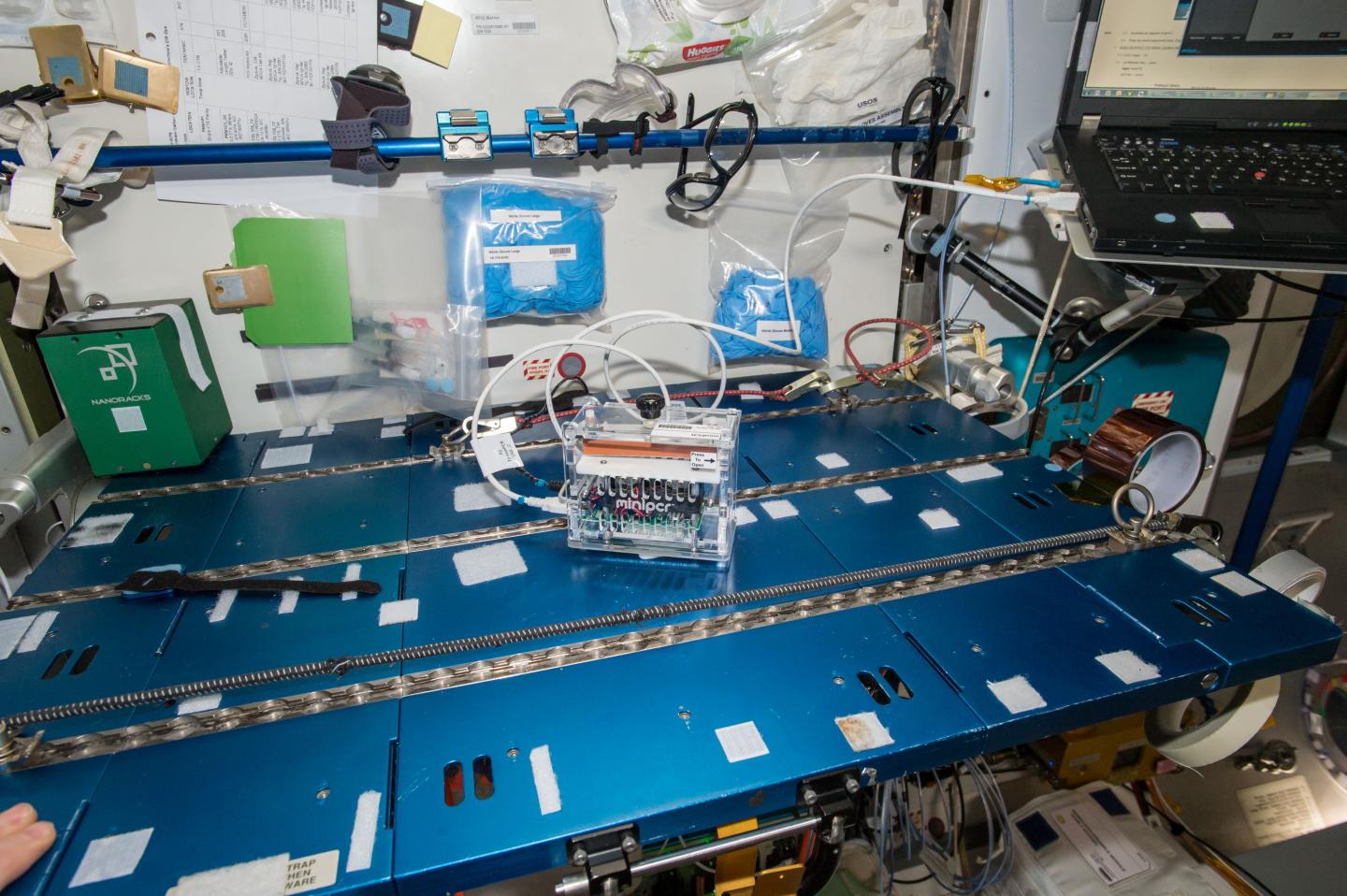

Credit: NASA
What do astronauts, microbes, and plants all have in common? Each relies on deoxyribonucleic acid (DNA) – essentially a computer code for living things – to grow and thrive.
Studying DNA in space could lead to a better understanding of microgravity's impact on living organisms and could also offer ways to identify unknown microbes in spacecraft, humans and the deep space locations we seek to visit. The microscopic size of DNA, however, can create some big challenges for studying it aboard the International Space Station.
Most Earth-based molecular research equipment is large in size and requires significant amounts of power to run. Those are two characteristics that can be difficult to support aboard the orbiting laboratory, so previous research samples requiring DNA amplification and sequencing had to be stored in space until they could be sent back to Earth aboard a cargo spacecraft, adding to the time required to get results.
However, all of that has changed in a few short years as NASA has worked to find new solutions for rapid in-flight molecular testing aboard the space station.
"We need[ed] to get machines to be compact, portable, robust, and independent of much power generation to allow for more agile testing in space," NASA astronaut and molecular biologist Kate Rubins said in a 2016 downlink with the National Institutes of Health.
The result? An advanced suite of tabletop and palm-sized tools including MinION, miniPCR, and Wet-Lab-2, and more tools and processes on the horizon.
Space-based DNA testing took off in 2016 with the Biomolecule Sequencer. Comprised of the MinION sequencer and a Surface Pro 3 tablet for analysis, the tool was used to sequence DNA in space for the first time with Rubins at the helm.
In 2017, that tool was used again for Genes in Space-3, as NASA astronaut Peggy Whitson collected and tested samples of microbial growth from around the station. Alongside MinION, astronauts also tested miniPCR, a thermal cycler used to perform the polymerase chain reaction. Together these platforms provided the identification of unknown station microbes for the first time from space.
This year, those testing capabilities translated into an even stronger portfolio of DNA-focused research for the orbiting laboratory's fast-paced science schedule. For example, miniPCR is being used to test weakened immune systems and DNA alterations as part of a student-designed investigation known as Genes in Space-5. The study hopes to reveal more about astronaut health and potential stress-related changes to DNA created by spaceflight. Additionally, WetLab-2 facility is a suite of tools aboard the station designed to process biological samples for real-time gene expression analysis. More tools for filling out the complete molecular studies opportunities on the orbiting laboratory are heading to space soon.
"The mini revolution has begun," said Sarah Wallace, NASA's principal investigator for the upcoming Biomolecule Extraction and Sequencing Technology (BEST) investigation. "These are very small, efficient tools. We have a nicely equipped molecular lab on station and devices ideally sized for spaceflight."
BEST will compare swab-to-sequencer testing of unknown microbes aboard the space station against current culture-based methods.
"We see changes in gene expression in response to spaceflight for every living thing in which we have looked for it," said Wallace. "Studying those changes is critical to understand adaptations to spaceflight and also provides the potential to discover novel responses that could result in alternative healthcare treatments on Earth."
While resupply and ground support are available for astronauts aboard the space station, missions beyond low-Earth orbit will require crews to rely on these new, space-saving technologies to track their health across time and to monitor potential health risks living alongside them. Fast, reliable sequencing and identification processes could keep explorers safer on missions into deep space. On Earth, these technologies may make genetic research more accessible, affordable and mobile.
###
Media Contact
Rachel Barry
[email protected]
281-244-7449
@NASA_Johnson
http://www.nasa.gov/centers/johnson/home
Original Source
https://www.nasa.gov/mission_pages/station/research/news/Back_To_Nucleic_Basics_DNA