Credit: Credit: William Bosl, Ph.D.
Autism is challenging to diagnose, especially early in life. A new study in the journal Scientific Reports shows that inexpensive EEGs, which measure brain electrical activity, accurately predict or rule out autism spectrum disorder (ASD) in infants, even in some as young as 3 months.
"EEGs are low-cost, non-invasive and relatively easy to incorporate into well-baby checkups," says Charles Nelson, PhD, director of the Laboratories of Cognitive Neuroscience at Boston Children's Hospital and co-author of the study. "Their reliability in predicting whether a child will develop autism raises the possibility of intervening very early, well before clear behavioral symptoms emerge. This could lead to better outcomes and perhaps even prevent some of the behaviors associated with ASD."
The study analyzed data from the Infant Sibling Project (now called the Infant Screening Project), a collaboration between Boston Children's Hospital and Boston University that seeks to map early development and identify infants at risk for developing ASD and/or language and communication difficulties.
William Bosl, PhD, associate professor of Health Informatics and Clinical Psychology at the University of San Francisco, also affiliated with the Computational Health Informatics Program (CHIP) at Boston Children's Hospital, has been working for close to a decade on algorithms to interpret EEG signals, the familiar squiggly lines generated by electrical activity in the brain. Bosl's research suggests that even an EEG that appears normal contains "deep" data that reflect brain function, connectivity patterns and structure that can be found only with computer algorithms.
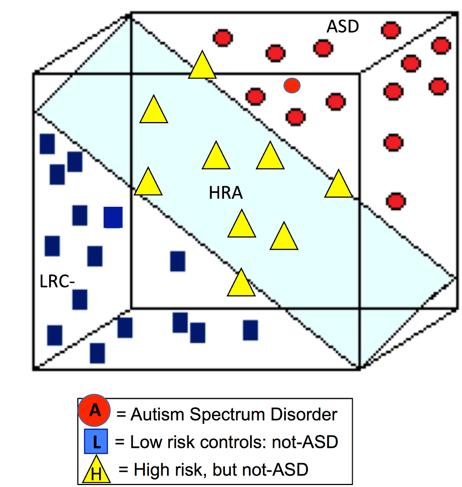
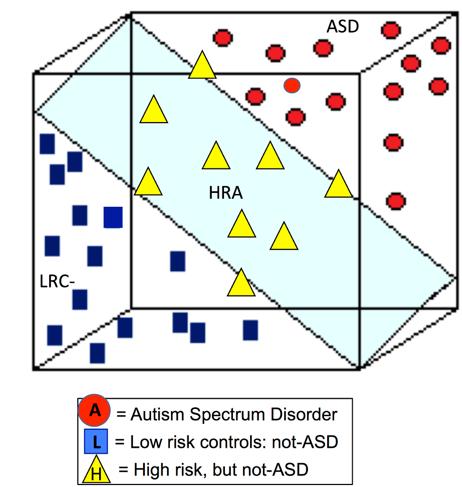
The Infant Screening Project provided Bosl with EEG data from 99 infants considered at high risk for ASD (having an older sibling with the diagnosis) and 89 low-risk controls (without an affected sibling). The EEGs were taken at 3, 6, 9, 12, 18, 24 and 36 months of age by fitting a net over the babies' scalps with 128 sensors as the babies sat in their mothers' laps. (An experimenter blew bubbles to distract them.) All babies also underwent extensive behavioral evaluations with the Autism Diagnostic Observation Schedule (ADOS), an established clinical diagnostic tool.
Bosl's computational algorithms analyzed six different components (frequencies) of the EEG (high gamma, gamma, beta, alpha, theta, delta), using a variety of measures of signal complexity. These measures can reflect differences in how the brain is wired and how it processes and integrates information, says Bosl.
The algorithms predicted a clinical diagnosis of ASD with high specificity, sensitivity and positive predictive value, exceeding 95 percent at some ages.
"The results were stunning," Bosl says. "Our predictive accuracy by 9 months of age was nearly 100 percent. We were also able to predict ASD severity, as indicated by the ADOS Calibrated Severity Score, with quite high reliability, also by 9 months of age."
Bosl believes that the early differences in signal complexity, drawing upon multiple aspects of brain activity, fit with the view that autism is a disorder that begins during the brain's early development but can take different trajectories. In other words, an early predisposition to autism may be influenced by other factors along the way.
"We believe that infants who have an older sibling with autism may carry a genetic liability for developing autism," says Nelson. "This increased risk, perhaps interacting with another genetic or environmental factor, leads some infants to develop autism — although clearly not all, since we know that four of five "infant sibs" do not develop autism."
###
Helen Tager-Flusberg, PhD, of Boston University was the third co-author on the paper. The study was supported by National Institute of Mental Health (R21 MH 093753), the National Institute on Deafness and Other Communication Disorders (R21 DC08647 R01 DC 10290) and the Simons Foundation.
About Boston Children's Hospital
Boston Children's Hospital, the primary pediatric teaching affiliate of Harvard Medical School, is home to the world's largest research enterprise based at a pediatric medical center. Its discoveries have benefited both children and adults since 1869. Today, more than 3,000 scientists, including nine members of the National Academy of Sciences, 17 members of the National Academy of Medicine and 11 Howard Hughes Medical Investigators comprise Boston Children's research community. Founded as a 20-bed hospital for children, Boston Children's is now a 415-bed comprehensive center for pediatric and adolescent health care. For more, visit our Vector and Thriving blogs and follow us on social media @BostonChildrens, @BCH_Innovation, Facebook and YouTube.
Media Contact
Bethany Tripp
[email protected]
617-919-3110
@BostonChildrens
http://www.childrenshospital.org/newsroom